
First tasting
How to Taste White Tea for the First Time
To taste white tea for the first time, keep the session simple: look at the dry leaves, warm the vessel and smell the leaves, brew one clear cup, then notice the liquor color, aroma, texture, flavor, and finish before you judge the label. The goal is not to decide in one sip whether the tea is “good.” The goal is to learn what the cup actually shows.
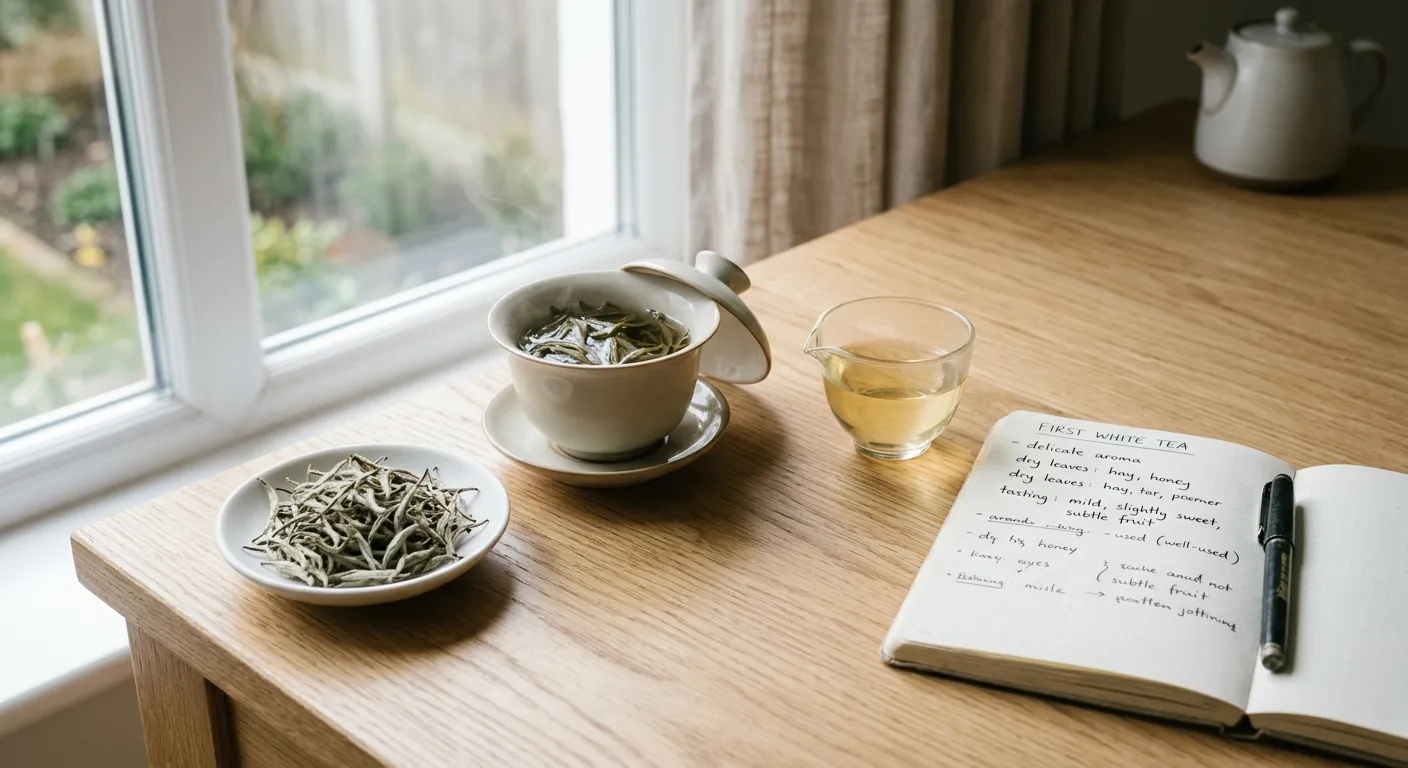
If you want to know how to taste white tea, start with details you can observe: leaf shape, dry scent, warmed-leaf aroma, color in the cup, feel on the tongue, and what remains after swallowing. Write down what you notice, including what you are unsure about.
upward
Read the full overview first
Use the broader guide first if you need the full scope before this page.
Set up a quiet first tasting
A first white tea tasting does not need ceremony. It does need a little consistency.
Use a clean cup or small brewing vessel, plain water, and enough time to pay attention. Avoid strongly scented food, perfume, or a flavored mug, because those can make the tea harder to read.
For a simple setup, prepare:
- A plain cup or small brewing vessel so you can see the liquor color.
- A second cup or small bowl if you want to pour the tea off the leaves and stop the steep.
- A notebook or phone note for short observations.
- The tea package nearby, but not as the main judge.
- A way to brew again so you can compare one infusion with the next.
If the package gives a brewing suggestion, use it as a starting point. More important for tasting is that you record what you did: vessel, leaf amount, water temperature if known, steep time, and whether the cup seemed thin, harsh, sweet, flat, aromatic, or balanced to you.
For a beginner white tea tasting, do not try to evaluate everything at once. Move in order: dry leaf, warmed leaf, liquor, aroma, taste, texture, finish, second infusion.
Observe the dry white tea leaves before brewing
Before water touches the tea, spend half a minute with the dry leaf. This is not a full quality verdict. It is a first clue.
Look at:
- Leaf size and shape: Are the pieces mostly whole, broken, bud-like, leafy, twisted, flat, loose, or compressed?
- Color range: Do you see pale green, olive, brown, silver, tan, or darker areas?
- Surface texture: Do some parts look downy, matte, glossy, brittle, or woody?
- Dust and fragments: Is the bottom of the bag full of powder, or are the leaves mostly intact?
- Dry aroma: Does it smell faint, floral, grassy, hay-like, fruity, woody, stale, smoky, or simply quiet?
These observations do not prove origin, age, grade, or processing style on their own. Beginners can easily overread dry appearance, especially when the label uses market language such as premium, aged, rare, old tree, high mountain, or hand-picked. Treat those words as questions to test in the cup, not as conclusions.
A useful note might be: “Long pale leaves, some broken edges, dry smell like hay and faint flowers.” That is more useful than “high quality” or “bad quality,” because it records what you actually saw.
Smell the warmed leaves, not only the dry leaf
Dry leaf aroma can be quiet. Warmth often makes scent easier to notice.
Warm your vessel with hot water, pour the water out, add the dry leaves, cover briefly if your vessel has a lid, then smell.
Separate the first impression from the details:
First impression
Bright, soft, sweet, green, woody, roasted, stale, sharp, muted.
Possible aroma notes
Dried grass, meadow flowers, hay, melon, pear, honey-like sweetness, warm wood, dry herbs, grain, or something you cannot name.
Condition clues
Does the scent feel clean and open, or closed, musty, flat, smoky, sour, or storage-heavy?
These words are only tools. White tea does not need to smell like a checklist of flowers and fruit. Some cups are quiet. Some are leafier. Some are rounder. A first-time drinker should not force poetic notes if “warm grass” or “soft dry leaves” is more honest.
This step also helps you separate aroma from taste later. Aroma is what rises before and during the sip. Taste is what you perceive on the tongue, together with aroma that returns after swallowing. Beginners often combine them into one judgment, but they become easier to understand when you name them separately.
Read the liquor color without making it the whole verdict
After brewing, look at the white tea liquor color in a clear cup if possible. Hold it against a white background or near natural light.
Notice:
- Is it nearly clear, pale straw, yellow, gold, amber, orange, or deeper brown?
- Is it bright and transparent, slightly hazy, or cloudy?
- Does the color change between the first and later infusions?
- Does a darker cup taste fuller, or simply stronger?
- Does a pale cup still have aroma and texture?
Color can help you describe the infusion, but it should not carry the whole white tea flavor evaluation. A pale liquor is not automatically weak, and a darker liquor is not automatically richer. The cup still needs to be judged through aroma, texture, taste, and finish.
If the tea looks very light and tastes empty, you might adjust your brewing later. If it looks dark and tastes rough or heavy, you might also adjust. For the first tasting, write down what happened before trying to fix it.
A useful note might be: “First infusion pale gold, clear, stronger aroma than color suggested.” That kind of note helps you avoid the common beginner mistake of equating visual intensity with flavor depth.
Sip in layers: aroma, taste, texture, finish
Take a small sip and let it move across the tongue. Do not rush to decide whether you like it. A good first tasting asks several smaller questions.
Aroma during the sip
Before judging flavor, ask what aroma appears while drinking.
Does the cup seem floral, grassy, fruity, woody, herbal, warm, sweet-smelling, or neutral? Does the aroma rise clearly, or does it disappear quickly?
You may notice that the scent from the warmed leaves and the scent in the cup are not identical. That is normal. The warmed leaf can show one side of the tea, while the liquor shows another.
Taste on the tongue
Now focus on taste.
Is it sweet, lightly bitter, savory, drying, grassy, mellow, sharp, flat, or rounded? Does the flavor arrive quickly or slowly? Does it sit at the front of the mouth, the sides, the back of the tongue, or mostly in the nose?
Try not to force a dramatic note. “Soft and lightly sweet, with a dry edge” is more useful than pretending to find a rare fruit note because the label suggested it.
Texture and body
White tea texture and finish are easy to miss at first. Texture is the feel of the tea: thin, silky, watery, round, coating, drying, prickly, smooth, or heavy. Two cups can have similar aromas but feel very different.
Ask:
- Does the tea feel light like water, or does it have body?
- Does it coat the mouth?
- Does it dry the tongue or cheeks?
- Is the dryness pleasant, distracting, or barely noticeable?
- Does the texture improve or fade in later infusions?
Texture is personal, but it is not imaginary. It is part of the cup.
Finish and aftertaste
The finish is what remains after swallowing. It may be short, clean, sweet, drying, floral, woody, warm, or almost absent. Wait a few seconds before sipping again.
A first-time note could be: “Soft aroma, pale gold liquor, light sweetness, slight dryness on the sides of the mouth, short clean finish.” That is a useful tasting note even if it sounds plain.
Compare the first and later infusions
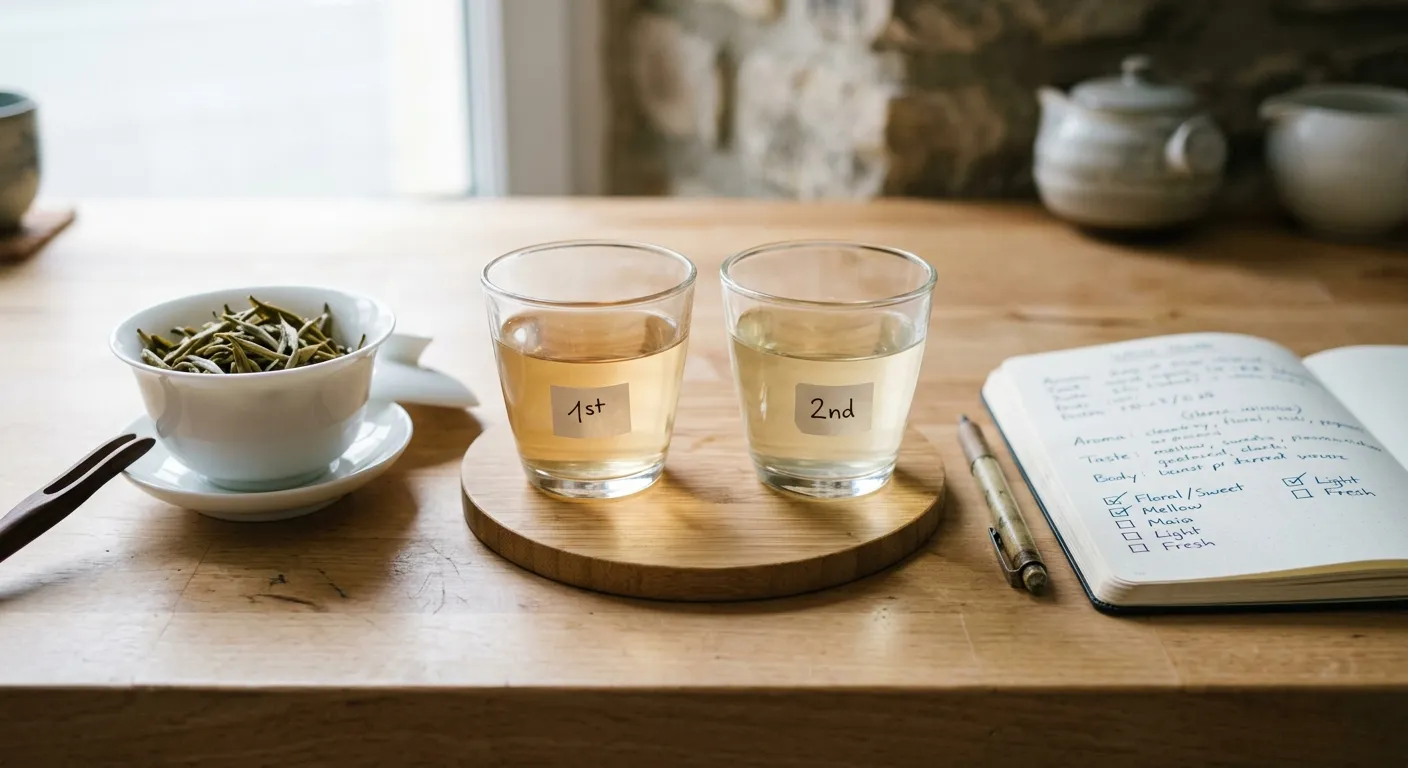
If your leaves can be brewed again, make a second infusion and compare it with the first. The goal is not to follow a formal method. It is to notice change.
Ask:
- Did the aroma open up or fade?
- Did the liquor color deepen or become lighter?
- Did the flavor become sweeter, greener, flatter, sharper, or more rounded?
- Did the texture change?
- Did the finish last longer or become shorter?
- Did any storage-like smell become more obvious after the leaves opened?
Some white teas may show more in the second cup than the first. Others may be most fragrant at the beginning. Treat this as observation, not rule. Your task is to compare the infusions in front of you.
A practical note format:
First infusion
Liquor color: Pale gold
Aroma: Warm hay, faint floral
Taste: Soft, lightly sweet
Texture: Thin to smooth
Finish: Short, clean
Second infusion
Liquor color: Deeper yellow
Aroma: More leafy
Taste: Fuller, slight dryness
Texture: Rounder
Finish: Longer
You do not need fancy language. The table simply prevents all impressions from collapsing into “I liked it” or “I did not like it.”
Do not let the label taste the tea for you
Beginners often meet white tea through names, grades, harvest claims, aging claims, and seller descriptions. Those details may be useful context, but they are not a substitute for tasting.
If a label says the tea is honey-sweet, ask: do I smell sweetness, taste sweetness, or only read the word?
If it says aged, ask: does the cup show depth, warmth, woodiness, dried fruit, storage aroma, or something else? Do not assume the word explains everything.
If it says premium or rare, ask: are the leaves cleanly aromatic, pleasant in texture, and satisfying across infusions, or is the pleasure mostly in the description?
This is not an argument against labels. It is a way to use them carefully. A label can tell you what the seller wants you to notice. Your cup tells you what you actually notice.
Also leave room for personal preference. You might prefer a quiet, pale, soft white tea over a stronger, darker, more aromatic one. Someone else may prefer the opposite. First-time white tea tasting should teach your palate, not force you into a market ranking.
What can change your first impression
A single cup is only a first reading. Several variables can change the result:
- Leaf amount: More or fewer leaves can change intensity, texture, and bitterness.
- Water temperature: Hotter or cooler water can change aroma release and extraction.
- Steep time: A longer steep can make the cup fuller, but may also bring more roughness depending on the tea.
- Vessel shape and material: A wide bowl, small cup, mug, or lidded vessel can change heat retention and aroma concentration.
- Water taste: Water that tastes strongly mineral, chlorinated, or flat can affect the cup.
- Storage condition: A tea that smells dull, musty, smoky, or mixed with other odors may reflect how it was kept, though one smell alone should not be overinterpreted.
- Your own palate: Food, fatigue, mood, and expectations can change what you notice.
Because of these variables, avoid making a final judgment from one imperfect brew. If the first cup seems too thin, too strong, or confusing, adjust only one thing next time. Change steep time, leaf amount, or water temperature, but not all at once. That way your notes stay meaningful.
A short note template for your first white tea tasting
Use this if you want structure without turning the session into an exam:
- 1. Dry leaf: What do I see? What do I smell?
- 2. Warm leaf: What aroma appears after warming?
- 3. Liquor: What color and clarity do I see?
- 4. Aroma: What rises from the cup?
- 5. Taste: What do I notice first, middle, and last?
- 6. Texture: Is it thin, smooth, round, drying, or coating?
- 7. Finish: What remains after swallowing?
- 8. Second infusion: What changed?
- 9. Label check: Did the cup support, complicate, or fail to show the label language?
- 10. Preference: Would I drink this again, and what would I adjust?
Keep the notes short. “Pale, floral, smooth, too light; try slightly stronger next time” is enough. Over time, these small notes become more useful than memorized flavor lists.
The calm way to judge your first cup
The clearest first tasting is not the most technical one. It is the one that slows you down enough to notice the tea before judging it.
Look at the leaves, smell them warm, brew a clear cup, separate aroma from taste, pay attention to texture and finish, and compare one later infusion if you can.
Then decide two things: what the tea showed, and whether you enjoyed it. Those are related, but not identical. A white tea can be easy to describe and still not be your preference. Another can be simple, quiet, and exactly what you want to drink.
That is the useful beginning of tasting white tea: not certainty, but clearer attention.