
Storage guide
White Tea Aging and Storage
White tea aging and storage is about two linked questions: how suitable white tea may change over time, and how to protect it from the things that usually make tea worse. Damp air, strong odors, light, excess heat, unstable conditions, and careless packaging can all leave a mark on the leaf.
Aged white tea can become darker, softer, sweeter-smelling, more herbal, or rounder in the cup. It can also become flat, stale, musty, or simply uninteresting. Age alone does not make a tea better. The starting leaf, processing, dryness, compression, storage space, and seller context all matter.
For a beginner, the practical path is simple: keep white tea dry, dark, clean-smelling, and stable; protect loose leaf and white tea cakes in ways that fit their form; and judge aged white tea claims through what you can see, smell, brew, and reasonably verify.
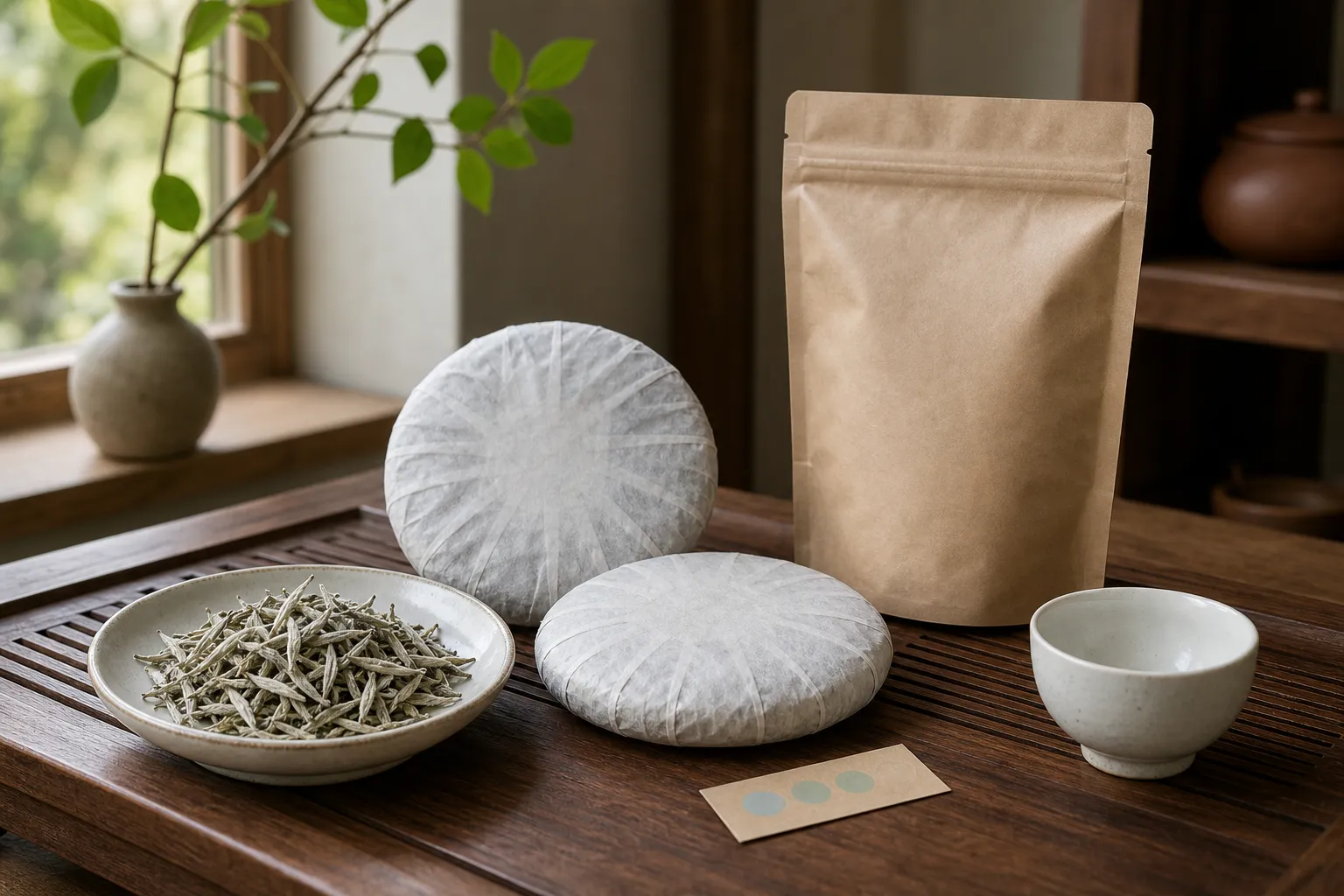
The Useful Way to Think About Aging White Tea
White tea is often described as a tea that can be enjoyed young or stored for later drinking. That idea is useful only when it stays attached to the actual leaf and its storage history.
A fresh Silver Needle, White Peony, Gongmei, or Shoumei does not become valuable or interesting just because time passes. Time may allow changes in aroma, liquor color, texture, and taste. It may also expose weak material, poor drying, odor contamination, or damp storage.
A clean five-year-old tea may be interesting. A badly stored five-year-old tea may simply be stale.
A practical framework has three parts:
| Question | What to notice | Why it matters |
|---|---|---|
| What is the tea? | Bud-heavy Silver Needle, bud-and-leaf White Peony, or larger-leaf Gongmei/Shoumei; loose leaf or cake; harvest and processing notes if supplied | Different leaf material and formats do not age in exactly the same way |
| How has it been stored? | Dryness, clean air, stable surroundings, low odor exposure, sensible packaging | Storage often matters more than romantic age language |
| How does it behave now? | Dry leaf aroma, leaf condition, liquor clarity, warm infusion smell, mouthfeel, aftertaste | The cup can reveal more than a vague label |
The goal is not to turn every tea drinker into an archivist. It is to give you enough structure to protect good tea, avoid obvious storage faults, and read aged white tea claims with a calmer eye.
What Happens When White Tea Ages
When people ask what happens when white tea ages, they are usually asking two things at once: what changes in the cup, and whether those changes are always desirable.
The careful answer is that white tea can move in several sensory directions, depending on material and storage. Many drinkers look for shifts in aroma, liquor color, sweetness, body, and freshness.
Aging may move white tea away from very fresh, bright, grassy, floral, or hay-like notes and toward deeper aromas. Depending on the tea and how it has been kept, aged white tea may suggest:
- dried hay or sun-warmed straw
- dried flowers
- jujube-like or date-like sweetness
- honeyed or mellow sweetness
- gentle herbal notes
- wood, leaf litter, or dried plant aromas
- a darker liquor than the same tea might show when young
- a rounder or softer cup feel
These are recognition cues, not promises. One white tea cake may become warm and sweet; another may remain thin; another may smell flat because it lost fresh aroma without gaining much depth.
Aging also cannot rescue every tea. Time may soften roughness in some teas, but it does not reliably repair poor material, careless drying, harsh storage, odor contamination, or visible damage. A tea that begins dull may not become complex. A tea stored near kitchen spices, incense, detergent, smoke, damp cardboard, or basement air may absorb those surroundings.
Young white tea and aged white tea can both be worth drinking. If you like a pale, lively cup with bright aroma, young white tea may be more satisfying. If you prefer warmer sweetness, deeper aroma, and a softer texture, an aged white tea may be worth exploring. The important point is to judge the actual tea, not the age number.
White Tea Storage Conditions That Matter Most
White tea storage is mostly about avoiding avoidable damage. You do not need a dedicated tea room for a small home collection, but you do need to think about air, moisture, smell, light, heat, and packaging.
A home cabinet can work well if it is clean, dry, away from sunlight, away from cooking odors, and not subject to large swings in heat or humidity. A display shelf can be poor storage if the tea sits in light, air, and household smells.
| Storage pressure | Why it matters | Practical response |
|---|---|---|
| Dampness | Damp storage can make tea smell heavy, stale, or suspicious; visible mold is a serious warning sign | Keep tea away from wet rooms, condensation, leaky walls, and humid cabinets |
| Odors | Tea can pick up surrounding smells | Avoid kitchens, spice drawers, cleaning products, perfume, smoke, incense, and musty furniture |
| Light | Light can weaken aroma and leaf condition over time | Use opaque containers, wrappers, boxes, or closed cabinets |
| Excess heat | Heat can flatten aroma and speed unwanted deterioration | Store away from ovens, sunny windows, heaters, and hot appliances |
| Unstable conditions | Repeated swings can stress packaging and stored leaves | Choose a calm location and avoid moving tea between very different environments |
There is no single home storage number that solves every climate and every tea. Observable condition matters more: clean smell, dry packaging, intact leaf, and a cup that does not taste damp or stale.
Clean Storage Smell Is a Basic Check
Before brewing an older tea, smell the dry leaf or cake carefully. You are looking for a clean storage smell: dry plant material, mellow sweetness, gentle woodiness, dried flowers, or other tea-like aromas.
Be more cautious if the tea smells like:
- wet cardboard
- mildew
- damp basement
- old cupboard
- smoke that was not expected from the tea
- perfume, detergent, or spice
- sourness or rot
- heavy dustiness that carries into the cup
Not every unfamiliar aroma is a fault. Some aged teas smell deeper, darker, or more herbal than young white tea. The concern is not “different.” The concern is dirty, damp, contaminated, or persistently unpleasant.
Packaging Should Protect, Not Perform
Packaging can help preserve white tea, but packaging language can also distract buyers. A wrapper, box, tin, bag, or carton is useful when it protects tea from odor, light, air exposure, and physical breakage. It is less useful when it simply looks old.
For loose white tea, resealable bags, clean tins, or lined containers can work if they are odor-free and kept in a stable place. For cakes, original paper wrapping may be part of the storage context, but a paper wrapper alone is not enough if the surrounding space is damp or smelly. Many drinkers keep cakes in cartons, clean cabinets, or other protective outer storage so the tea remains dry and sheltered from household odors.
Old-looking packaging should be read carefully. Faded paper, yellowed wrappers, handwritten notes, or vintage-style labels may provide context, but they do not prove harvest date, storage quality, or authenticity on their own.
How to Store White Tea at Home
For most readers, the best answer to how to store white tea is not a specialized cellar. It is a reliable home routine.
Choose one storage area and make it boring: dry, dark, clean, and away from smells. Then match your packaging to the form of tea you have.
A simple routine:
- Keep tea away from the kitchen if possible. Kitchens often have heat, steam, oil, spice, and food smells.
- Avoid bathrooms, laundry rooms, garages, and damp basements. Even wrapped tea can suffer in unpredictable spaces.
- Use odor-free containers. New containers may smell like plastic, wood finish, cardboard, glue, or metal. Smell them before using.
- Separate strongly aromatic teas or scented products. White tea should not sit beside jasmine tea, spices, incense, coffee, or flavored teas unless each is very well sealed.
- Do not keep opening aging tea unnecessarily. Frequent handling increases exposure to air, odor, and humidity.
- Label what you know. Record tea name, harvest year if supplied, purchase date, seller, cake pressing date if given, and storage notes.
- Check occasionally, not obsessively. Smell and inspect stored tea from time to time, especially after seasonal humidity changes or a move.
This routine will not turn every tea into a great aged tea. It simply gives the tea a better chance of staying clean.
Loose White Tea Storage and White Tea Cake Storage
Loose white tea and compressed cakes need the same basic protection, but they do not behave exactly the same.
Loose white tea has more exposed surface area than compressed tea, so it can respond quickly to air and odors. Delicate bud-heavy teas can also crush easily if packed carelessly.
For loose white tea storage
- use clean, dry, odor-free bags, tins, or containers
- avoid transparent jars unless they stay inside a dark cabinet
- leave enough room so fragile leaves are not crushed
- do not mix different teas in the same container
- keep samples separate from full portions
- press air out of flexible bags gently, without grinding the leaves
- avoid containers that previously held coffee, spices, flavored tea, or scented products
If a loose white tea is highly aromatic when fresh, some fragrance may fade with time even under careful storage. That is not automatically a storage failure. But if the tea becomes flat, dusty, sour, musty, or visibly damaged, treat that as a problem rather than normal aging.
For white tea cake storage
- keep wrappers intact when possible
- avoid placing bare cakes directly against scented wood, glue-heavy cardboard, or plastic with chemical odor
- store cakes in a clean outer box, carton, cabinet, or container
- separate teas with very different aromas
- inspect edges and surfaces for damp spots, unusual fuzz, or odor
- avoid breaking the whole cake unless you plan to drink it steadily
- label any unwrapped portions clearly
A cake can look impressive and still be poorly stored. Pressing does not protect tea from a bad environment. If the storage space smells wrong, the cake may eventually reflect that.
White Tea Cakes Versus Loose Leaf for Aging
White tea cakes versus loose leaf is a common comparison because aged white tea is often sold in pressed formats, while many drinkers first meet white tea as loose leaf. The best choice depends on your storage space, drinking habits, budget, and comfort with uncertainty.
This is not a contest where one format always wins.
| Question | Loose white tea | White tea cakes |
|---|---|---|
| How exposed is the leaf? | More surface area is exposed | Compression can slow exposure, especially inside the cake |
| Is it easy to brew small amounts? | Very easy to weigh and adjust | Requires prying or breaking pieces |
| Is it easy to inspect? | Easier to see individual leaf condition | Surface is visible; inner material is harder to judge until broken |
| How does it store? | Needs protection from crushing, odor, and air | Easier to stack, but still needs clean, dry storage |
| What about aroma changes? | May lose fresh aroma more quickly if poorly sealed | May change more gradually, depending on compression and storage |
| What should buyers watch? | Staleness, crushed leaf, weak aroma, storage odor | Wrapper context, pressing information, inner leaf condition, damp or musty smell |
White tea cakes attract aging interest for practical and cultural reasons. They are compact, easy to label, and connected to the broader culture of storing compressed tea. A cake also gives the buyer an object with a production story: wrapper, weight, pressing date if supplied, and sometimes batch or origin notes.
Those details can be useful, but they are not proof by themselves. A cake wrapper tells you what the seller or producer presents. The tea still needs to pass sensory and condition checks.
Loose white tea should not be dismissed as less serious. It is easier to inspect, easier to brew in small amounts, and often easier for beginners to understand. You can see buds, leaves, stems, color variation, and breakage more directly.
Choose loose white tea if you want easy brewing, smaller quantities, direct visual inspection, and less commitment. Choose cakes if you want compact storage, a format commonly associated with aging, and a tea you can revisit gradually. Neither format protects you from poor storage or exaggerated age language.
Humidity and White Tea Storage
Humidity is one of the hardest parts of white tea storage because the practical response depends on climate, housing, packaging, season, and storage space. Instead of chasing a universal number, use a condition-based approach: keep white tea dry, clean-smelling, and away from damp storage.
White tea is a dried leaf product. When stored carelessly in damp surroundings, it can develop off aromas, lose clarity, or show visible warning signs. At the same time, anxious over-handling can create its own problems: constant opening, over-sealing in smelly materials, or moving tea between unstable spaces. Steady, clean storage is usually more helpful than frequent intervention.
Good dry storage feels uneventful:
- the cabinet smells neutral
- packaging stays crisp rather than limp or tacky
- wrappers do not feel damp
- tea aroma remains tea-like
- no visible mold appears
- brewed liquor smells clean
- the taste is not musty, sour, or stale in a damp way
If you live in a humid region, the storage area matters more. An interior cabinet in an air-conditioned room may behave differently from a closet beside an exterior wall. A sealed container may help, but only if it is clean and dry before tea goes in.
Check stored tea after long rainy periods, moving house, heat waves, leaks, condensation, renovation, travel shipments, or long periods in a closed box. You do not need to open every package every week. Occasional checks are enough for most small collections.
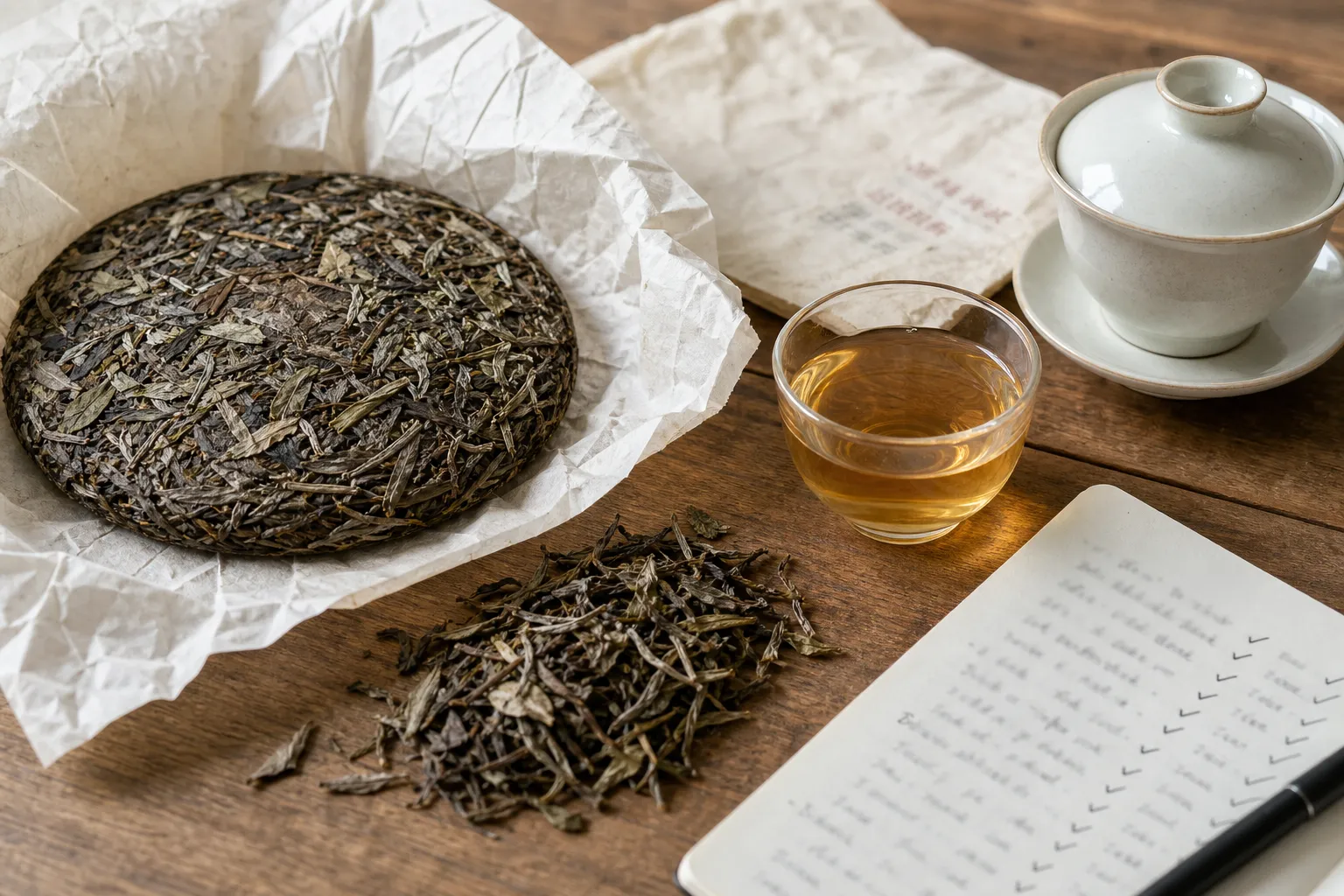
How to Check Aged White Tea Claims
Checking aged white tea claims is one of the most useful skills for anyone buying older tea. Market language may use words such as aged, old, vintage, dry-stored, cellar-stored, or cake as if they settle the matter. They do not.
A stronger evaluation looks at several clues together. No single clue proves everything.
| Checkpoint | What to look for | What it may suggest | What it cannot prove alone |
|---|---|---|---|
| Harvest information | Year, season, region, variety or grade if supplied | Whether the seller has specific records | Authenticity or storage quality |
| Pressing information | Pressing year for cakes, if different from harvest | Whether loose material may have been pressed later | Storage quality before pressing |
| Packaging context | Wrapper, label, batch notes, storage marks | A trail of handling and seller detail | True age by appearance alone |
| Dry leaf condition | Color, breakage, visible mold, damp spots | General handling and condition | Exact age |
| Dry aroma | Clean, sweet, woody, herbal, stale, or damp notes | Storage quality and odor exposure | Full drinking quality |
| Infusion aroma | Whether warmth reveals clean or musty notes | Hidden storage faults | Exact origin |
| Liquor clarity | Clear enough for the tea type and brewing method | Basic leaf condition and brewing cleanliness | Quality ranking by itself |
| Taste | Clean sweetness, depth, roughness, stale dampness | Whether you enjoy the tea and whether faults carry through | Age or authenticity |
| Seller context | Specific answers, consistent details, realistic language | Better confidence than vague claims | Complete certainty |
A good seller should be able to provide what they know and admit what they do not know. Vague romance is not the same as information. “Old tea from dry storage” is less useful than a clear description of harvest, pressing, storage setting, packaging history, and current sensory condition.
Before buying a more expensive aged white tea, ask ordinary questions:
- What is the harvest year?
- Was it stored loose first and pressed later?
- If it is a cake, what is the pressing year?
- What storage conditions are known?
- Has the tea been kept away from strong odors?
- Are there photos of the dry leaf or cake surface?
- Is the wrapper original, replaced, or unclear?
- Can the seller describe aroma and taste without relying only on age?
- Is the price based on documented details, rarity language, or both?
Use extra caution when several warning signs appear together: visible mold, damp or basement-like smell, sour aroma, strong non-tea odors, sticky or musty packaging, stale damp taste after brewing, evasive seller answers, or pricing that depends almost entirely on an age number.
Brewing as a Storage Check
Brewing is not only for drinking. It is also one of the best ways to check how an aged white tea has held up. Warm water releases aromas that may not appear clearly in the dry leaf.
You do not need a complicated method. Use a small amount of tea, clean water, and a familiar vessel. Brew lightly at first so strong extraction does not hide the early aroma. Then extend later infusions to see whether sweetness, body, and aftertaste appear.
Notice these points in the first infusions:
- Dry leaf aroma before water: clean, stale, sweet, woody, herbal, dusty, or damp?
- Warm leaf aroma after water: pleasant depth, or a storage odor that becomes stronger?
- Liquor appearance: reasonably clear, or murky in a way that seems inconsistent with the tea and brewing?
- Mouthfeel: thin, rough, round, drying, soft, or heavy?
- Aftertaste: sweet, dry, musty, sour, or clean?
- Consistency: does the tea open up, or does a fault become more obvious?
Aged white tea does not need to be perfectly smooth to be interesting. Some teas have rustic edges. The concern is when off aromas dominate and carry through the cup.
Do not let one brew decide everything. Too much leaf, overly aggressive steeping, a dirty vessel, or distracted brewing can distort judgment. If the tea shows no warning signs but tastes disappointing, try again with a different leaf amount, shorter steeps, or a different vessel.
But brewing adjustments should not be used to excuse visible mold, persistent damp odor, or strong contamination smells. Technique can fix bitterness or thinness. It cannot make a compromised tea clean.
Common Misunderstandings About Aged White Tea
Aged white tea attracts interest because it sits at the meeting point of flavor, storage, culture, and market language. That also makes it easy to misunderstand.
Older does not always mean better. An older tea may be deeper, smoother, or more complex. It may also be flat, faded, stale, contaminated, or simply not to your taste. A young tea from good material and careful handling can be more enjoyable than an older tea with weak storage.
Cake does not always mean good for aging. A white tea cake is a format, not a quality grade. Compression may support storage in some ways, but a cake can still be made from ordinary material, stored badly, or sold with exaggerated language.
Dry-stored still needs context. Dry compared with what? Stored where? In what packaging? For how long? Around what odors? Was the tea loose before pressing? The phrase is useful only when it connects to concrete storage details.
Herbal aroma language should stay sensory. Some aged white tea is described with herbal, camphor-like, or old-apothecary-style vocabulary. Such language can describe aroma impressions, but it should not be stretched into health-outcome claims. If a sales pitch moves away from flavor, storage, and documentation into sweeping outcome language, slow down.
A Root Map for Learning White Tea Aging and Storage
This page gives the central map. The narrower topics below are useful next steps when you want to go deeper without trying to solve everything at once.
| Reader question | Best next topic | What it should help you decide |
|---|---|---|
| What changes in aroma, taste, liquor, and texture? | What Happens When White Tea Ages | Whether the tea’s changes sound like appealing aging or simple decline. |
| How should I protect white tea in a normal home? | How to Store White Tea at Home | Where to keep tea, what containers to use, and what household spaces to avoid. |
| Should I age cakes or loose leaf? | White Tea Cakes vs Loose Leaf for Aging | Which format fits your storage space, brewing habits, and buying comfort. |
| How worried should I be about humidity? | Humidity and White Tea Storage | How to think about dampness, seasonal changes, and regional climate without chasing a magic number. |
| How do I judge old tea before buying? | How to Check Aged White Tea Claims | How to combine leaf condition, aroma, packaging, storage history, and seller detail. |
These are entry points, not separate rules that compete with one another. A tea cake comparison still depends on humidity. A storage plan still depends on whether the tea is loose or compressed. Aged tea claims still need brewing checks.
A Practical Decision Path for Beginners
If you are new to aged white tea, do not begin with the oldest or most expensive cake you can find. Start with a small amount of a clearly described tea and compare it with a younger white tea of a similar style.
- Decide what you want from aging. Are you looking for deeper sweetness, less grassy freshness, a softer cup, darker liquor, or a tea you can revisit over time? If you do not know yet, buy smaller samples rather than full cakes.
- Buy tea with specific information. Look for harvest information, tea type, origin context when available, pressing information for cakes, and plain descriptions of storage and taste. Specific information does not remove all uncertainty, but it gives you something to evaluate.
- Smell before you brew. Clean, mellow, sweet, woody, hay-like, floral, or herbal aromas may be normal depending on the tea. Damp, sour, musty, perfumed, chemical, or dirty smells deserve caution.
- Brew gently, then push the tea. Start with a moderate brew to assess aroma and cleanliness. Later, use a longer infusion to see whether the tea has body and whether any storage fault becomes stronger.
- Store what you keep. Once you buy a tea, your storage becomes part of its future. Keep labels, wrappers, and notes. Store it where it will not absorb smells. Recheck it after seasonal changes.
A small, well-kept tea collection is more useful than a large collection you cannot monitor.
When to Stop Drinking or Buying a Tea
Most storage decisions are about preference and quality. Some are simpler: if tea shows strong warning signs, do not force yourself to drink it.
Stop and reconsider if you see visible mold, smell persistent dampness, or detect contamination that carries into the brew. If a tea makes you uneasy because of its appearance or aroma, there is no obligation to rationalize it as aged character.
For buying, step away when the seller cannot answer basic questions, when the price seems built only on an age number, or when the tea’s sensory condition does not match the story.
Evidence note: This page treats white tea aging as a sensory, storage, and buyer-evaluation topic. Public claims about exact white-tea aging chemistry, universal home humidity thresholds, medical effects, or guaranteed market value need stronger direct evidence than this page uses. The safer reader approach is practical: clean tea, clean storage, clear information, and no pressure to accept doubtful tea.
The Core Takeaway
Aged white tea can be rewarding when good leaf, careful processing, clean storage, and honest context come together. It can also be disappointing when age is used as a shortcut for quality.
For everyday white tea storage, keep the tea dry, dark, odor-free, and stable. Protect loose white tea from crushing, air, and smell. Keep white tea cakes wrapped and sheltered from damp or contaminated spaces. Check older tea through leaf condition, clean storage smell, packaging context, harvest and pressing information, infusion aroma, liquor clarity, and taste.
The calmest rule is also the most useful: let age invite attention, not trust. A date, wrapper, cake shape, or seller phrase can start the conversation, but the tea still has to look clean, smell clean, brew clean, and make sense in context.