
Does Brewing White Tea Longer Increase Caffeine
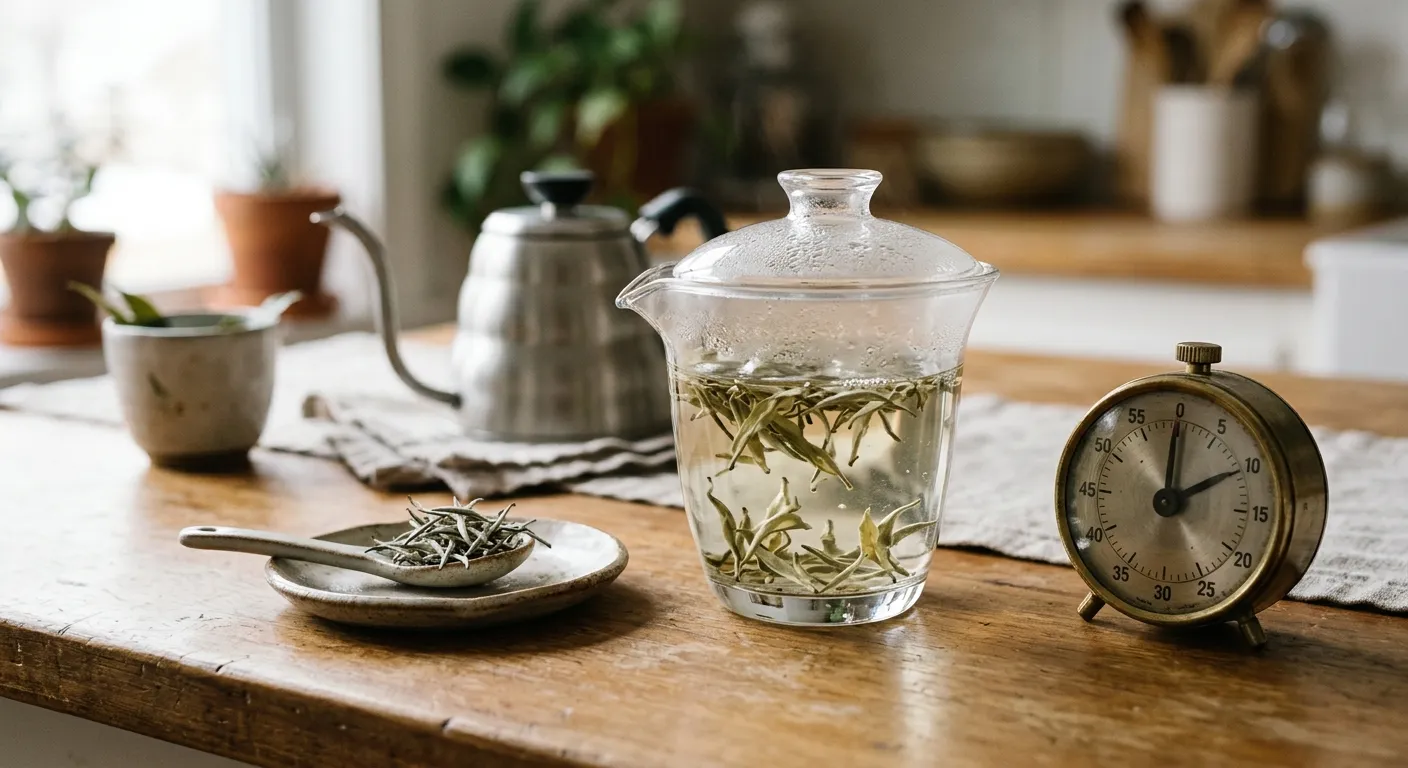
Yes. If you brew the same white tea with the same leaf amount, water temperature, and vessel, a longer steep will usually pull more soluble material from the leaf, including caffeine.
But the practical answer to does brewing white tea longer increase caffeine is not “just watch the clock.” The cup also depends on leaf dose, water temperature, vessel size, leaf shape, tea style, and whether you are making one long mug infusion or several short rounds.
So if you push a white tea from delicate to strong, you are probably increasing overall extraction. You are not getting a precise caffeine number from steeping time alone.
upward
Read the full overview first
Use the broader guide first if you need the full scope before this page.
What a Longer White Tea Steep Changes
When white tea sits in hot water, soluble compounds move from the leaf into the infusion. That includes aroma compounds, polyphenols, amino acids, minerals, sugars, and methylxanthines, the compound family that includes caffeine.
In the cup, a longer steep may show up as:
- deeper color, especially with White Peony, Gongmei, or Shoumei;
- fuller body;
- more drying texture or astringency;
- stronger hay, honey, herb, wood, or dried-fruit notes;
- more bitterness if the tea is pushed with very hot water or a heavy dose.
Those signs tell you extraction has increased. They do not tell you exactly how much caffeine is in the cup.
This is where many white tea drinkers get misled. A five-minute mug of Shoumei may taste much stronger than a short infusion of Silver Needle, but “stronger” is a sensory impression, not a caffeine reading. A sweet, pale, bud-heavy tea can still contain caffeine. A darker, aged-looking infusion is not automatically a high-caffeine cup.
Taste helps you understand how the brew is developing. It does not measure caffeine.
Why Time Is Only One Variable
If you are asking about white tea steeping time and caffeine, you may be deciding whether to steep shorter, brew cooler, use less leaf, or avoid a very strong cup. Time matters, but it works alongside several other brewing choices.
Leaf amount can matter as much as steeping time
A small pinch of white tea steeped for five minutes may extract less total caffeine than a densely packed gaiwan brewed through several short infusions. More leaf means more material available to release caffeine and other compounds.
That is why “long steep” and “strong brew” are not always the same thing. You can make a strong brewed white tea by using more leaf, hotter water, a smaller vessel, longer time, or a mix of those choices.
If you are thinking about caffeine exposure, pay attention to the leaf-to-water ratio, not only the timer.
Hotter water extracts faster
Hotter water generally draws soluble compounds from tea leaves more quickly than cooler water. Research on tea infusions, including work outside white tea specifically, points to steeping time and temperature as important extraction variables.
That does not give us a white-tea-specific caffeine curve. It does give us a useful brewing boundary: a long steep in very hot water is not the same as a long steep in cooler water.
You can feel this in the cup. A cooler white tea infusion may stay soft, floral, and gentle even with more time. A hotter infusion can become fuller and more assertive quickly, especially with mature leaves or broken pieces.
Buds, open leaves, and broken pieces behave differently
White tea is not one uniform material. Silver Needle, White Peony, Gongmei, and Shoumei can differ in bud-to-leaf ratio, harvest style, processing, storage age, and leaf shape.
Whole buds and intact leaves do not infuse like small broken particles. Broken leaf exposes more surface area to water and can extract quickly. A fluffy whole-leaf tea may need time simply to hydrate and open. A compressed cake may extract unevenly at first if the piece has not loosened.
That is why two white teas steeped for the same number of minutes can produce very different cups.
Vessel size changes what “long” means
A three-minute steep in a large mug is different from a three-minute steep in a small gaiwan with a high leaf dose.
Mug brewing usually means more water, a lower leaf concentration, and one longer infusion. Gongfu-style brewing often uses more leaf with short repeated infusions. A single long mug steep may extract steadily into one cup; several short infusions may spread extraction across many cups.
If you drink every round, your total caffeine intake may not match what you would guess from the first infusion alone.
Strong Flavor Is Not a Caffeine Meter
A common misunderstanding is that strong flavor equals high caffeine in a precise way. It is understandable: when white tea turns darker, thicker, more bitter, or more drying, it feels stronger. Often, that means more total extraction has happened.
But caffeine has no simple visible marker in the cup.
Color can mislead. Aged or leafier white teas may brew amber or orange because of leaf style, oxidation-related changes, storage, and extracted polyphenols. A pale bud tea may look light while still contributing caffeine. Bitterness can also mislead because it can come from several extracted compounds, not caffeine alone.
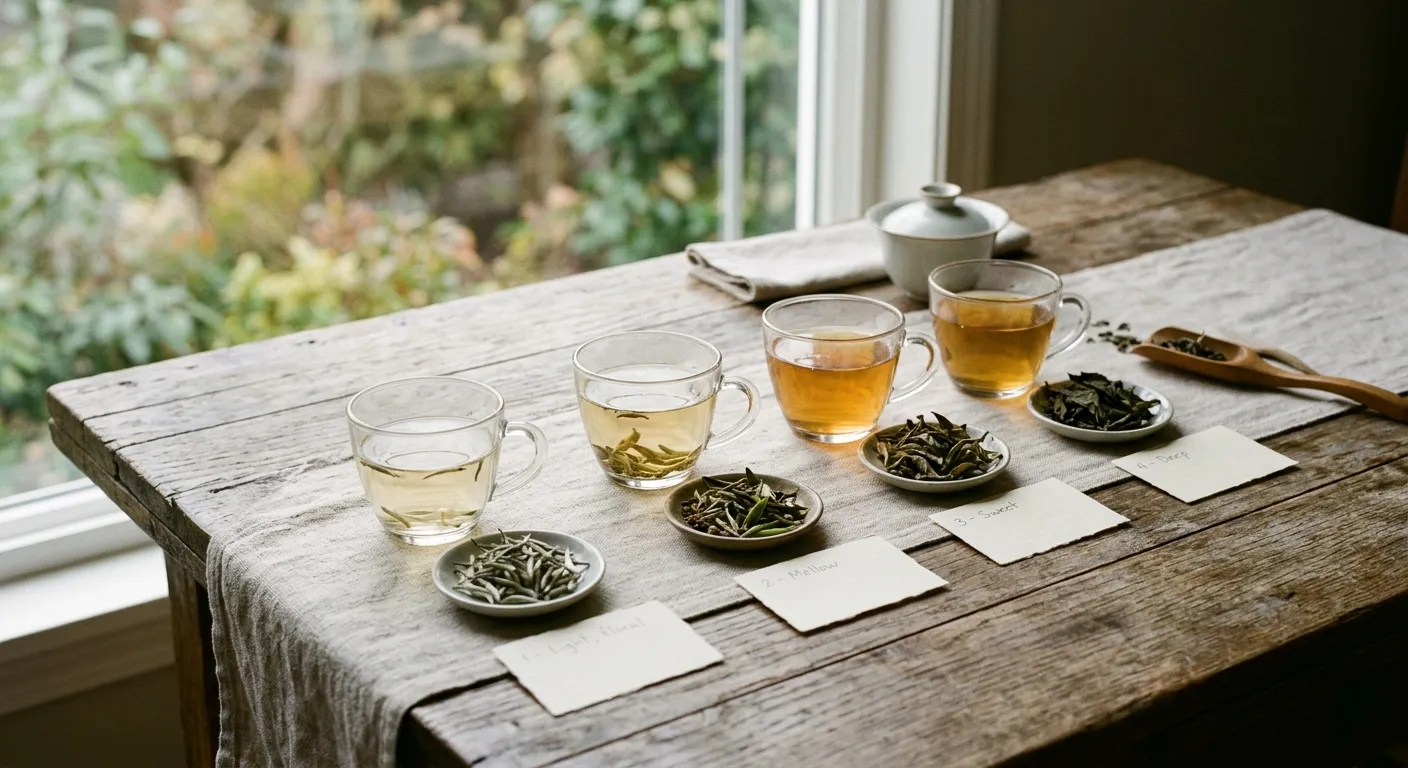
| What you notice in the cup | What it may suggest | What it cannot prove |
|---|---|---|
| Deeper color | More overall extraction, leafier material, or age-related change | Exact caffeine content |
| More bitterness | Hotter water, longer time, more leaf, or faster extraction | A fixed caffeine increase |
| Fuller body | More dissolved material in the infusion | That the cup is caffeine-heavy |
| Strong aroma | Active extraction of aromatic compounds | A caffeine measurement |
| Pale liquor | A light-looking infusion or delicate tea style | That the tea is caffeine-free |
Your palate can tell you whether a cup is thin, balanced, pushed, or harsh. It cannot tell you the milligrams of caffeine.
If You Want a Gentler Cup
Some readers ask this question because they enjoy white tea but are sensitive to caffeine. Caffeine sensitivity varies from person to person, so the brewing notes here are general, not personal guidance.
For a gentler cup, change one variable at a time:
- Shorten the first steep. If you usually brew a mug for five minutes, try two or three minutes and taste before extending.
- Use slightly cooler water. Cooler water can slow extraction and often keeps white tea softer.
- Use less leaf. A smaller dose reduces the amount of leaf material available to extract.
- Use more water for the same leaf amount. This can make the infusion less concentrated.
- Pay attention to multi-infusion sessions. Compounds continue to extract across rounds, so do not assume only the first cup matters.
- Do not rely on bitterness alone. A mild cup can still contain caffeine.
None of these choices gives a guaranteed caffeine number. They are brewing levers, not precise controls. Still, they are more useful than asking steeping time to do all the work.
White tea should not be treated as caffeine-free, and “white” does not automatically mean extremely low caffeine under every brewing method.
When a Longer Steep Still Makes Sense
A longer steep is not always a mistake. Some white teas open slowly. Loose Shoumei, aged White Peony cake, or thicker leaf grades may taste flat if brewed too cautiously. In those cases, extending the steep can bring out sweetness, dried-fruit depth, herbaceous warmth, or a rounder texture.
The better question is: what are you trying to fix in the cup?
- If the tea tastes watery, increase time slightly.
- If it tastes harsh, lower the water temperature or shorten the steep.
- If it smells good but tastes thin, try a little more leaf.
- If it becomes bitter before it becomes full, the water may be too hot, or the leaf may contain many small broken pieces.
A simple white tea adjustment rhythm:
- Brew once with your normal leaf amount and water temperature.
- If the cup is thin, extend the next steep modestly.
- If it becomes rough or bitter, lower the temperature or reduce time.
- If it remains weak, adjust leaf amount before making the steep much longer.
- Keep notes on the tea style, not just the minute count.
This keeps the focus on the cup in front of you rather than turning steeping time into the only serious variable.
What the Evidence Can and Cannot Say
The available research supports the general mechanism: tea preparation variables, including steeping time and temperature, can influence caffeine-related compounds in an infusion. That is enough to answer the brewing question carefully.
It is not enough to give exact white tea caffeine values for each minute of steeping. The available sources do not provide a confirmed white-tea-specific extraction table for Silver Needle, White Peony, Gongmei, and Shoumei, nor do they support broad claims that all long-steeped white tea becomes very high in caffeine.
The most accurate practical answer is conditional:
- Longer steeping can increase caffeine extraction.
- The increase is shaped by leaf amount, temperature, vessel, leaf form, and brewing style.
- Strong taste suggests more overall extraction, but it does not measure caffeine precisely.
- Caffeine-sensitive drinkers may prefer shorter, cooler, lighter brews, while recognizing that no simple steeping rule gives a fixed number.
Bottom Line for Your Next Cup
If all other variables stay the same, brewing white tea longer will usually extract more from the leaf, including caffeine. But white tea caffeine extraction is not controlled by time alone.
For a gentler cup, shorten the steep, cool the water slightly, or use less leaf. For a fuller cup, extend time carefully. Either way, do not treat flavor strength as a caffeine meter. Adjust one variable at a time, taste the result, and read the cup as a white tea infusion rather than a caffeine calculation.
Sources
Sources and further reading
Reference links are limited to sources considered suitable for public citation in this page.