
White tea caffeine guide
Does White Tea Have Caffeine
Yes. White tea has caffeine because it is made from Camellia sinensis, the same tea plant used for green, oolong, black, and dark teas. The better question is how strong a real cup is likely to feel.
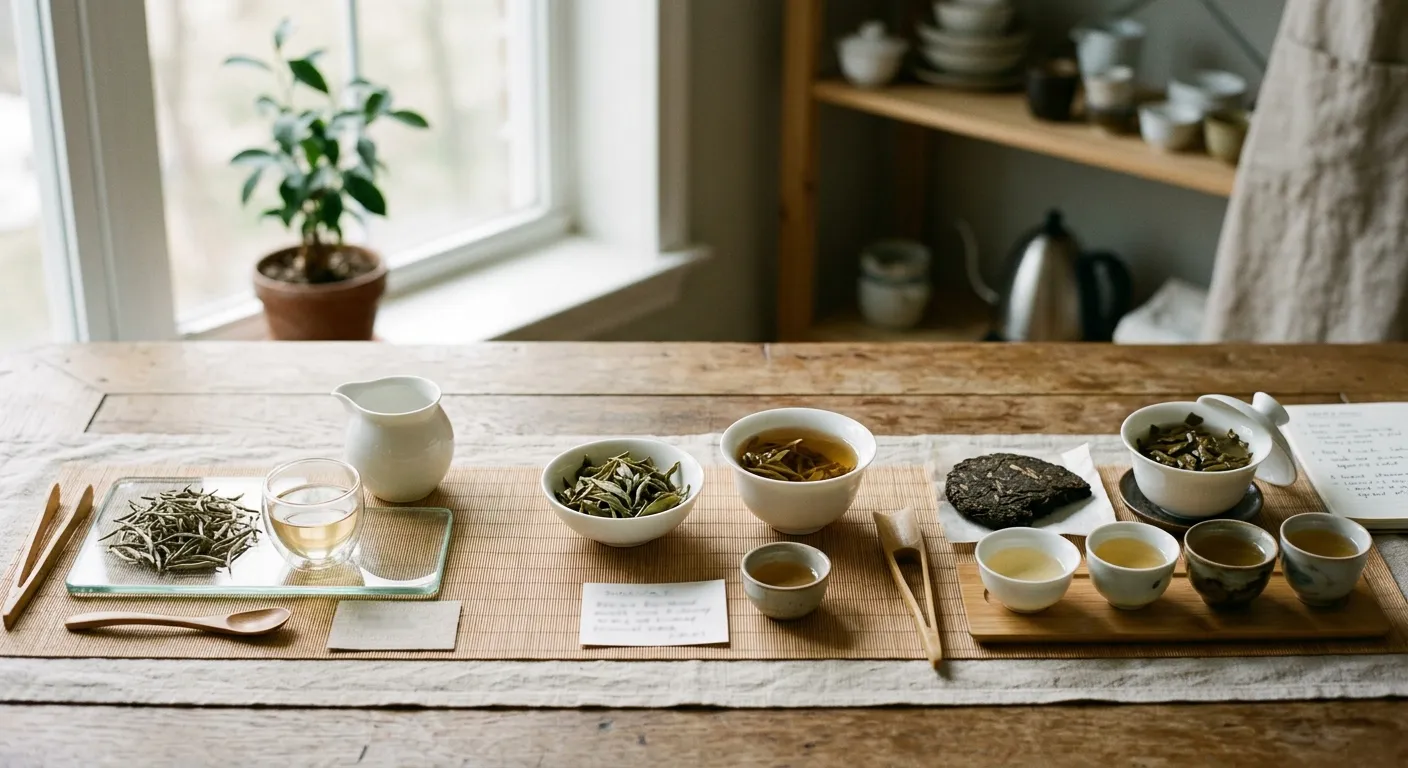
A pale Silver Needle infusion, a fuller White Peony bowl, and a compressed aged Shoumei session can land very differently. Leaf style, dry-leaf amount, water temperature, steeping time, vessel size, and the number of infusions you drink all change the result. White tea is often described as delicate or gentle, but those words describe flavor and texture. They do not prove that the cup is low in caffeine.
upward
Read the full overview first
Use the broader guide first if you need the full scope before this page.
White tea is not caffeine-free, even when it tastes light
The common mix-up starts with the word “white.” It sounds mild, so some readers assume the tea is naturally caffeine-free. It is not. Unless a product is specifically processed and labeled as decaffeinated, white tea should be treated as a caffeinated tea.
That does not mean every cup feels strong. White tea can taste floral, hay-like, melon-like, honeyed, woody, or gently herbal depending on the style and storage. Many white teas have little bitterness when brewed lightly, so they may feel softer than a brisk black tea or a grassy green tea. But caffeine and flavor do not move in perfect lockstep.
A pale liquor can still contain caffeine. A sweet aroma does not prove a weak stimulant effect. A cup with almost no bitterness may still be made with plenty of leaf. That is why “is white tea low caffeine?” has no useful single answer unless the brewing method is named.
Practical answer for the tea table
- White tea contains caffeine.
- The amount in the cup can vary.
- Brewing choices matter.
- Personal sensitivity matters.
- Flavor delicacy is not the same as caffeine absence.
Why white tea caffeine numbers vary so much
If you have seen several caffeine charts online, you may have noticed that they rarely agree. Some place white tea below green tea. Others put certain white teas near or above some green teas. The disagreement often comes from comparing different leaves and different brewing methods as if they were the same cup.
A responsible caffeine number needs context: tea type, leaf weight, water volume, temperature, steeping time, and serving size. Without those details, a neat chart may look more useful than it is.
Leaf style and bud-to-leaf material
White tea is not one uniform leaf. Silver Needle is usually associated with tender buds. White Peony includes buds and young leaves. Gongmei and Shoumei often contain more mature leaf material and can look broader, darker, looser, or more rustic depending on processing and storage.
It is tempting to say one grade always has the most caffeine, but the prepared cup is not controlled by grade name alone. Bud-heavy teas are often discussed as caffeine-relevant because young plant material can differ from mature leaves, yet the cup still depends on how much leaf is used and how it is steeped.
Better questions to ask
- Is the tea mostly buds, buds with leaves, or broader mature leaves?
- How dense is the dry leaf?
- Is it brewed casually in a mug or concentrated in a small vessel?
- How many rounds are you drinking?
A lightly dosed Silver Needle mug may feel gentle. A dense small-vessel Silver Needle session with repeated infusions may feel more noticeable. A loose Shoumei brewed casually may feel mild, while a concentrated aged white tea cake session can feel stronger because of the leaf amount and repeated cups.
Dry-leaf amount
Leaf amount is one of the clearest practical levers. More dry leaf in the same water volume usually means a more concentrated infusion overall: aroma, body, color, flavor compounds, and caffeine extraction.
This is where many white tea strength comparisons become misleading. If one person brews 2 grams in a large mug and another brews 6 grams in a small gaiwan, they are not comparing the same drink. The second session may produce smaller cups, but the liquid can be more concentrated, and the drinker may consume several infusions.
A “gentle” white tea can become a stronger session simply because the leaf-to-water ratio is high.
Water temperature
White tea is often brewed below a full boil, especially tender bud-heavy teas. Lower temperatures can produce a sweeter, softer cup with less sharpness. Hotter water can draw out more flavor intensity and may increase extraction of caffeine and other soluble compounds, though the exact result depends on the whole brewing setup.
For practical brewing, temperature affects both sensory strength and how the cup feels. Hotter water may make a white tea seem fuller, thicker, more drying, or more bitter at the edges. Taste cannot measure caffeine precisely, but temperature is still part of the answer.
If you want a gentler cup, temperature is one of the easier variables to adjust before changing teas entirely.
Steeping time
Longer steeping gives water more time to extract soluble material from the leaf. In the cup, this often shows up as deeper color, stronger aroma, more body, and sometimes more bitterness or a drying finish.
Does brewing white tea longer increase caffeine? In a broad practical sense, longer contact time can contribute to more extraction. But it should not be turned into a tidy formula without a specific brewing method. A 30-second steep in a small gaiwan, a 3-minute mug infusion, and a long grandpa-style glass are different situations.
For everyday use, keep the point modest: if the same leaf, water, and vessel are held constant, a longer steep will usually make the cup stronger overall. If you are caffeine-sensitive, very long steeps are not the gentlest place to begin.
Vessel size and total volume
A small porcelain gaiwan, a large mug, a glass tumbler, and a clay pot can all change how white tea is experienced. Vessel size affects dilution and serving pattern.
A small-vessel session may use more leaf and shorter steeps. Each cup is small, but the session can continue through many infusions. A large mug may use less leaf and produce one bigger serving. Neither method is automatically lower in caffeine unless you know how much leaf was used, how much water passed through it, and how much liquid you actually drank.
This is one reason “how much caffeine in white tea” is hard to answer as a single number. A cup is not always the same cup.
Number of infusions consumed
White tea is often brewed more than once, especially whole-leaf teas and compressed cakes. The first infusion matters, but it is not the whole session if you drink several rounds.
Many tea drinkers assume the first steep carries the largest share of what the leaf gives up quickly. That may often be a reasonable working assumption, but it is better not to turn it into a universal rule without a specific white-tea infusion study. The practical point is easier: repeated infusions add up.
If you drink six small cups from the same leaves, the total caffeine experience is not just the first cup. It is the whole session.
White tea strength: flavor strength and caffeine strength are not the same
“Strong” is a slippery word in tea. A reader may mean:
- high caffeine
- bold flavor
- thick body
- darker color
- stronger aroma
- more bitterness
- more leaf in the pot
- a tea that keeps them alert
- a tea that feels heavy after several cups
These meanings overlap, but they are not identical. White tea caffeine questions become clearer when you separate sensory concentration from stimulant effect.
A cup can taste strong because it is oversteeped, because the leaves are broken, because the water is very hot, because the tea is aged and woody, or because the leaf-to-water ratio is high. Some of those conditions may also affect caffeine extraction, but taste alone is not a laboratory reading.
The opposite is also true. A clean, sweet Silver Needle can feel light on the tongue and still contain caffeine. A mellow aged Shoumei cake can taste rounded rather than sharp and still be caffeinated. “Soft” is a flavor impression, not a decaffeination method.
For a real decision, watch your own brewing log more than a generic chart. Note the tea style, grams of leaf if you measure, vessel size, water temperature, steep length, and number of cups. Over time, you will see which white tea sessions feel lighter or stronger for you.
Silver Needle, White Peony, Shoumei, cakes, and aged white tea
White tea names help you ask better questions, but they do not replace brewing details.
Does Silver Needle white tea have more caffeine than White Peony?
Silver Needle and White Peony are often compared because they use different leaf material. Silver Needle is associated with buds; White Peony includes buds and leaves. That difference matters, but it does not support a firm rule that one always contains more caffeine in the prepared cup.
A bud-heavy tea brewed with a high leaf dose may feel more noticeable than expected. A White Peony brewed lightly in a large mug may feel gentle. Change the leaf amount, and the comparison changes. Change the steeping time, and it changes again.
For buyers and brewers, the more useful distinction is sensory and practical:
- Silver Needle often rewards careful brewing because its charm can be subtle.
- White Peony often gives more leaf-and-bud range, with aroma, body, and sweetness showing more readily.
- Either can be brewed lightly or intensely.
If caffeine sensitivity is part of your decision, do not rely on the grade name alone.
Does aged white tea have less caffeine than fresh white tea?
Aged white tea changes in aroma, color, texture, and flavor impression. It may become darker, softer, woodier, date-like, herbal, or more rounded depending on storage and material. Those changes can make the tea feel less sharp, but they do not show that caffeine has disappeared.
Aging can change the drinking experience. Ordinary aged white tea should still be assumed to contain caffeine.
This matters with aged Shoumei and other compressed white teas. Because they can brew smoothly and repeatedly, it is easy to drink more cups than intended. A mellow session is not automatically a low-caffeine session.
Does white tea cake have more caffeine than loose leaf white tea?
Compression is not a caffeine category by itself. A cake can be made from different grades and materials, and loose leaf can also vary widely. What compression changes most visibly is handling: you break off a piece, the leaf may open gradually, and the session often invites repeated steeping.
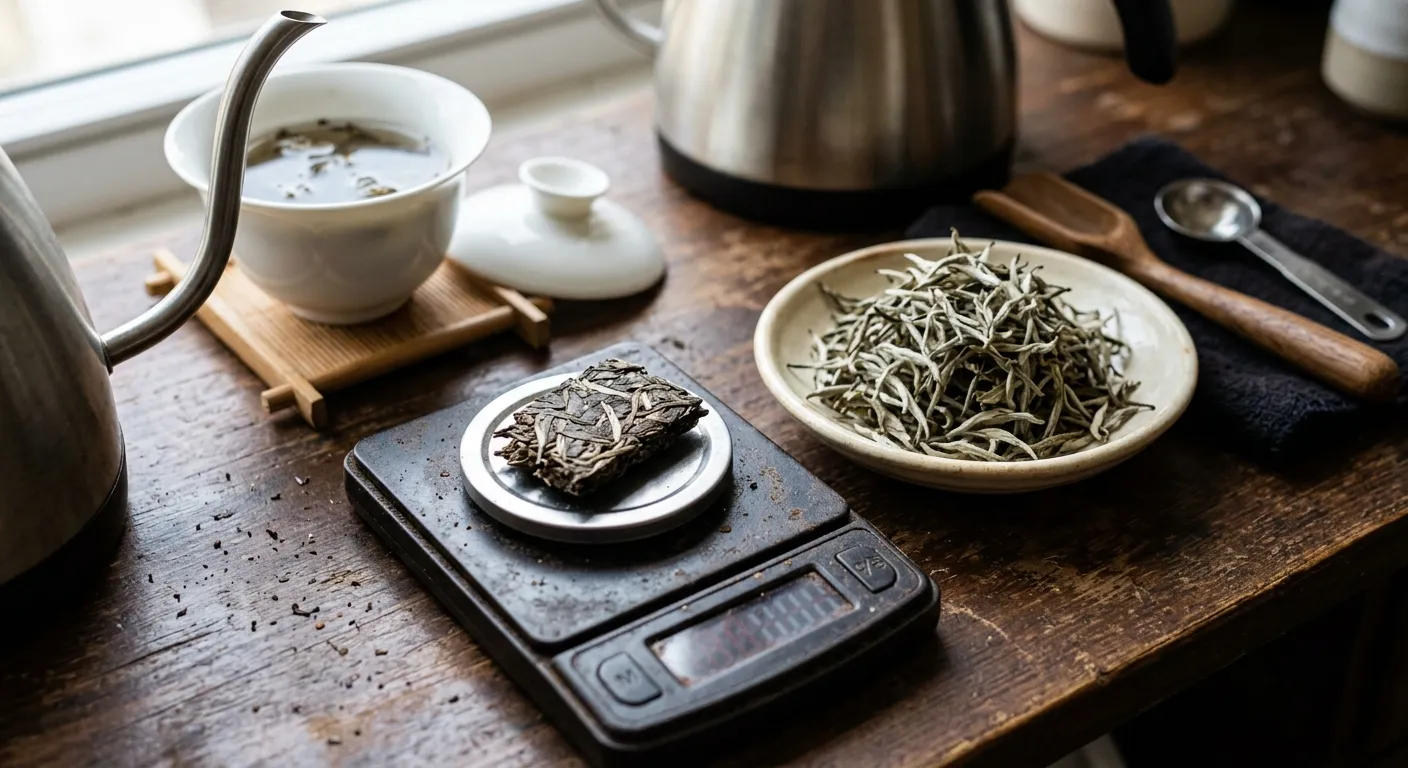
A dense piece of cake can also make leaf amount harder to estimate by eye. What looks like a small chunk may weigh more than expected. If caffeine matters to you, weighing compressed tea is more reliable than guessing by volume.
Loose leaf is easier to judge visually, but fluffy white tea can mislead in the other direction: a large-looking handful may weigh little, while a compact cake piece may weigh more than it appears.
How to brew white tea for a gentler caffeine cup
No brewing method can make regular white tea caffeine-free. But you can shape the session so it is gentler in concentration and easier to read.
-
Use less leaf, not just shorter time.
If you usually brew a packed gaiwan, reduce the dry-leaf amount. Leaf dose is one of the most important controls.
-
Choose a larger water volume for casual drinking.
A mug or small pot with moderate leaf can feel softer than a concentrated small-vessel session.
-
Use moderate water temperature.
Especially for bud-heavy teas, slightly cooler water can give a sweeter, less forceful cup. Avoid pushing heat and time together if you want a lighter result.
-
Keep the first steep controlled.
Instead of a long opening infusion, start shorter and lengthen later only if the flavor is too thin.
-
Limit the total session, not only the first cup.
Repeated infusions matter. If you are trying to keep the session gentle, decide how many rounds you plan to drink.
-
Do not chase color as your only guide.
Some white teas stay pale even when flavorful. Others darken with age or storage. Color helps, but it is not a caffeine meter.
A low-intensity starting point is a modest amount of leaf in a mug or small pot, water below boiling, and a moderate steep. If the cup tastes too thin, adjust one variable at a time. Add a little more time before adding much more leaf. If it feels too strong, reduce leaf amount first.
People vary in caffeine sensitivity. If caffeine intake is already being managed for personal health reasons, it is better to seek individualized guidance from a qualified professional rather than treating any tea category as automatically suitable.
Is white tea stronger than green tea in caffeine?
White tea and green tea both come from Camellia sinensis, and both can vary. It is too simple to say white tea is always lower than green tea or always higher than green tea. Tea type names do not control every part of the cup.
A delicate white tea brewed with a lot of leaf can feel stronger than a lightly brewed green tea. A small serving of white tea may feel gentler than a large mug of green tea. A shaded, bud-heavy, broken, powdered, or heavily dosed tea in another category can complicate comparisons further.
For readers, the better comparison is not “white versus green” in the abstract. Compare actual preparations:
- How much leaf?
- How much water?
- How hot?
- How long?
- Whole leaf or broken leaf?
- One infusion or many?
- How much did you drink in total?
Commercial caffeine charts without brewing details should be read as rough orientation, not as a direct answer for your own gaiwan, mug, or pot.
Can white tea keep you awake?
It can, depending on the person and the session. Since white tea contains caffeine, some drinkers may notice alertness or lighter sleep if they drink it late, especially in a concentrated session. Others may find moderate white tea gentler than other caffeinated drinks.
For ordinary tea planning, timing and total volume matter. A single light morning cup is different from a long evening session with many infusions. If white tea seems to keep you awake, look first at dose, clock time, and number of rounds before assuming the tea category itself is the only cause.
A practical way to judge your next cup
When deciding how much caffeine may be in white tea, do not start with the color of the liquor or a single number from a chart. Start with the session.
Ask:
- Is this tea bud-heavy, leaf-heavy, loose, or compressed?
- How many grams of leaf am I using, or how visually dense is the portion?
- What is the vessel size?
- Am I using cooler water, hot water, or water just off the boil?
- How long is the first steep?
- How many infusions will I actually drink?
- Does this tea feel strong because of caffeine, or because it is concentrated, bitter, thick, or aromatic?
- How do I personally respond to this tea at this time of day?
That framework is more honest than a universal caffeine promise. White tea is a caffeinated tea, but the strength of a real cup is made at the meeting point of leaf style, brewing method, serving pattern, and personal sensitivity. If you want a gentler experience, brew with less leaf, moderate heat, controlled time, and fewer total infusions. If you want more body and intensity, increase one variable at a time and pay attention to how the session feels beyond flavor alone.
Sources
Sources and further reading
Reference links are limited to sources considered suitable for public citation in this page.