
White tea caffeine guide
Which White Tea Has the Most Caffeine
Bud-heavy white teas are the most likely place to look. If you are asking which white tea has the most caffeine, the practical answer is: a young, fine-grade, bud-rich white tea—especially Silver Needle—is often the strongest candidate by leaf material.
But that is not the same as saying “Silver Needle always has the most caffeine.” The cup you drink can change just as much with dry leaf weight, water temperature, steep time, vessel size, and how many infusions you finish. A soft, pale white tea can still contain caffeine, and a supposedly gentler style can become a stronger session if brewed heavily.
upward
Start with the broader guide
Use the broader guide first if you need the full scope before this page.
The most likely higher-caffeine white tea: Silver Needle, with caveats
If you choose by tea type alone, Silver Needle is the white tea most often associated with higher caffeine potential because it is made mostly from young buds. That is why people often connect “Silver Needle caffeine” with the idea of a higher-caffeine white tea.
Still, public reference sources do not give a universal white-tea-specific ranking across every cultivar, harvest, grade, and brewing style. So it is better to read the tea in front of you than to treat the name as a caffeine number.
Often higher potential
Silver Needle / bud-only or bud-dominant lots
Look for many intact pale buds, a fine pluck, and a high bud ratio.
Variable, sometimes close
White Peony
Buds plus young leaves; the result depends on how bud-rich the grade is.
Often more mature-leaf driven
Gong Mei
More open leaves, mixed grades, and harvest and sorting details matter.
Broad and variable
Shou Mei
Larger mature leaves, stems, loose forms, and compressed forms can all change the practical cup.
This is a buying and brewing guide, not a lab-confirmed caffeine ladder. A very bud-rich White Peony may come close to some Silver Needle lots. A tightly packed Shou Mei cake brewed with a heavy hand can also feel stronger than the name suggests.
Why the tea name does not decide the caffeine in your cup
White tea names describe plucking style, grade, appearance, and market category. They do not give an exact caffeine amount.
When two people ask for the “highest caffeine white tea,” they may mean different things. One may mean caffeine in the dry leaf by weight. Another may mean the cup that feels strongest at breakfast. Those are related, but they are not always the same question.
Buds versus mature leaves
Young buds are the main reason Silver Needle is often treated as a higher-caffeine candidate. A bud-dominant tea can differ from one made mostly of larger leaves, but bud content is still a clue, not a measurement.
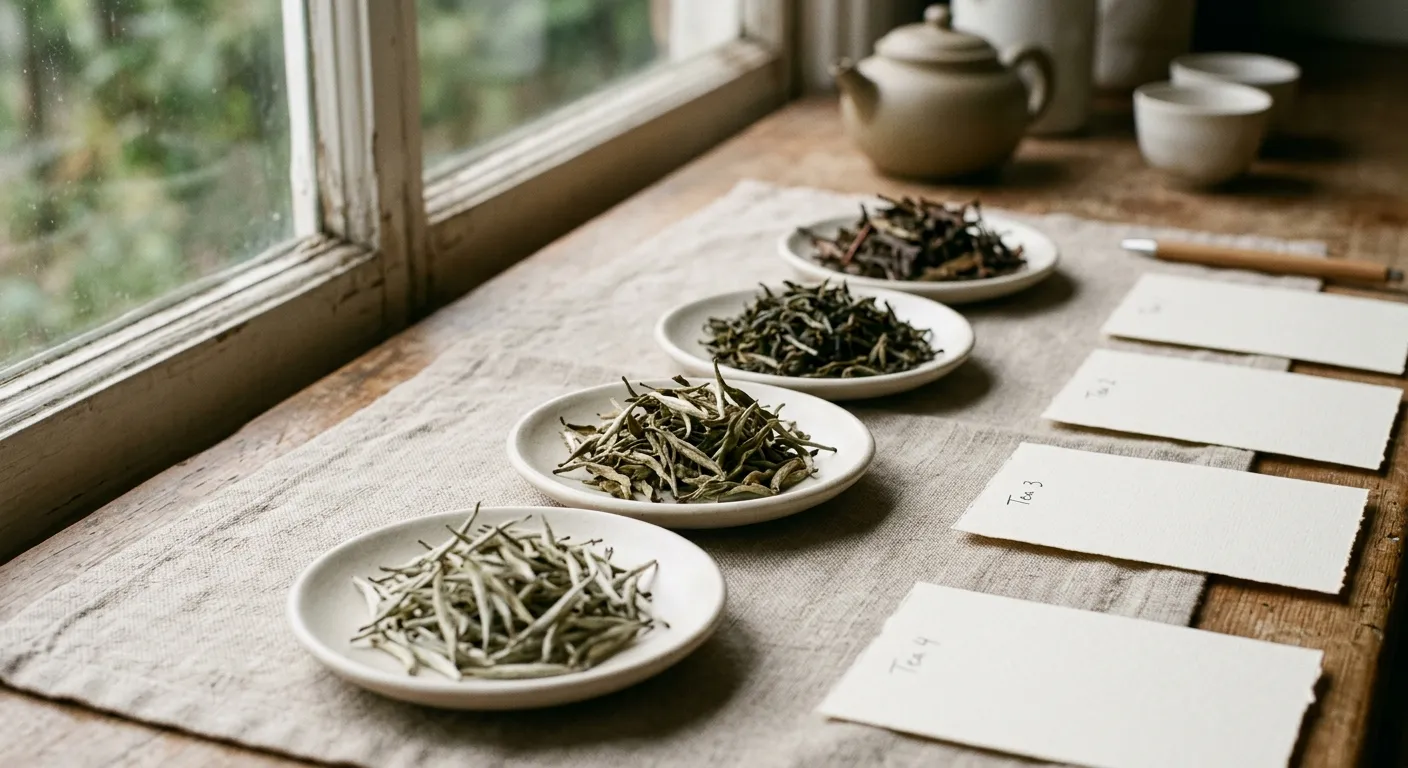
When comparing samples, look closely at the dry leaf:
- Are there many slender, downy buds?
- Is the tea mostly open leaves?
- Are stems prominent?
- Does the grade look fine and uniform, or mixed and coarse?
- Is it bud-only, bud-and-leaf, or mainly mature leaf?
Those details tell you more than the label alone.
Leaf grade and harvest style
Fine-grade, early-season white teas are often sold around tender buds and young leaves. Mature-leaf styles may be plucked later or sorted differently. These points can matter, but they do not support a fixed rule such as “early harvest always has more caffeine” or “Shou Mei is always lower.”
A seller who gives a clear pluck standard, harvest season, cultivar, and processing description gives you more to judge than a broad label like “white tea.”
Dry leaf weight
This is the variable many caffeine comparisons miss.
A loose, fluffy Silver Needle can fill a spoon while weighing less than expected. A compressed Shou Mei cake chip may look small but weigh more. If you compare by spoonful instead of grams, you may accidentally brew one tea much stronger than the other.
For a fair comparison, weigh the tea. A 5 g gaiwan session and a 2 g mug infusion are not a clean comparison, even if the tea names are familiar.
Vessel size and serving size
A gaiwan, small teapot, large mug, and travel bottle all create different drinking patterns. A concentrated 100 ml gaiwan infusion may look modest, but if you drink eight or ten infusions, the total session volume adds up. A large mug may use fewer infusions but more water at once.
So “white tea serving size” matters. The caffeine question is not only what enters one steep. It is also how much brewed tea you actually drink.
Brewing choices that can make white tea stronger
Once you own the tea, brewing can shift the answer more than the type name suggests. General tea references note that brewed tea caffeine varies with preparation. For white tea drinkers, that means the same leaves can become a softer cup or a more assertive one depending on the recipe.
More leaf usually means a stronger cup
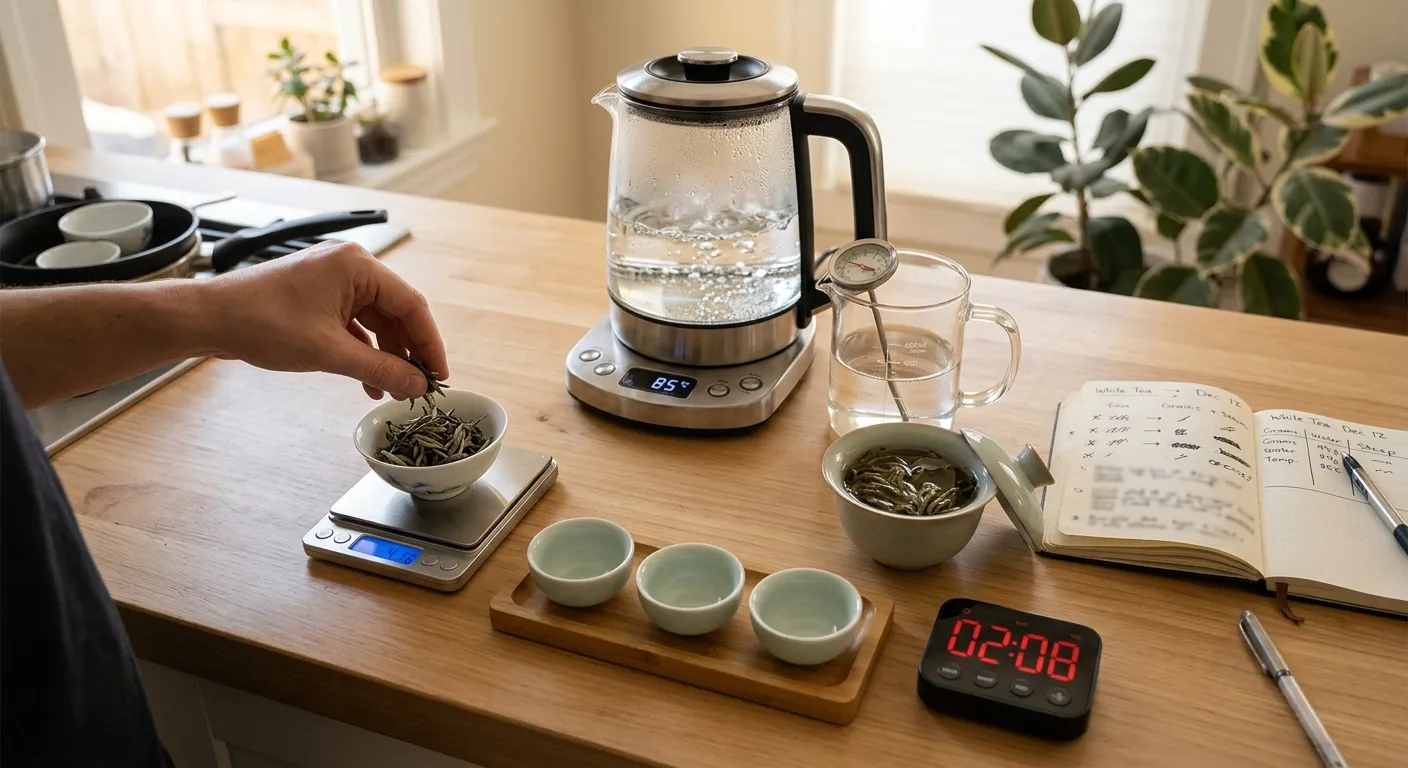
If you want to compare Silver Needle versus White Peony, start with the same dry leaf weight. If one tea is brewed at 6 g in a small gaiwan and the other at 2 g in a large mug, you are comparing recipes as much as tea types.
For a clearer comparison, record:
- grams of dry leaf
- water volume
- water temperature
- steep time
- number of infusions consumed
- total brewed volume
This will not give you a laboratory caffeine number, but it prevents the most obvious false comparison.
Hotter water can extract more from the leaf
Water temperature and caffeine are often discussed together because hotter water tends to extract tea compounds more aggressively. In white tea, hotter water can also bring out more body, bitterness, and edge, especially in broken or leafy grades.
A Silver Needle brewed cool and briefly may feel softer than a mature-leaf white tea brewed hotter and longer. That does not mean the mature-leaf tea contains more caffeine by dry weight. It means the brewing method changed the cup.
Longer steeping can matter
Longer contact gives water more time to extract from the leaf. A quick gaiwan infusion is not the same as a five-minute mug steep.
If you want a lighter-feeling session, shorter steeps, less leaf, and smaller total volume are the direct levers. If you want to compare teas, keep steep time consistent.
Multiple infusions change the total
White tea is often brewed through several infusions. A first cup may taste delicate, while later rounds bring out sweetness, hay, melon, herbs, dried flowers, or warm wood, depending on the tea and its age.
Caffeine comparison becomes messy when one person drinks only the first infusion and another finishes the whole session. The “most caffeinated cup” may not be a single cup at all. It may be the total session.
Common confusion about white tea types and caffeine
White tea attracts caffeine myths because its liquor can be pale, its aroma can be gentle, and its processing is often described as minimal.
The first misunderstanding: white tea is caffeine-free. It is not. White tea comes from the tea plant, and caffeine is part of normal brewed tea.
The second: white tea is always the lowest-caffeine tea. Broad tea categories are too blunt for that. A bud-rich white tea brewed heavily may not behave like a faint, low-dose cup.
The third: pale color means low caffeine. Color and caffeine do not move together neatly. A delicate-looking Silver Needle infusion can still contain caffeine, while a darker aged white tea may owe its color to oxidation, aging, compression, storage, or steeping style.
The fourth: Silver Needle versus White Peony has one permanent answer. Silver Needle is the cleaner higher-caffeine guess by bud concentration, but a bud-rich White Peony, stronger recipe, or larger serving can narrow the practical difference.
The same caution applies to Gong Mei versus Shou Mei. These names point toward different leaf materials and market grades, not exact caffeine labels.
How to choose if caffeine is part of your decision
If you want a white tea that is more likely to brew with higher caffeine, choose a fresh or relatively young bud-heavy tea, especially Silver Needle or a very bud-rich White Peony. Then brew it with a measured leaf dose so you know what you are comparing.
If you want a gentler white tea session, do not rely only on choosing Shou Mei or an aged cake. Control the recipe:
- use fewer grams of leaf
- avoid very long mug steeps
- keep water temperature moderate if the tea tastes good that way
- drink fewer total infusions
- consider your full day’s caffeine intake, not only the tea table
Caffeine sensitivity varies. Some people notice a small cup of tea late in the day; others do not. Public health and regulatory sources discuss caffeine in terms of total intake and individual context, but they do not rank white tea types or certify any one white tea as high or low caffeine. If caffeine affects your sleep or personal health situation, follow qualified guidance rather than using a tea label as your only decision tool.
For ordinary tea selection, the simplest rule is this: Silver Needle is often the strongest candidate by bud-heavy style, but the strongest white tea you actually drink is the one brewed with the most extractive recipe and the largest finished serving.
Quick answers
Is Silver Needle the highest caffeine white tea?
It is often the most likely higher-caffeine candidate because it is bud-heavy. But not every Silver Needle will outrank every White Peony, Gong Mei, or Shou Mei in the cup. Brewing method, grade, and serving size can change the result.
Does White Peony have less caffeine than Silver Needle?
Often it may be treated that way when White Peony contains more leaves and fewer buds. A bud-rich White Peony can be closer than the name suggests. Compare the actual leaf material and brew both teas with the same dry weight.
Can brewing make more difference than the white tea type?
Yes, in the practical cup. More leaf, hotter water, longer steeping, and more total infusions can make a white tea session stronger than a lighter recipe using a supposedly higher-caffeine tea.
Sources
Sources and further reading
Reference links are limited to sources considered suitable for public citation in this page.