
White tea caffeine comparison
Does Aged White Tea Have Less Caffeine Than Fresh White Tea
Aged white tea should not be assumed to have less caffeine than fresh white tea. The short answer is: not reliably, and not from age alone.
Aged white tea caffeine can vary with leaf grade, harvest style, compression, broken leaves, brewing ratio, water temperature, steep time, vessel size, and how many infusions you drink. An older cake may taste softer, darker, rounder, or less sharp than a fresh loose white tea, but that mellow feeling is not the same as a measured caffeine reduction.
If you are choosing tea because caffeine matters to you, the age label is too weak to use by itself. Look at the leaf and the brewing method first.
upward
Start with the broader guide
Use the broader guide first if you need the full scope before this page.
Why “aged” does not automatically mean lower caffeine
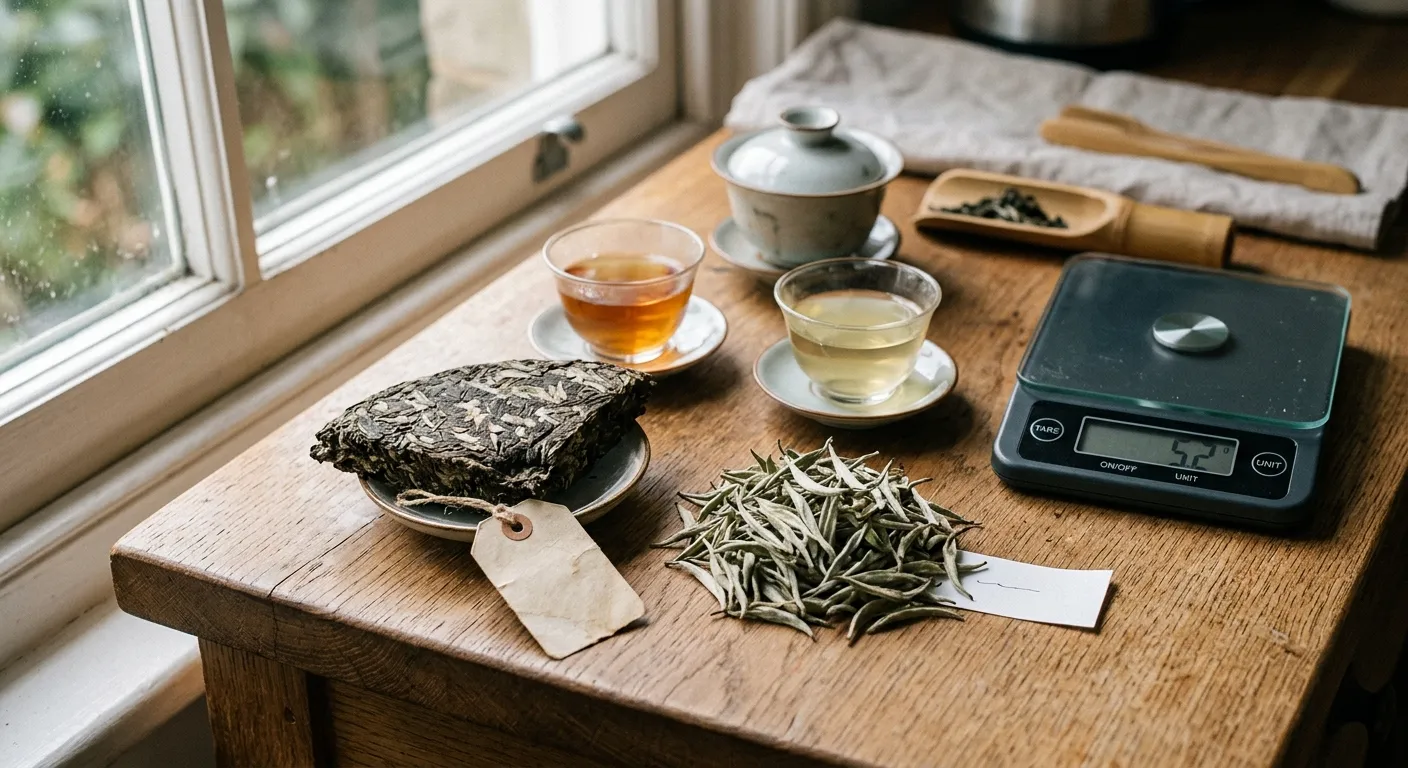
The assumption usually comes from taste. Aged white tea often develops warmer, deeper, less grassy flavors than very fresh white tea. A stored Shoumei cake may brew darker and smoother than a newly made Bai Mudan. A loose aged white tea may smell like dried herbs, honeyed wood, dates, or old paper rather than spring greens.
That sensory shift can make the cup feel gentler. But caffeine is not judged by softness on the tongue.
The available evidence supports a narrower conclusion: brewed tea caffeine varies, especially with preparation conditions, but it does not show that white tea aging by itself steadily lowers caffeine in a predictable way. “Aged” is a storage and market description, not a caffeine measurement.
It may tell you the tea has been kept for some period of time. It may suggest a different aroma profile. It may affect how the leaves open in the cup. It does not, on its own, tell you how much caffeine will end up in your brewed tea.
A fresh white tea and an old white tea can also be very different materials before age enters the comparison. A fresh Silver Needle made mostly from buds is not the same as an aged Shoumei cake with larger leaves and stems. If one feels stronger or lighter, you may be comparing grade, picking standard, leaf structure, compression, and brewing style—not only fresh vs aged white tea caffeine.
What changes caffeine in the cup more clearly than age
For a tea drinker, the practical question is not only what sits in the dry leaf. It is what enters the liquor you actually drink. Several visible choices at the table can change brewed white tea caffeine more clearly than the age claim.
Leaf weight and water volume
A dense 7 grams of compressed aged cake in a small gaiwan is not comparable to a loose handful of fresh white tea in a large mug unless you know the leaf weight and water volume. Compression can mislead the eye. A small flake from a cake may weigh more than it looks.
For a fairer comparison, use the same leaf weight, vessel size, and water amount. Otherwise, a stronger cup may simply be a heavier dose.
Steep time
Caffeine extraction is affected by preparation time. A quick rinse and short infusions will not behave like a five-minute mug steep. If an aged tea is brewed through repeated short infusions and a fresh tea is brewed once for several minutes, the result is not a clean comparison.
Shorter steeps may produce a lighter extraction, though they do not make a caffeinated tea caffeine-free.
Water temperature
Hotter water generally extracts more from tea leaves than cooler water. It also changes flavor balance. A fresh white tea brewed gently may feel delicate, while an aged cake pushed with hotter water may feel thick and dark.
That difference can come from brewing choices, not simply age.
White tea is brewed across a wide range of temperatures depending on style. Silver Needle, White Peony, Gongmei, and Shoumei are not always handled the same way. When thinking about white tea aging caffeine, keep the brewing temperature in the comparison instead of treating the teas as equal by label alone.
Broken leaves, intact leaves, and compression
Broken leaves expose more surface area. A compressed aged cake may include fragments, edges, stems, and tight inner pieces that open unevenly. A fresh loose tea may have more intact leaves or buds.
This is one reason caffeine in old white tea cannot be judged from the wrapper age. Two aged cakes from the same stated year may brew differently if one is tightly compressed, one is looser, one contains more broken material, or one has been stored in a way that changes aroma and texture.
Number of infusions you drink
A single pale cup is different from a long session. If you drink eight or ten infusions of an aged cake, your total caffeine intake from that session may be higher than from one small cup of fresh white tea, even if each individual infusion feels smooth.
When comparing aged white tea caffeine levels in ordinary drinking, count the session, not just the first pour.
The mellow aged-tea problem
Aged white tea is often described as mellow, gentle, rounded, soft, sweet, woody, or soothing. Those words can be useful for tasting. They help you recognize the difference between a sharp fresh tea and a stored tea with deeper aromatics.
They become misleading when they are treated as caffeine evidence.
A cup can taste calm because bitterness has softened, grassy edges have faded, or the aroma has moved toward dried fruit and warm wood. The body may feel thicker. The finish may be less pointed. None of those observations shows that the caffeine is lower.
The reverse can also happen. A fresh white tea may taste pale and floral but still contain caffeine. A bud-heavy tea may look delicate and brew light, yet “delicate” does not mean “very low caffeine.” White tea as a category is sometimes casually described as low in caffeine, but that broad statement can hide real variation between cultivars, grades, harvests, and brewing methods.
A better way to read tasting language
What you notice: Softer aged flavor
What it may suggest: Storage has changed aroma and taste
What it does not show: Lower caffeine
What you notice: Darker liquor
What it may suggest: Leaf type, age, storage change, or stronger brewing
What it does not show: A predictable caffeine level
What you notice: Less bitterness
What it may suggest: Different extraction balance or leaf character
What it does not show: Caffeine has disappeared
What you notice: Calm marketing language
What it may suggest: A seller’s flavor or wellness framing
What it does not show: A measured caffeine result
What you notice: Stronger body
What it may suggest: Higher dose, hotter water, longer steep, compression, or leaf material
What it does not show: More or less caffeine by itself
This distinction matters when buying aged cakes. A label that says “old white tea” or “aged white tea” may help set flavor expectations, but it should not be read as a caffeine guarantee.
How to compare fresh and aged white tea more fairly
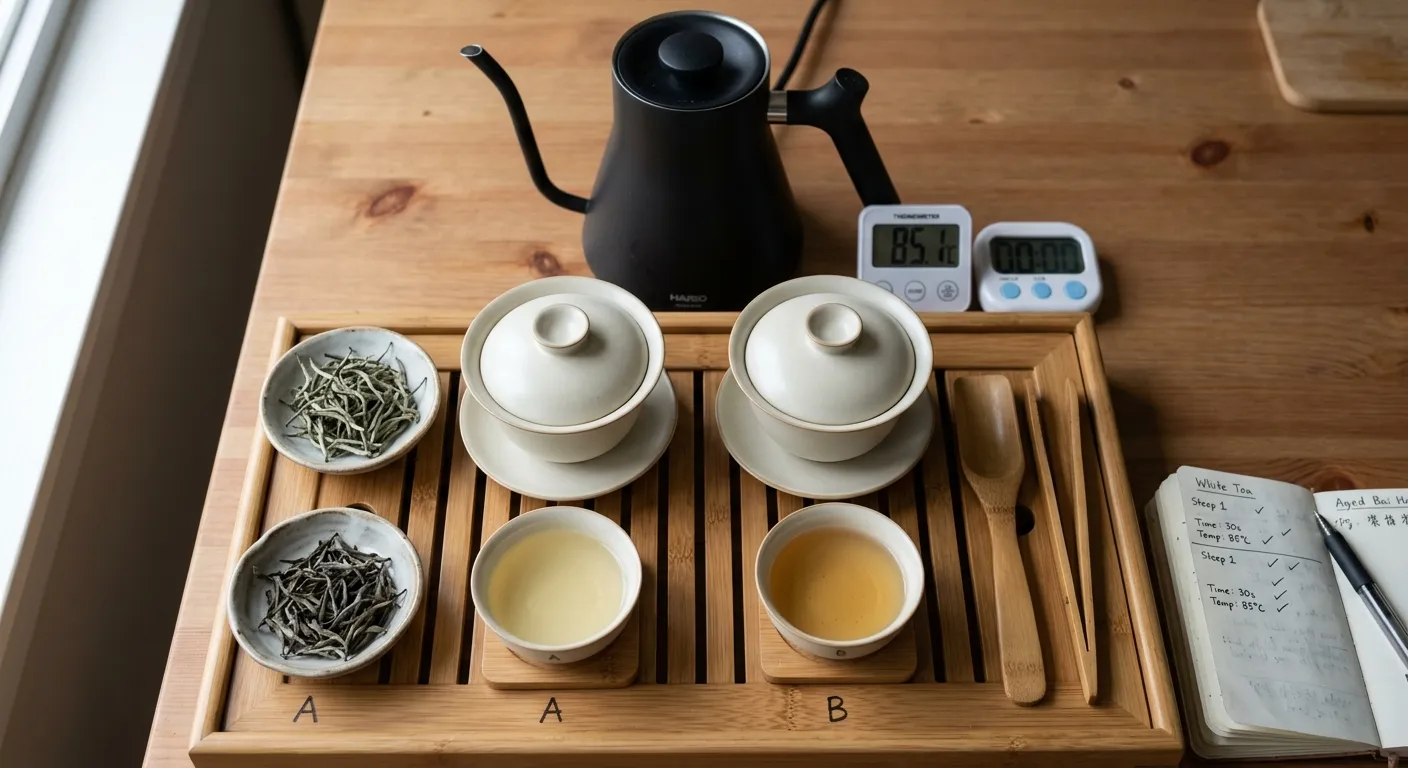
If you have both teas in front of you, do not start with the age claim. Make the comparison less noisy.
Choose samples that are as similar as possible. Comparing a fresh White Peony with an aged White Peony is more useful than comparing a fresh Silver Needle with a heavily compressed aged Shoumei cake. It still will not give you a lab caffeine number, but it reduces the obvious confounders.
Use the same setup
- same dry leaf weight
- same vessel size
- same water volume
- same water temperature
- same steep time
- same number of infusions tasted
- similar time of day, if you are judging your own response
First note
Which tea tastes softer, darker, sharper, sweeter, or thicker?
Second note
How does the session feel afterward?
That second question is personal and imperfect. Sleep, food, stress, serving size, and caffeine tolerance can all affect how someone experiences tea. Still, a controlled comparison is more useful than assuming aging and white tea caffeine move in one simple direction.
For buying, ask more concrete questions than “Is it low caffeine?” A seller may not have lab data, but they may be able to tell you the picking grade, approximate harvest style, whether it is loose or compressed, how tightly it is pressed, and how they suggest brewing it. Those details are more useful than a vague claim that the tea is mellow.
A note for caffeine-sensitive drinkers
Caffeine sensitivity varies from person to person. General consumer guidance treats caffeine as something people may need to moderate depending on their own situation and tolerance. That does not make aged white tea a special exception.
If you are deliberately limiting caffeine, do not use aged white tea as a workaround simply because it tastes smoother. Treat it as caffeinated tea unless you have a specific product with clear caffeine information.
Practical ways to reduce uncertainty include drinking smaller servings, brewing lighter, avoiding long late-day sessions, and paying attention to your own response. Those are everyday tea habits, not medical instructions. If your caffeine limits are connected to a personal health situation, the tea’s age label is not enough information to rely on.
The clean answer
Aged white tea may taste more mellow than fresh white tea, but it cannot be assumed to have less caffeine.
The better reading is:
- Age alone is not a reliable caffeine indicator.
- Fresh vs aged white tea caffeine depends heavily on leaf material and brewing.
- A mellow aged cup does not prove a low-caffeine cup.
- Compression, dose, steep time, temperature, and infusion count can change what you actually drink.
- If caffeine matters to you, compare similar teas under controlled brewing conditions or treat both fresh and aged white tea as caffeinated.
For most white tea drinkers, the age of the tea is more useful for thinking about aroma, texture, storage character, and buying context than for estimating caffeine. Use the cup’s softness as a tasting note, not as a caffeine measurement.
Sources
Sources and further reading
Reference links are limited to sources considered suitable for public citation in this page.