
Tea caffeine comparison
Is White Tea Stronger Than Green Tea in Caffeine
White tea is not automatically stronger than green tea in caffeine, and green tea is not automatically stronger than white tea. The useful answer to white tea vs green tea caffeine is at the cup level: a bud-heavy white tea brewed with plenty of leaf can feel stronger than a lightly brewed green tea, while a mild white tea infusion can feel gentler than a concentrated green tea.
The tea family name is only a starting point. To compare two actual teas, look at the leaf material, dry leaf amount, water temperature, steep time, number of infusions, and cup size. Those details can change the result enough that simple caffeine charts often disagree.
upward
Read the full overview first
Use the broader guide first if you need the full scope before this page.
The short answer: compare the cup, not only the category
“White tea” and “green tea” are broad families, not fixed caffeine levels. A delicate Silver Needle, a leafier White Peony, a larger-leaf Shoumei, a steamed green tea, and a pan-fired green tea may behave differently in the cup.
Practical answer
White tea can be stronger than green tea in some brewing situations, but it should not be assumed to be stronger or weaker by category alone.
A better comparison starts with a few plain questions:
- Which white tea are you brewing?
- Which green tea is it being compared with?
- Are you using the same dry leaf weight?
- Are the cup sizes similar?
- Are the steeping time and water temperature close enough to compare?
- Are you counting only one infusion, or the whole session?
Without those details, “white tea is stronger” or “green tea is stronger” is too blunt. It may describe one cup and fail for the next.
What changes the caffeine comparison
A fair tea caffeine comparison begins with the actual leaves. The label helps you orient yourself, but the cup is shaped by visible and practical variables.
Leaf grade and bud-to-leaf ratio
White tea is often discussed by leaf style. Silver Needle is made from tender buds, White Peony includes buds and leaves, and Shoumei or Gongmei styles are usually leafier. Those differences matter because the material in the vessel is not identical.
A bud-heavy white tea may not behave like a coarse, mature-leaf white tea. A fine green tea with small, tender material may not behave like a larger, more open green tea leaf. When a caffeine chart treats all white teas as one line and all green teas as another, it can hide this variation.
For a white tea drinker, the question is not only “white or green?” It is also “buds, bud-and-leaf, or larger leaves?”
Dry leaf amount
The amount of tea in the vessel can matter more than the category name. A generous scoop of white tea in a small gaiwan is not the same as a light spoonful of green tea in a large mug.
This is why casual comparisons often sound contradictory. One person may brew white tea lightly, using fewer leaves and a short steep. Another may use a high leaf dose and drink several concentrated infusions. Both are describing real cups, but not the same comparison.
If you want a clearer result, weigh the dry leaf or use the same measured amount for both teas.
Water temperature and steep time
Brewing recipe affects extraction. Hotter water and longer contact time can make a cup taste stronger, more bitter, or more structured, depending on the tea. It can also change what is drawn from the leaves.
Because this article does not rely on a visible source set for exact caffeine numbers, it avoids assigning precise milligram values to specific temperatures or steep times. The practical point is enough: a quick, cooler infusion is not the same as a long, hot steep.
If your white tea is brewed for several minutes in a mug while your green tea is brewed briefly to keep bitterness down, the white tea may seem stronger even if a generic chart suggested otherwise.
Vessel and serving size
A small gongfu-style cup and a full Western-style mug are different servings. A tea can be light per sip but add up across many infusions. Another tea can be more concentrated in a single mug but consumed only once.
Before judging caffeine in white tea vs green tea, decide what “stronger” means:
- stronger per gram of dry leaf;
- stronger per infusion;
- stronger per mug;
- stronger across a whole session;
- stronger in the way the cup feels to you.
Most home drinkers really mean, “How much am I getting from the cup or session I actually drink?”
Why white tea is often misunderstood
White tea has a soft image. Its pale liquor, gentle aroma, and simple processing style can make it seem automatically mild in every sense. That is where the confusion starts.
A white tea can taste soft while still being made from tender young material. A green tea can taste grassy, brisk, or astringent without necessarily being higher in caffeine in that particular cup. Flavor strength and caffeine strength only loosely overlap in everyday tasting. A bold cup is not always the most caffeinated, and a pale cup is not automatically low in caffeine.
This matters with Silver Needle in particular. Many beginners see the light color and assume it must be very low in caffeine. That may or may not be true for a given tea and brewing method. The visual delicacy of the infusion should not be treated as a caffeine measurement.
The opposite mistake happens with green tea. Some drinkers assume green tea must be stronger because it tastes sharper or more astringent. But briskness can come from processing, leaf shape, water temperature, and steep time, not only from caffeine.
A practical way to compare one white tea with one green tea
To compare your own white tea and green tea more fairly, keep the test simple and repeatable.
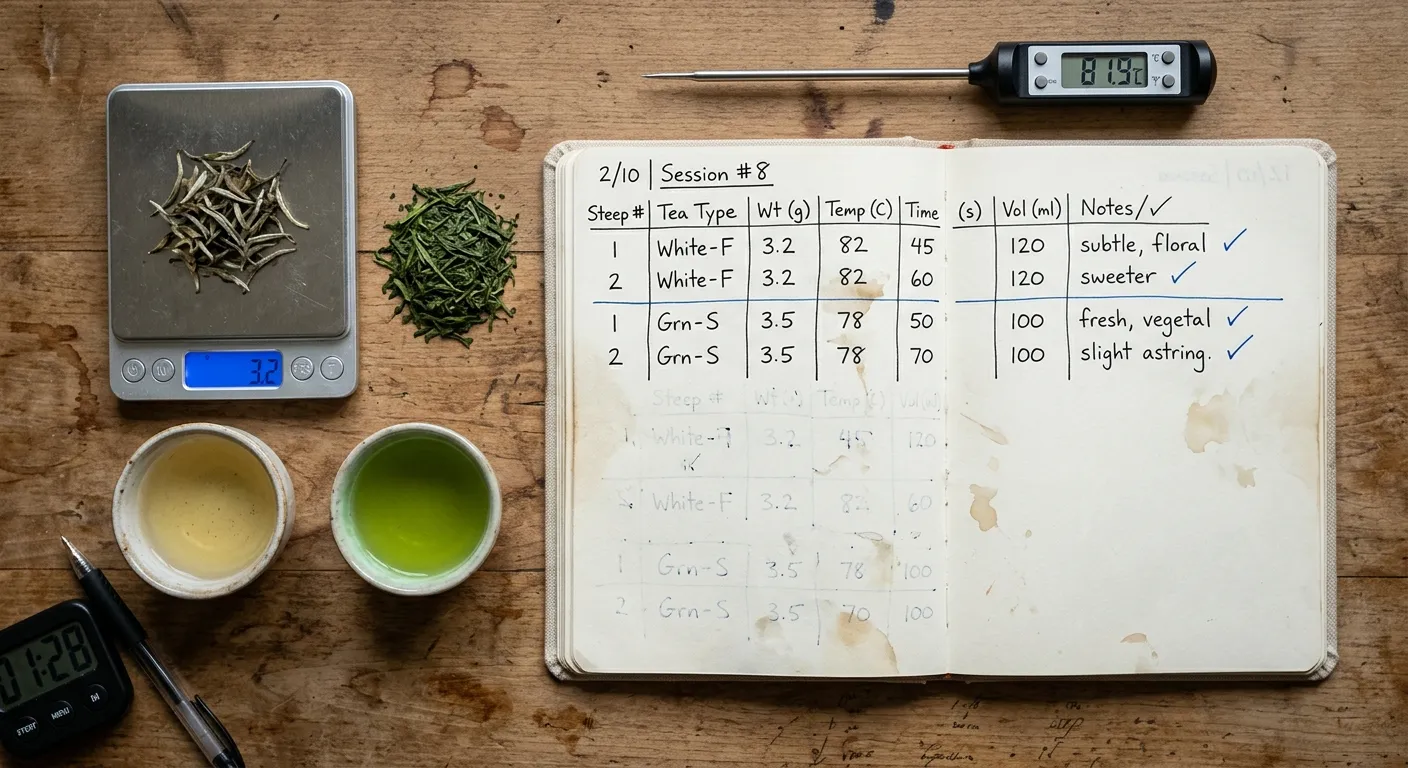
Use the same cup size. Use a similar dry leaf amount. Brew each tea in a way that still suits it, but write down what you did: grams or spoonfuls, water temperature if you track it, steep time, and number of infusions. Then compare the cups, not just the labels.
Dry leaf amount
More leaf can make a stronger cup regardless of category.
Leaf style
Bud-heavy, mixed bud-and-leaf, and larger-leaf teas may not compare neatly.
Water temperature
Brewing hotter or cooler changes the cup.
Steep time
Longer contact can produce a stronger infusion.
Cup size
A small tasting cup and a large mug are different servings.
Number of infusions
A full session may matter more than the first cup alone.
This will not give you laboratory caffeine data. It will stop the most common false comparison: a strong-brewed white tea against a weak-brewed green tea, or the reverse.
It also helps with white tea selection. If you want a gentler everyday cup, you may choose a leafier white tea and brew it lightly. If you enjoy a more concentrated session, you might use more leaf in a smaller vessel and avoid assuming the cup is low in caffeine just because it is white tea.
When caffeine charts conflict
You may see one chart saying white tea is lower than green tea, another suggesting the opposite, and a seller page placing a product into a neat caffeine bracket. Treat those as rough context unless they explain the tea sample, leaf amount, brewing method, and serving size.
The material available for this article did not include public, verifiable sources with exact caffeine ranges, tea chemistry data, or controlled brewing comparisons. For that reason, this page avoids precise milligram numbers and does not declare a universal winner.
That does not make the question useless. It makes the answer conditional. White tea and green tea caffeine can vary by the actual leaves and by brewing. A confident chart without context may be easy to scan, but it may be less helpful for the cup in front of you.
Boundary note
If you need exact caffeine intake for personal health reasons, a general tea page cannot provide that level of personal guidance. Product-level testing, clear product documentation, or advice from a qualified health professional may be more appropriate. For ordinary tea selection, the better habit is to notice the recipe and serving size instead of relying only on the tea family name.
So, is white tea stronger than green tea?
Sometimes it can be. Often it may not be. The category alone is not enough.
A bud-rich white tea brewed generously can plausibly be stronger in the cup than a lightly brewed green tea. A delicate white tea brewed with fewer leaves and a short infusion can be milder than a concentrated green tea. Between those examples is a wide middle ground shaped by leaf grade, harvest style, dry leaf dose, water temperature, steep time, and how much you drink.
Do not buy or brew white tea assuming it is caffeine-free or always lower than green tea. Compare the actual tea, the amount of leaf, and the way you brew it.
That shift makes the white tea vs green tea caffeine question clearer. It moves the comparison away from category folklore and toward the real cup: leaves, vessel, water, time, and serving size.