
White tea forms
Can White Tea Be Loose Leaf, Cake, or Ball Form
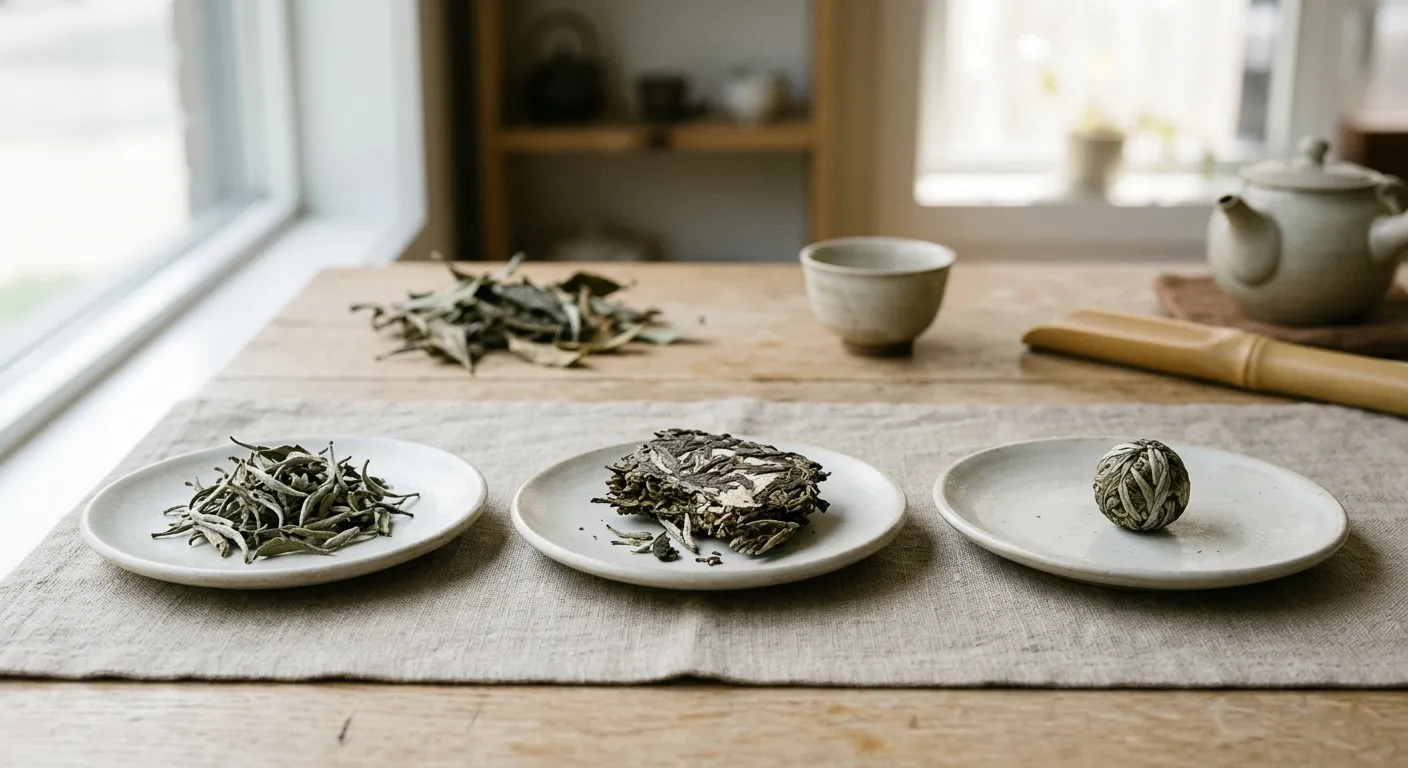
Yes. White tea can be sold as loose leaf, cake, or ball form. Those are plausible white tea forms, but they describe shape and handling more than they prove anything about quality.
The practical difference is simple: loose leaf white tea is easiest to inspect and measure; a white tea cake is compressed and usually needs to be loosened before brewing; a white tea ball is a small pressed portion that opens gradually in water. None of these shapes, on its own, confirms age, origin, storage condition, authenticity, flavor quality, or health value.
upward
Read the full overview first
Use the broader guide first if you need the full scope before this page.
What the Form Actually Tells You
The form tells you how the tea has been prepared for sale, storage, handling, and brewing.
A white tea loose leaf form means the leaves are not pressed into a solid shape. You can usually see more of the material before brewing: buds, larger leaves, stems, broken pieces, color variation, and surface texture.
A white tea cake form means the tea has been compressed into a disc, brick, or other pressed shape. You break or pry off a portion before brewing. The outside may look neat, while the inner layers give more clues about leaf size, aroma, breakage, and compression.
A white tea ball form is usually a small compressed unit, often meant for one brewing session. Seller descriptions may also use words such as mini cake, pearl, or ball. Since wording varies, focus on observable details: weight per piece, tightness of compression, how the leaves open, and how the tea tastes across several steeps.
The main boundary: shape is a handling cue, not a quality certificate.
Loose Leaf White Tea: Clearer to Inspect and Adjust
Loose leaf white tea is often the easiest form for beginners because it gives you more control from the start. You can weigh it, smell it, inspect it, and adjust the amount without first breaking apart a compressed piece.
Useful things to look at include:
- whether the material is mostly buds, larger leaves, stems, or mixed grades
- whether the leaves look whole, fluffy, twisted, flat, broken, or dusty
- whether the dry aroma is clean, floral, hay-like, woody, stale, sour, smoky, or damp
- whether the color looks reasonably consistent or strangely uneven
- whether the tea can be measured without crushing the leaves
These clues do not prove origin or age, but they help you brew better. Fluffy leaves can take up a lot of space, so weight is more reliable than spoon volume. Broken material may infuse faster. Larger, airier leaves may need slightly more leaf or a longer steep to avoid a thin cup.
Loose leaf is also easier for side-by-side comparison. If you are tasting two samples, use the same vessel, similar water temperature, similar leaf weight, and similar steeping time. That will not remove every variable, but it keeps the comparison more useful.
The tradeoff is fragility. Loose white tea can break if packed tightly or handled roughly. It also has more exposed surface area than a compressed cake or ball, so storage near moisture, cooking smells, perfume, or strong spices can change the aroma.
White Tea Cake Form: Compression Changes the Brew
A white tea cake is compressed white tea. The first difference is not prestige; it is handling.
Instead of scooping leaves, you separate a portion from the cake. That step affects extraction. If you place one dense chunk directly into water, the outside may infuse before the center opens. If you crush the cake into many tiny fragments, the tea may steep quickly and taste heavier than expected.
When handling a white tea cake, check:
- whether it separates in layers or crumbles into dust
- whether the compression feels loose, moderate, or very tight
- whether the inside smells similar to the outside
- whether there are damp, musty, or storage-heavy odors
- whether the seller gives weight, harvest information, storage context, and clear photos
A cake can be satisfying to handle and compact to store, but it asks more from the drinker. Use a tea pick or small knife carefully if needed. The goal is to release a workable piece while keeping some leaf structure intact, not to grind the tea down.
For brewing white tea cakes, the first infusion may taste light if the compressed piece has not opened. Some drinkers use a brief rinse or a slightly longer first steep, but the right adjustment depends on chunk size, compression, vessel size, and the tea itself. A dense piece in a small gaiwan behaves differently from a thin flake in a larger pot.
Most importantly, a cake is not automatically older, rarer, or better stored. If a seller uses age or origin language, read that as a separate claim. Check wrapper details, leaf appearance, aroma, storage smell, seller context, and brewing behavior together.
White Tea Ball Form: Convenient, but Less Transparent
A white tea ball can be convenient: one ball, one session. That simplicity is useful, but it also gives you less to inspect before brewing.
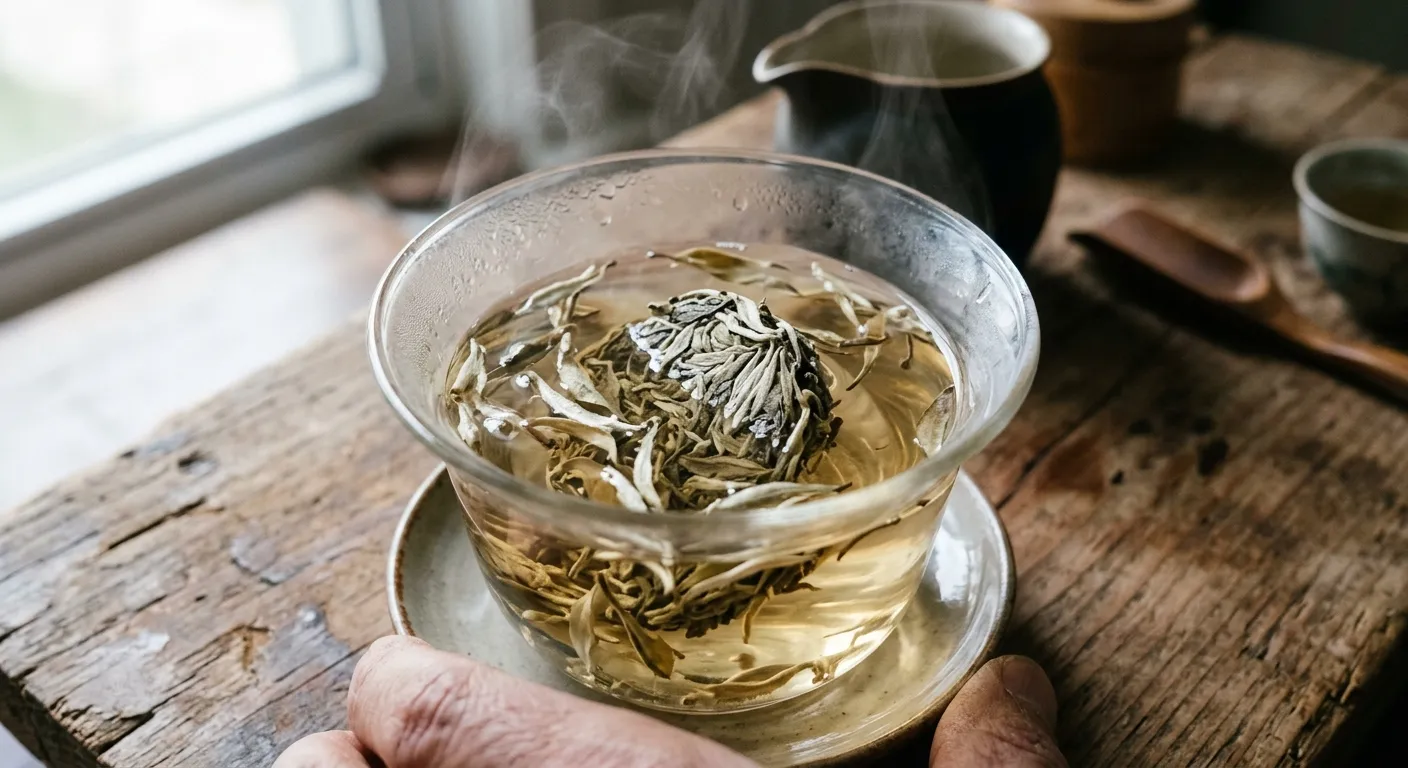
With loose leaf, you can see the material immediately. With a ball, the leaves are folded or compressed into a small unit, so the outer surface may hide the inner condition. You learn more as it opens in hot water.
Compared with cakes, balls differ mostly in portion size and brewing pace. A cake gives you a larger compressed piece from which you choose an amount. A ball is already portioned, though the seller’s idea of a portion may not match your vessel or taste. One ball may be too strong for a small gaiwan and too light for a large mug.
When brewing white tea balls, watch:
- the listed weight per ball
- how quickly the ball loosens
- whether the first steep tastes closed, faint, or already strong
- whether the opened leaf looks recognizable or mostly fragmented
- whether later steeps become smoother, stronger, thinner, or uneven
If the first cup tastes weak, the tea may simply still be opening. If it becomes too strong quickly, the ball may be too much leaf for the vessel, or the steep time and water temperature may need adjustment.
A neat ball can look attractive in photos, but shape is easy to overread. It should not replace basic checks: leaf condition, aroma, storage smell, weight, and seller clarity.
Cake Versus Loose Leaf Versus Ball: How to Choose
Choose based on how you plan to use the tea, not on which form sounds more impressive.
Loose leaf
Helps with: easy inspection, flexible measuring, beginner comparison.
Watch: fragility, storage exposure, volume misjudgment.
Cake
Helps with: compact handling, gradual opening, portioning from a larger piece.
Watch: breaking technique, tight compression, age or quality assumptions.
Ball
Helps with: convenience, single-session portions, easy counting.
Watch: hidden inner leaf, fixed portion size, slow opening.
Choose loose leaf if you want the clearest view of the leaf and the easiest way to adjust brewing.
Choose cake form if you are comfortable breaking compressed tea and enjoy watching the leaves open over several steeps.
Choose ball form if you want pre-portioned convenience and do not mind adjusting around a fixed piece size.
If you want the least uncertainty, buy a small amount before committing to a large cake or many balls.
Reading White Tea Seller Descriptions
Seller descriptions often mix shape words with quality words. That is where confusion starts.
Words such as loose leaf, cake, compressed, mini cake, pearl, and ball describe presentation. Words about age, origin, grade, rarity, storage, or premium value make separate claims. Those claims need separate support.
A careful buyer can ask:
- Is the form clearly described, including weight?
- Are there photos of both dry tea and brewed leaf?
- Does the listing explain whether the tea is loose, pressed, or individually portioned?
- Are age and origin details specific, or only decorative?
- Is storage described in practical terms?
- Does the tea smell clean when received?
This does not mean compressed white tea is suspicious. It means compression should be treated as one physical feature among several. The same caution applies to loose leaf: loose presentation does not automatically mean fresher, better, or more authentic.
Brewing Adjustments by Form
The form should guide your first adjustment.
For loose leaf, control leaf weight and steep time. If the cup tastes thin, use slightly more leaf or extend the steep. If it tastes too strong, shorten the steep or reduce the amount.
For cake pieces, avoid dropping in one hard lump without noticing its thickness. A thin flake may open quickly; a dense chunk may need time. If the early infusion is pale, let the leaves separate before judging the tea. If the cup becomes heavy fast, the piece may have broken into too many small fragments.
For balls, match the ball weight to the vessel. If one ball overwhelms a small gaiwan, use shorter steeps or a larger vessel. If it tastes light in a mug, extend the infusion. Watch how the ball opens rather than judging only the first pour.
Across all forms, aroma is a useful checkpoint. Dry leaf, warmed leaf, and wet leaf can each tell you something. Pleasant aroma does not prove a label claim, but damp or musty smells are worth taking seriously, especially when the inner material was hidden by compression.
What Shape Cannot Prove
White tea can be loose leaf, cake, or ball form, but shape cannot settle the bigger questions.
Use form as the beginning of inspection, not the final answer. Buy a small amount when possible, inspect the dry tea, smell it before brewing, brew with measured leaf and controlled time, and watch how the leaves open.
The better question is not which white tea form is automatically best. It is which form gives you the clearest path to inspect, brew, store, and enjoy the tea with realistic expectations.