
Processing note
Is White Tea Really Minimally Processed
Yes, in a comparative tea-processing sense. If you are asking is white tea minimally processed, the practical answer is that white tea is usually understood as a style shaped mainly by withering and drying, with less deliberate rolling, bruising, roasting, or heavy shaping than many other tea categories.
That does not mean the leaves are untouched, raw, or automatically better. Fresh leaves still have to be picked, sorted, spread, monitored, dried, packed, stored, and transported. “Minimally processed” is useful as a clue about handling, not as a final judgment on quality, taste, storage value, or wellness.
For the drinker, the better question is: does the description match what you can see, smell, and brew?
upward
Start with the broader guide
Use the broader guide first if you need the full scope before this page.
What “minimally processed” means in white tea
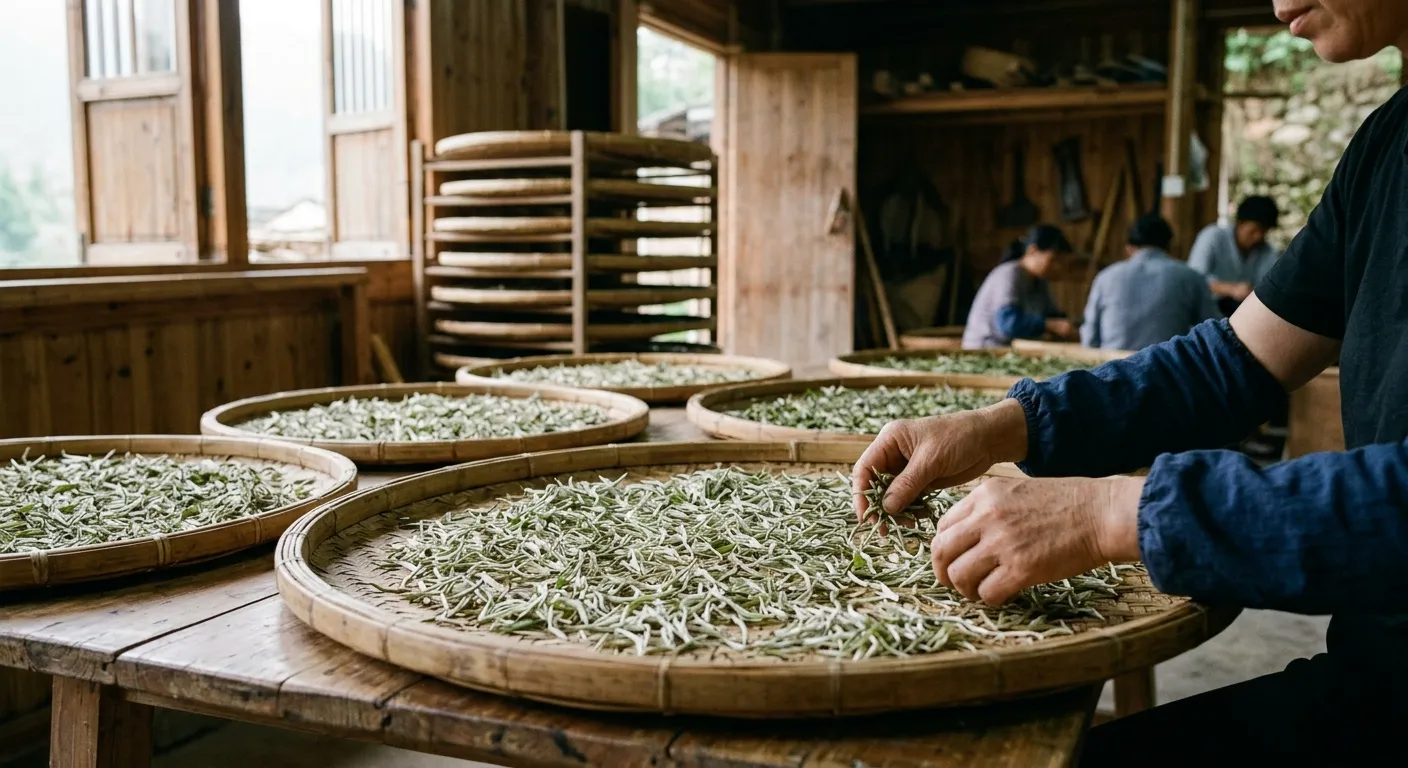
In everyday tea language, minimal processing usually means fewer major steps between fresh leaf and finished tea. For white tea, the phrase most often points to two core stages: withering and drying.
Withering is when freshly picked leaves lose moisture after harvest. The leaves are not simply resting in a neutral state. Their water content changes, aroma develops, and the fresh green leaf becomes more stable. Drying then reduces moisture further so the tea can be stored and transported.
That is the reasonable core of the phrase. White tea is often described as less intervention-heavy because its identity is not usually built around the same level of rolling, shaping, bruising, high-heat fixing, or directed oxidation used in some other tea styles. But “less handled” is still not the same as “unprocessed.”
White tea is minimally processed compared with more heavily manipulated tea styles because its character is generally built through careful withering, drying, and restrained handling rather than repeated shaping or aggressive transformation.
This definition leaves room for real variation. A bud-heavy Silver Needle and a mature-leaf Shoumei can both be white tea, but they will not show the same version of “minimal processing” in the cup. Leaf grade, harvest style, weather, drying choices, storage, and compression all change the result.
What the phrase does not prove
The biggest misunderstanding is treating “minimally processed” as “untouched.” That is where the phrase starts to mislead.
Tea does not become stable just because it has been picked. Even gentle white tea handling involves decisions: how thickly the leaves are spread, how long they wither, when drying begins, how moisture is reduced, and how the finished tea is stored.
It also does not mean “no oxidation.” During withering, internal changes can occur. White tea is better understood as less forcefully transformed than teas whose production depends on more active bruising, rolling, or managed oxidation. It is not frozen in a fresh-leaf state.
Nor does minimal processing prove quality. A simple process can be careless. A refined white tea can involve subtle, precise handling. The phrase alone does not guarantee cleaner flavor, higher grade, better aging potential, or better value.
It also should not be stretched into a health promise. White tea often appears near wellness language in the market, but processing style alone should not be treated as proof of a health effect. For this page, the useful focus is the tea itself: the leaves, aroma, liquor, texture, storage condition, and whether the seller’s wording gives enough concrete detail.
How to check the claim in the leaf and cup
A processing claim becomes more useful when you connect it to things you can observe. None of these cues can reconstruct the full production history by themselves, but they can help you decide whether a description feels plausible.
Start with the dry leaf
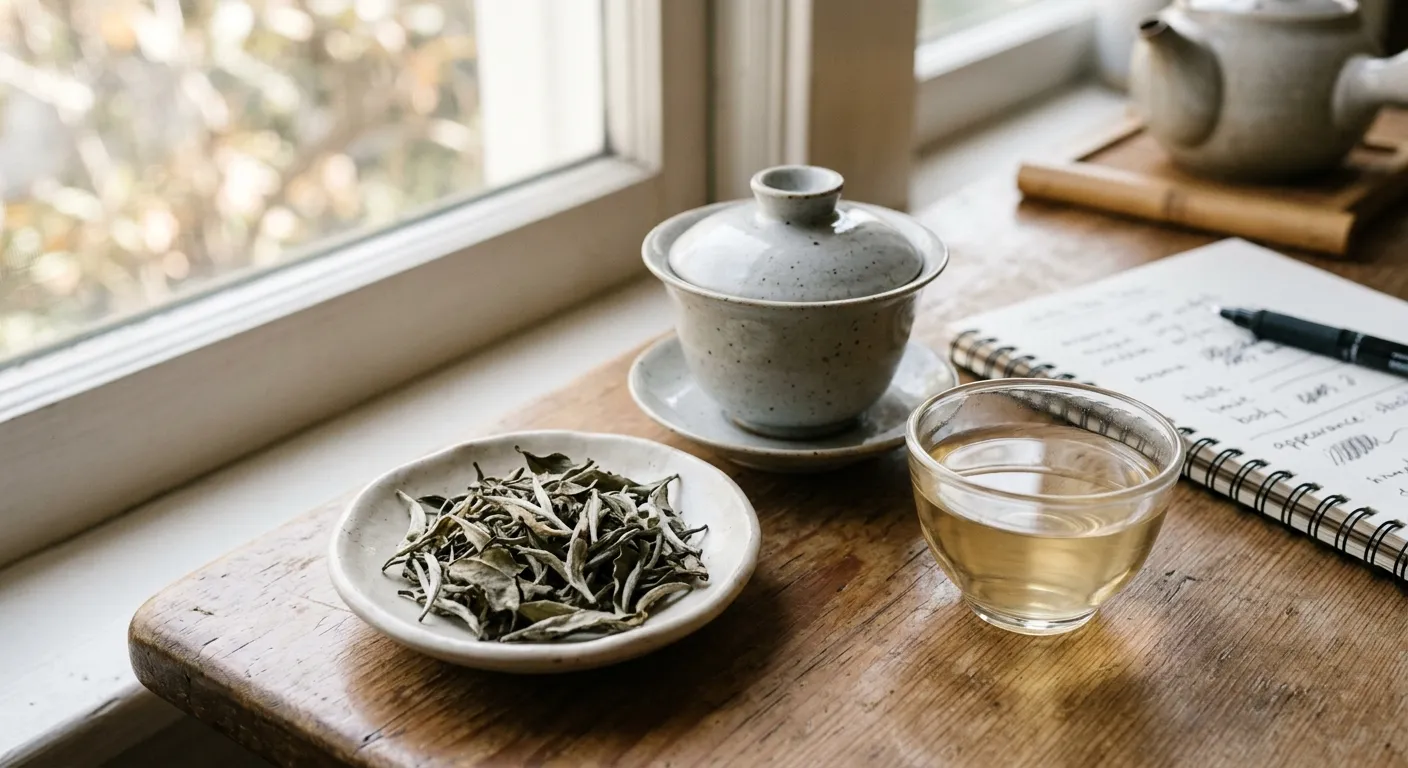
Many white teas show visible buds, open leaves, fine down on buds, uneven natural shapes, or a loose structure rather than tightly rolled pellets or heavily twisted leaves. Mature-leaf white teas may look broader, flatter, and more mixed in color. Bud-heavy teas may look pale, silvery, or downy. These signs can support the idea of restrained shaping, but they do not prove every processing detail.
Then smell the dry tea
Younger white tea may suggest hay, dried grass, wildflower, melon rind, light honey, cucumber skin, or soft herbs, depending on the material and storage. Aged white tea may move toward dried fruit, date, wood, leaf litter, or warm grain notes. These are tasting cues, not guarantees. Poor storage can flatten or distort aroma even if the tea was gently made.
Watch the infusion
Many white teas open gradually. Some need enough leaf and time before they show body. A pale liquor is not automatically weak; bud-heavy teas can be light in color and still aromatic. At the same time, a watery cup may point to too little leaf, water that is too cool, too short a steep, old stock, or leaf material with limited depth.
The point is not to force one profile onto all white teas. Ask whether the tea behaves like something shaped by withering, drying, and gentle transformation rather than heavy roast, deep rolling, or a strongly fermented character.
What changes the answer
Compared with many green teas
The difference is often discussed through heat treatment and fresh-leaf character. Green tea is commonly framed around keeping a greener profile, while white tea is usually discussed through withering and drying. That comparison is helpful, but not every green tea or white tea fits a neat rule.
Compared with oolong or black tea
White tea is usually described with less emphasis on bruising, rolling, oxidation control, roasting, or shaping. Its processing language tends to be quieter: wither, dry, preserve a gentle aromatic range.
Compared with dark or post-fermented teas
White tea should not be described as if it follows the same production logic. Aged white tea can change in storage, and compressed white tea cakes do exist, but aging after production is not the same as being made as a dark tea from the beginning.
Loose leaf and compressed cakes
Form also matters. Loose white tea and compressed cakes can behave differently in brewing and storage. Pressed cakes require additional handling compared with loose leaf, so calling all white tea “untouched” is especially weak when compression is involved.
How marketing language overstates it
White tea labels and product pages often use words that feel reassuring: natural, pure, raw, clean, untouched, ancient, simple. Some may be casual shorthand for restrained handling, but they are not evidence by themselves.
A better reading is to separate processing information from mood language.
Processing information
Processing information may mention leaf grade, harvest season, withering, drying, loose or compressed form, storage, origin context, or an age claim. Even then, the details should be plausible and consistent with the tea in front of you.
Mood language
Mood language makes the tea sound desirable without giving much to verify. Words like “pure” or “least processed” may sound attractive, but they do not tell you how the leaves were withered, how they were dried, how they were stored, or whether the tea will taste balanced.
For a buying decision, ask:
- Does the seller identify the white tea type or leaf grade clearly?
- Do the dry leaves look consistent with the described style?
- Is the aroma clean, lively, and suitable for the tea’s age?
- Does the infusion gain body after you adjust leaf amount and steep time?
- Are age, storage, and origin claims explained with context?
- Is “minimally processed” being used as a processing clue, or as vague superiority language?
If a description offers only romantic wording and no concrete tea information, treat the minimal-processing claim as incomplete.
A practical way to use the idea
The phrase is still useful when kept in its proper place. It can help explain why many white teas taste gentle, open, floral, hay-like, fruity, or softly sweet rather than sharply grassy, heavily roasted, or deeply malty. It can also explain why some white teas need patience in brewing: larger, less shaped leaves may release flavor more slowly than smaller broken leaves or more tightly worked teas.
When brewing, use the idea as a guide to observation. If the tea is bud-heavy and subtle, use enough leaf and give the first infusion time to open. If it is mature-leaf Shoumei, expect a broader, warmer cup and do not judge it by Silver Needle standards. If it is aged or compressed, a brief rinse or rest can help loosen the leaves before you judge the aroma and body across several infusions.
So, is white tea really minimally processed? In the careful tea-processing sense, yes, often. In the marketing sense that implies nothing meaningful happened between the bush and your cup, no. White tea depends on quiet, controlled handling, and that handling leaves traces you can look for in the dry leaf, smell in the aroma, and test in the brew.