
Brewing variable
How Water Temperature Changes White Tea Flavor
Change only the water temperature, and the same white tea can seem like a different cup.
Cooler water often makes white tea feel gentler: softer aroma, lighter body, less sharpness, and a sweetness that may feel more delicate than obvious. Hotter water often gives the cup more force: stronger aroma, fuller body, quicker bitterness or astringency, and a finish that can turn brisk, dry, or sharp if the leaf is pushed too far.
That is the practical answer to water temperature white tea flavor: temperature changes how quickly the cup develops and which sensations become most noticeable. The result is not fixed. Leaf grade, harvest style, age, storage, vessel, water quality, and steep time can all shift the balance.
upward
Start with the broader guide
Use the broader guide first if you need the full scope before this page.
Start with the same leaves and change only the heat
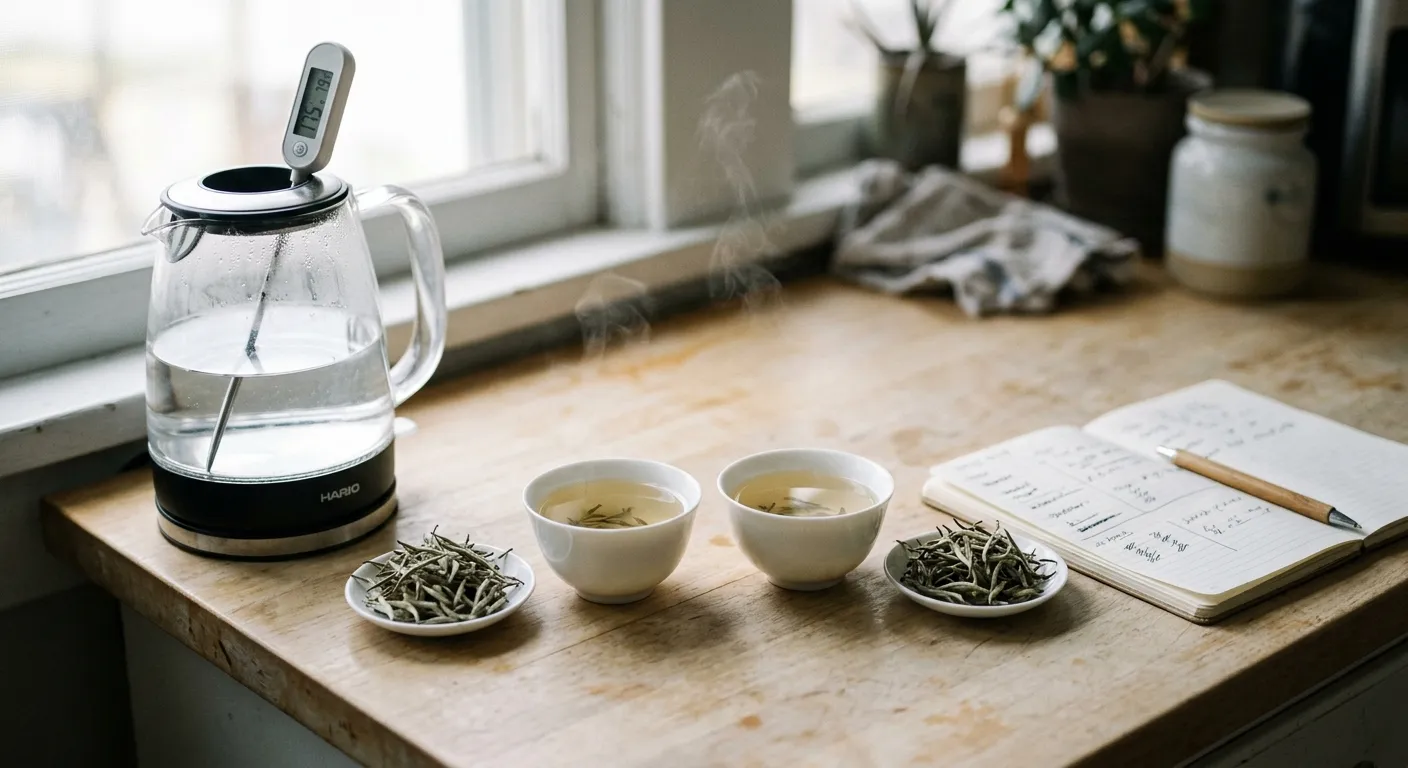
The clearest way to understand white tea brewing temperature taste is not to memorize one rule. It is to compare two cups with as few moving parts as possible.
Use the same white tea leaves, the same vessel, the same water amount, and the same steep time. Change only the water temperature. If you also change leaf quantity, steep longer, switch vessels, or pour from a kettle that cools differently, you may still learn something, but you will no longer be looking mainly at temperature.
Tea leaves
Same tea, same weight or measured portion.
Vessel
Same cup, gaiwan, teapot, or infuser.
Water volume
Same amount of water.
Steep time
Same timing.
Temperature
The one variable you intentionally change.
Taste the cups side by side if possible. If not, take quick notes right after each cup: aroma, perceived sweetness, bitterness, astringency, body, aftertaste, and whether the tea feels thin, soft, full, harsh, or muted.
This kind of same leaves temperature comparison is more useful than asking whether white tea “should” always be brewed cool or hot. Silver Needle, White Peony, Gongmei, Shoumei, loose leaf, compressed cakes, fresh tea, and aged tea can all respond differently. Even within the same named style, storage and handling can change how the cup behaves.
What cooler water can bring out
Cooler water is often chosen when a drinker wants to protect delicacy. In the cup, that can mean a softer opening aroma, a lighter liquor, a gentler finish, and less immediate dryness.
If a white tea has fine buds, downy texture, pale floral notes, or quiet sweetness, lower heat may help those features stay visible. The cup may feel less crowded by bitterness, roughness, or dry edges.
This is where “low temperature white tea sweetness” needs careful wording. Cooler water does not add sweetness to the leaf. It may simply make bitterness or astringency less dominant, so the existing sweetness is easier to notice. Depending on the tea, that sweetness might suggest light honey, soft grain, fresh hay, or a clean aftertaste.
Cooler brewing can make sense when
- the cup tastes sharp even with a short steep;
- the aroma seems delicate and easily covered;
- the tea becomes drying before it becomes flavorful;
- a young or tender white tea feels more graceful with gentler handling;
- you want to compare fragrance and finish rather than strength.
The tradeoff is thinness. Cooler water can make white tea taste clean but underdeveloped. The liquor may look pale, smell pleasant, and still feel hollow. The finish may disappear quickly. If that happens, temperature may be only one part of the problem. The steep may be too short, the leaf amount too light, the vessel too cool, or the tea itself mild.
When the cup feels flat, do not jump straight to the hottest water. Try a small increase in heat, a slightly longer steep, or a little more leaf. Change one factor at a time if you want to know what helped.
What hotter water can bring forward
Hotter water often makes white tea feel more expressive and more physical. The aroma may rise faster. The liquor may feel fuller. The aftertaste may lengthen. A compressed or older white tea may seem more open after stronger heat, especially if the leaves are dense, mature, or slow to loosen.
This is the appealing side of warmer brewing: more presence. White tea body and temperature are closely linked in the drinker’s experience, even when the exact cause is not being measured. A hotter cup can feel thicker, deeper, and more satisfying when the tea has enough material to support it.
But hot water white tea bitterness is a common troubleshooting point. Higher heat can also make roughness appear quickly. The cup may become drying on the tongue, pointed at the back of the throat, or bitter enough that sweetness becomes harder to find. Some drinkers call this “scorched” or “harsh,” though those words can mean different things in different cups.
Hotter water may help when
- the tea smells closed or muted;
- the body feels too thin;
- a compressed piece is slow to open;
- an aged or more mature white tea tastes dull with gentler brewing;
- the finish is clean but too short.
Hotter water may be too much when
- bitterness arrives before aroma;
- the finish becomes dry and gripping;
- floral or soft notes collapse into a rough edge;
- the tea tastes stronger but not more detailed;
- the second or third sip feels less pleasant than the first.
The useful question is not “Is hot water bad for white tea?” It is: does this temperature reveal more of this tea, or does it push the cup toward bitterness and dryness?
Aroma, sweetness, bitterness, body, and delicacy do not move together
Temperature changes white tea sweetness, bitterness, aroma, body, and delicacy in overlapping ways. They do not all improve at the same time.
A slightly warmer cup may give a clearer aroma but more astringency. A cooler cup may feel sweeter but lose body. A hotter infusion may make an aged tea more rounded while making a tender bud tea feel sharp. A lower-temperature cup may seem elegant in the first infusion and too weak later.
Aroma
Does the smell become clearer, warmer, more floral, more grassy, more honeyed, or simply stronger?
Perceived sweetness
Is sweetness easier to notice, or is it hidden behind bitterness and dryness?
Bitterness
Does bitterness add structure, or does it dominate?
Astringency
Does the finish feel clean and lightly drying, or rough and gripping?
Body
Does the liquor feel thin, silky, round, weighty, or heavy?
Delicacy
Are the subtle notes still visible, or has the brew become loud but less precise?
This is why white tea aroma and temperature should not be judged only by the first smell from the cup. A hotter infusion may smell stronger at first and still taste less balanced after three sips. A cooler infusion may smell quiet but leave a more graceful aftertaste. Both outcomes are possible.
Why the same temperature can behave differently
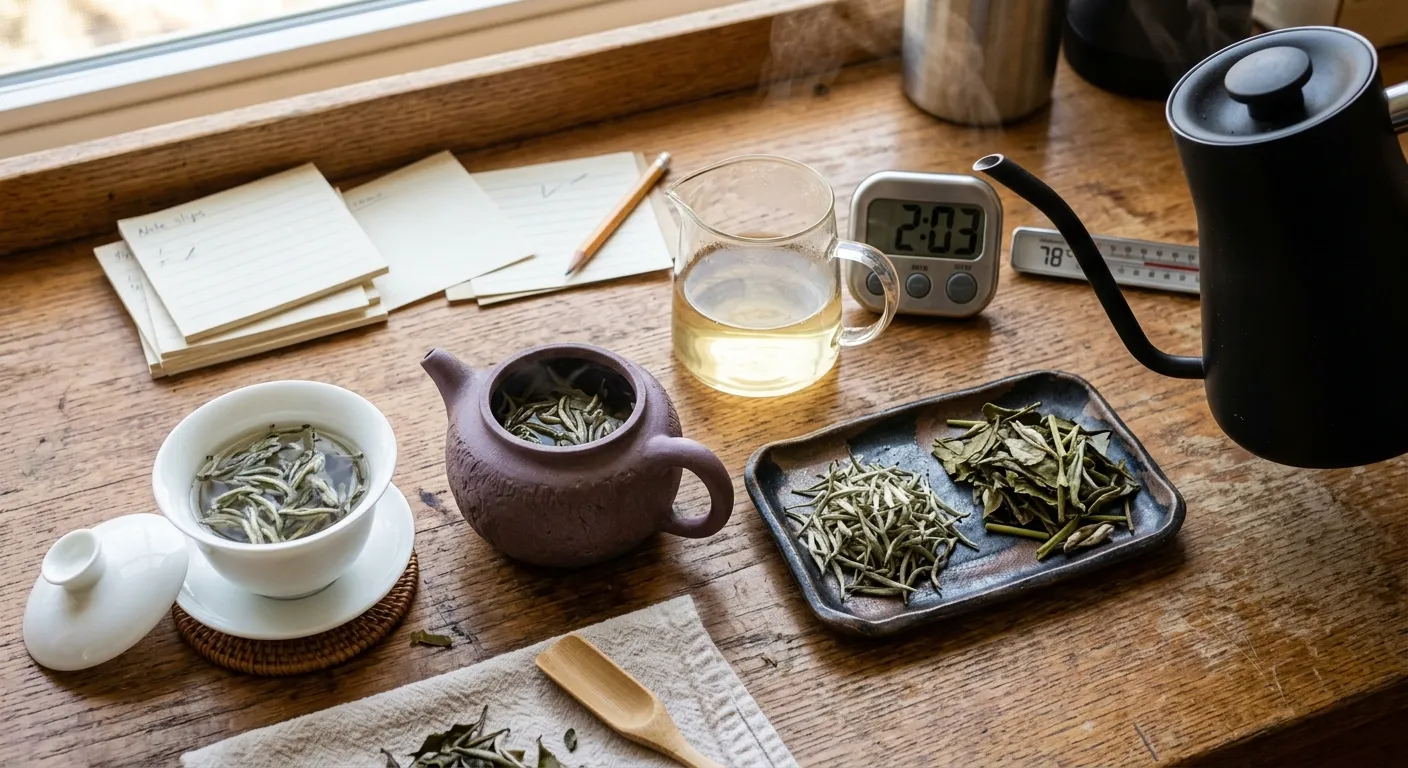
There is no single temperature rule that explains every white tea. The same heat can feel gentle with one tea and aggressive with another.
Leaf style matters
Bud-heavy teas, leaf-and-bud teas, mature leaf styles, broken leaves, and compressed tea do not present the same surface area or density. An open leaf may give flavor quickly. A tight cake piece may need more time or heat to loosen.
Harvest and processing style matter
White tea is often described as minimally processed, but that does not mean every batch behaves the same way. Withering, drying, leaf maturity, and handling can influence how the leaf expresses itself in the cup. For a specific tea, it is better to describe what you taste than to assume one fixed cause.
Age and storage matter
A fresh white tea may emphasize pale florals, hay, freshness, or gentle sweetness. An aged white tea may show deeper, warmer, or dried-fruit-like impressions, depending on the tea and its storage. Poor storage can also create dull, stale, sour, or musty impressions that temperature will not really solve.
The vessel matters
A thin porcelain gaiwan, a thick teapot, a glass mug, and a basket infuser can hold and lose heat differently. If your white tea tastes sharp in one vessel but not another, water temperature may not be the only difference.
Water quality matters
The same leaves can taste clearer, flatter, sharper, or heavier depending on the water. This is not a water chemistry guide, but for practical tasting, water should not be ignored.
Steep time matters as much as temperature
A cooler long steep can become more intense than a hotter very short steep. A short hot infusion may be vivid but balanced. If a cup disappoints, look at temperature and time together.
If the cup tastes too flat or too sharp
Most temperature adjustments begin with one of two complaints: the white tea tastes too flat, or it tastes too sharp.
If the cup tastes too flat, ask
- Did the leaves fully wet and open?
- Was the vessel very cold?
- Was the steep time unusually short?
- Did the tea smell good but taste hollow?
- Would a small increase in temperature bring more aroma and body?
A flat cup is not always underheated. It can also come from too little leaf, weak water, a large mug with too much water, tired leaves, or tea that has lost freshness. But if the other variables seem steady, warmer water is a reasonable next test.
If the cup tastes too sharp, ask
- Did bitterness arrive immediately?
- Is the drying feeling stronger than the aroma?
- Does the aftertaste feel rough rather than clean?
- Did a delicate tea lose its softer notes?
- Would slightly cooler water make sweetness easier to notice?
A sharp cup is not always overheated. It may be over-steeped, heavy in broken leaf, stored poorly, or simply not to your taste. Still, reducing temperature is one of the cleanest adjustments because it changes the cup without changing the tea itself.
Avoid overcorrecting. If a cup is flat, do not make every variable stronger at once. If it is sharp, do not weaken every variable at once. Adjust heat first, then taste again.
A practical way to compare white tea temperatures
Choose one white tea and brew two small cups.
- Measure or visually divide the same amount of leaf for each cup.
- Use the same vessel type and water volume.
- Brew one cup with gentler water and one with hotter water.
- Keep the steep time the same.
- Smell first, then sip each cup while warm.
- Return after a few minutes and taste again as the liquor cools.
Useful note style
- “Cooler cup: softer aroma, pale sweetness, thin body, clean finish.”
- “Hotter cup: stronger aroma, more body, more bitterness, drier aftertaste.”
- “Cooler cup: too quiet.”
- “Hotter cup: more interesting but slightly sharp.”
This small exercise makes practical white tea brewing temperature less abstract. You are not trying to prove a universal rule. You are learning how one tea responds in your vessel, with your water, at your table.
If you brew with multiple short infusions, you can also adjust across rounds. A gentle first infusion may preserve delicate aroma. A warmer later infusion may help the leaves open. Or the reverse may be better if the tea starts sharp and settles later. White tea cup level experience is often built from these small corrections, not from one fixed instruction.
What this answer can and cannot do
This article stays at the cup level. It does not give exact temperature ranges, chemical thresholds, or claims that a hotter or cooler cup changes white tea’s health effects.
The practical guidance is narrower: compare the same leaves under controlled brewing conditions, then observe aroma, perceived sweetness, bitterness, astringency, body, delicacy, and aftertaste. Temperature can be a powerful lever, but it is not the only one.
A useful working summary
- Use gentler heat when the tea needs softness, clarity, and less edge.
- Use stronger heat when the tea needs more aroma, body, and opening power.
- If the cup becomes thin, move a little warmer or steep slightly longer.
- If the cup becomes sharp, move a little cooler or shorten the steep.
Let the cup answer, not the rule.