
Comparison guide
White Tea vs Green Tea
People usually compare white tea vs green tea when they are trying to choose a first loose-leaf tea, fix a cup that tastes too thin or too sharp, or understand why two pale-looking leaves can brew so differently.
The useful answer is not that one tea is automatically better. The comparison changes with leaf style, processing, harvest material, water temperature, steep time, freshness, storage, and seller context.
Because no public, verifiable reference links are available for this draft, this article keeps health and chemistry claims narrow. White tea and green tea are often discussed around caffeine, polyphenols, and wellness language, but this page does not use those topics as buying promises. The comparison here stays close to what you can actually observe: dry leaf appearance, aroma, liquor color, brewed leaf texture, infusion strength, storage condition, and how the tea responds when you adjust brewing.
upward
Read the full overview first
Use the broader guide first if you need the full scope before this page.
White Tea vs Green Tea: The Basic Difference for Beginners
The basic white tea and green tea difference is usually described through processing and cup character. That helps, but the category name is not a complete verdict.
A label can tell you the broad family. It cannot tell you by itself whether the cup will be sweet, grassy, mellow, brisk, floral, nutty, thin, heavy, young, aged, carefully stored, or badly handled.
Four things to compare first
Dry leaf
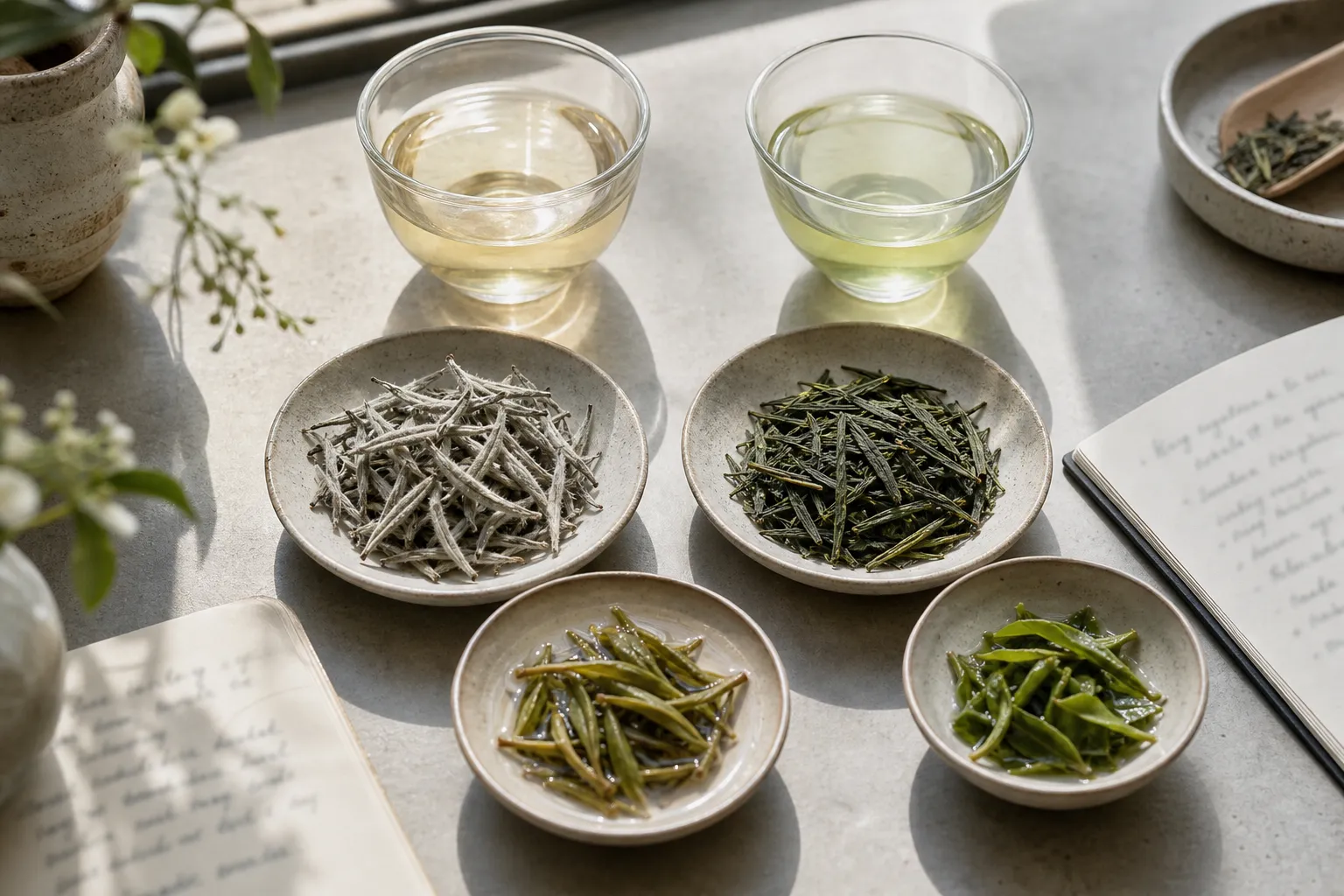
Notice buds, leaves, broken pieces, color range, visible down, twist, flatness, and compression. Leaf style affects how quickly flavor enters the water.
Aroma
Notice fresh, floral, hay-like, vegetal, toasted, marine, fruity, woody, or muted notes. Aroma often gives a warning before the first sip.
Brewing response
Watch how the tea changes with hotter water, more leaf, or longer time. Some teas become fuller; others turn sharp or flat.
Storage condition
Check freshness, seal, humidity exposure, age claim, and seller clarity. Storage can change aroma, texture, and confidence in the label.
White tea compared to green tea often feels slower and softer in the cup, especially when brewed gently. Many green teas show a more immediate fresh-leaf character. That is a tasting frame, not a rule. A broken or heavily leafed white tea can brew strongly. A carefully brewed green tea can be mild. A stale example of either category can taste dull.
A better beginner question is not “Which tea is milder?” It is: “What leaf style am I holding, how was it stored, and how does it behave in my cup?”
Is White Tea Less Processed Than Green Tea?
White tea is often described as less handled than green tea, while green tea is often described through steps that preserve a fresh green character. That broad distinction is useful as an entry point, but it can become too blunt.
“Less processed” can make white tea sound simple, passive, or automatically superior. It is not that simple. A lightly handled leaf still depends on plucking material, withering conditions, drying, sorting, storage, and time. Green tea also should not be reduced to one method or one flavor. Shape, style, origin, freshness, and brewing can change the cup widely.
Questions to ask when reading a processing claim
- Does the dry leaf look whole, broken, bud-heavy, leaf-heavy, flat, curled, twisted, or compressed?
- Does the aroma lean fresh, floral, vegetal, sweet, toasted, hay-like, woody, or muted?
- Does the tea open slowly across several infusions, or does most flavor arrive quickly?
- Does the brewed leaf look tender and intact, or chopped and exhausted after a short steep?
- Does the seller describe harvest, origin, storage, and age in a way you can check against the leaf?
For white tea drinkers, this matters because the word “white” can make people expect extreme delicacy. Some white teas are quiet and pale when brewed lightly. Others can be thick, sweet, herbaceous, fruity, woody, or drying, especially with more leaf, hotter water, longer time, or age.
For green tea drinkers, the word “green” can make people expect only grassy or sharp flavors. In practice, brewing choices and leaf style can soften, sweeten, or deepen the cup.
Processing gives the starting point. The cup gives the correction.
White Tea vs Green Tea Taste: What Changes in the Cup
The most useful white tea vs green tea taste comparison happens in three stages: smell the dry leaf, taste the first infusion, then adjust one variable at a time.
White tea often invites slower attention. In many cups, its appeal may come from light body, soft sweetness, floral lift, hay-like warmth, or gradual change over several steeps. Bud-heavy white teas may feel pale and silky when brewed gently. Leafier white teas may show more body and darker aromatics. Stored white tea may move away from fresh floral notes toward dried fruit, herb, wood, or honeyed impressions, depending on the tea and storage.
Green tea is often approached for freshness, clarity, and a more immediate leaf-driven taste. It may show vegetal, nutty, marine, toasted, sweet, floral, or brisk qualities depending on style and brewing. If brewed too hot or too long for the particular leaf, some green teas can become sharp, drying, or heavy in the finish. That does not make green tea inherently harsh. It means the brewing setup is part of the taste.
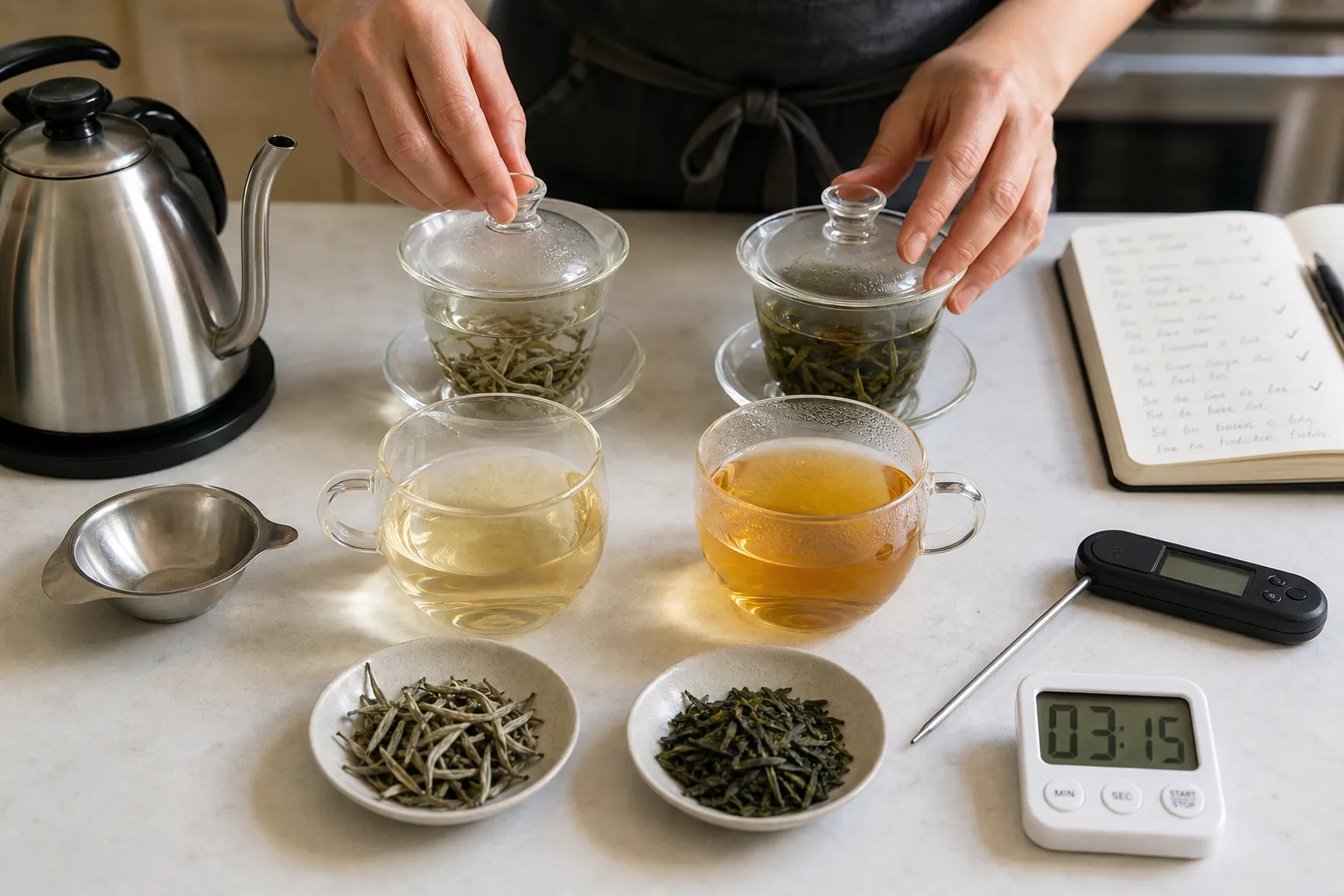
When comparing side by side, do not force both teas into the same method at first. A fair comparison is not always identical treatment. It is controlled observation.
A controlled tasting structure
- Use similar cup size and water quality.
- Start with moderate leaf amounts.
- Brew each tea gently first.
- Smell the lid, cup, and wet leaf before judging.
- Increase time or temperature only after the first impression.
- Note whether the tea gains sweetness, bitterness, aroma, body, or dullness.
The question is not only “Which tastes better?” It is “Which tea gives the kind of cup I want today?” A green tea may suit someone who wants a clear, fresh, direct infusion. A white tea may suit someone who wants a softer beginning and a slower unfolding cup. Those are tendencies, not fixed rules.
Why White Tea Often Looks Different from Green Tea
White tea vs green tea color can confuse beginners because the names sound as if they should predict the liquid exactly. In practice, color appears in three places: dry leaf, liquor, and brewed leaf.
Dry white tea may show pale buds, silvery down, green-gray leaves, brownish tones, or mixed shades depending on grade, leaf material, age, and storage. Some white teas look fluffy and loose. Others are leafier, darker, or compressed. A white tea cake can look very different from a loose bud tea.
Dry green tea often signals freshness through greener visual cues, but green tea is not one uniform look. Shape, color, gloss, breakage, and aroma should be read together. A vivid dry leaf is not proof of good taste by itself, and a dull-looking leaf is not enough information without aroma, storage, and brewing response.
Liquor color is also easy to overread. A pale cup does not automatically mean weak tea, and a deeper cup does not automatically mean better extraction. White tea liquor may be very light, golden, amber, or deeper depending on leaf style, age, amount, water temperature, and time. Green tea liquor can also range from pale to more saturated. Cloudiness, dullness, or a flat aroma may matter more than color alone.
Brewed leaf is often more revealing than the liquid. After steeping, look at how evenly the leaves opened, whether they seem tender or fragmented, and whether the aroma remains pleasant. If the wet leaf smells stale, sour, musty, smoky in an unintended way, or lifeless, the issue may not be the tea category. It may be storage, handling, age, or simply a tea that does not suit your preference.
Color helps. Aroma and brewing behavior help more.
White Tea vs Green Tea Brewing Temperature
White tea vs green tea brewing temperature is one place where beginners get mixed advice. Some instructions keep both teas gentle. Others recommend hotter water for certain white teas, especially leafier or stored examples. Without stronger source support here, a universal temperature rule would be too confident. The practical answer is to test carefully.
The same water can taste different because leaf structure, age, shape, and brokenness affect how quickly flavor releases. A tender green tea may become unpleasant if pushed too hard. A sturdy white tea may taste thin if the water is too cool or the steep too short. A bud-heavy white tea may need patience rather than force. A leafier white tea may welcome a slightly stronger approach.
Can you brew white tea like green tea? Sometimes, yes. Lower temperature, moderate time, and a light hand can protect aroma while you learn the leaf. But if the white tea tastes watery after several attempts, treating it exactly like a delicate green tea may be the problem. Increase one variable at a time.
Adjust one variable at a time
Thin, quiet, watery
Add time before adding heat. Watch whether sweetness appears, or only dryness.
Fragrant but weak
Add a little more leaf. Watch whether body improves without roughness.
Sharp or drying
Shorten time or cool the water. Watch whether aroma remains while the edge softens.
Flat or stale
Smell dry and wet leaf again. The issue may be storage, not brewing.
Good first cup, weak later
Extend later steeps. Some leaves release slowly.
This works better than memorizing one number. Green tea and white tea are not competing under one rigid rule; each is being read through its own response.
Is White Tea Milder Than Green Tea?
White tea is often marketed or described as mild, and that can be true in many gentle brewing sessions. But “mild” needs a clearer meaning. It can refer to pale color, low bitterness, soft aroma, light body, gentle sweetness, or simply less intensity than expected.
Those are not the same thing.
A tea can be pale but aromatic. It can be light in body but drying in the finish. It can look delicate but brew strongly with more leaf. It can smell soft but taste woody or heavy after storage. Green tea can be brisk, but it can also be sweet, round, nutty, or quiet when the leaf and brewing method support that result.
Mild in which way?
- Mild color: the liquor looks pale.
- Mild aroma: the scent is quiet.
- Mild bitterness: the finish does not grip the tongue much.
- Mild body: the tea feels light rather than thick.
- Mild stimulation: this should not be assumed from category alone.
Caffeine and wellness comparisons need better sourcing than this draft has. Serving size, leaf amount, brewing strength, cultivar, harvest, and individual sensitivity can all complicate category-level claims. If you are comparing white tea and green tea for personal tolerance, treat the label as incomplete information and pay attention to your own serving size and response.
In ordinary tasting terms, white tea may be the easier first cup for someone who dislikes strong vegetal or brisk flavors. Green tea may be easier for someone who wants a clearer, fresher taste that announces itself quickly. Neither category is automatically gentler in every meaningful sense.
White Tea vs Green Tea for Beginners: Which Is Easier to Start With?
The easiest tea to start with is the one that gives clear feedback. For some beginners, that is green tea because changes in temperature and time show up quickly. For others, it is white tea because a gentle infusion may feel forgiving and less abrupt.
Choose white tea first if you want
- A slower cup that rewards repeated smelling and short notes.
- A softer entry into loose-leaf brewing.
- A category where bud-heavy, leafier, loose, and compressed styles can be compared over time.
- A reason to learn storage and age claims carefully.
Choose green tea first if you want
- A fresher-tasting cup with more immediate feedback.
- A brewing practice that teaches precision quickly.
- A wide range of leaf shapes and regional styles to explore later.
- A tea that often makes over-steeping easy to notice.
If you are buying your first examples, avoid building the comparison around the highest price tier. Buy small amounts, compare similar freshness claims, and read the seller’s description for concrete details rather than decorative language. A useful label should help you understand what the leaf is, how it was stored or packed, and how to brew it.
For white tea, be cautious with age language. An older tea is not automatically better, and an age claim is not the same as good storage. For green tea, freshness language can also be overused. “Fresh” should still be checked against aroma, packaging, leaf condition, and cup behavior.
A beginner does not need a final verdict. A beginner needs two honest teas, a notebook, and a habit of changing only one brewing variable at a time.
White Tea vs Green Tea Price: Why Similar Leaves Can Cost Different Amounts
White tea vs green tea price is shaped by more than category. Similar-looking leaves can cost different amounts because of leaf grade, harvest timing, origin claim, processing labor, sorting, scarcity, age claim, storage history, packaging, and seller positioning. Since this draft does not have source material to rank those factors by market weight, treat them as buyer questions rather than fixed pricing rules.
A high price can make sense in some contexts, but it is not proof by itself. A low price can be a good everyday find, but it may also reflect broken leaf, vague sourcing, old stock, or storage uncertainty. The category name should not do the seller’s work.
Before paying more, ask
- What exactly is the leaf style: buds, one bud with leaves, mature leaves, broken material, loose tea, or compressed tea?
- Is the harvest or production description specific enough to be useful?
- Does the aroma support the freshness or age story?
- If the tea is aged white tea, is storage described clearly?
- Are brewing instructions realistic, or are they vague sales copy?
- Can you buy a small sample before committing to a larger amount?
White tea buyers may see premium language around buds, age, origin, or rarity. Green tea buyers may see premium language around freshness, season, shape, or limited batches. Those cues are not meaningless, but they need checking. Look for alignment between description, appearance, aroma, and cup behavior.
The best value is not always the cheapest tea or the most prestigious one. It is the tea whose label, leaf, and brewed result make sense together.
White Tea vs Green Tea Storage: Which One Changes More Over Time?
White tea vs green tea storage is one of the most important practical differences for a white tea-focused reader, but it needs careful wording. This page should not promise specific aging outcomes. It can give a practical storage lens.
Green tea is commonly valued for fresh aromatic qualities, so buyers often pay close attention to recent production, sealed packaging, and stale aromas. White tea, especially some leafier or compressed examples, is often discussed in relation to longer storage and change over time. But “can change” is not the same as “will improve.” Poor storage can damage tea in any category.
Storage cues for both categories
- Clean, dry storage.
- Protection from strong odors.
- Sensible packaging.
- Aroma that still feels alive.
- No musty, sour, or unpleasant storage smell.
- Seller language that separates age, storage, and quality.
Fresh white tea vs fresh green tea is a useful comparison because it removes some of the age confusion. When both are new-season teas, focus on dry leaf aroma, first infusion clarity, texture, and aftertaste. Does the white tea feel soft, floral, sweet, grassy, hay-like, or thin? Does the green tea feel fresh, vegetal, nutty, marine, sweet, brisk, or sharp? Which one changes more pleasantly when you adjust the brew?
For stored white tea, ask a different question: does age add depth, or does it only add darkness and a tired smell? A deeper color alone is not enough. The cup should still give a reason to keep drinking.
White Tea vs Green Tea Misconceptions
Processing is not destiny
If white tea is described as less handled, some readers may assume it is automatically more natural, better, or gentler. That does not follow. Processing style is only one part of quality and taste.
Green tea is not one flavor
Green tea can sound narrow if someone has only tasted a harsh or over-brewed example. Brewing method, leaf style, and freshness can change the cup substantially.
Color is not the same as strength
Pale liquor can still have aroma and finish. Darker liquor can be satisfying, over-extracted, aged, or simply brewed with more leaf. Color matters most when paired with smell and taste.
Wellness language is not a buying shortcut
This article does not make health-outcome claims for either category. If category-level promises are used to sell tea, separate them from observable tea quality. For choosing a daily cup, flavor, brewing comfort, storage confidence, and honest labeling are more useful.
A final trap is asking which tea is better before asking what you want from the session. White tea and green tea can both be excellent, ordinary, stale, overpriced, carefully made, badly brewed, or personally unsuitable. The category opens the door; the leaf in front of you decides the conversation.
A Practical Way to Compare Your Next Two Teas
If you have one white tea and one green tea at home, compare them without trying to crown a winner.
- First, smell both dry leaves in a warm cup. Write down concrete words: floral, grassy, sweet, toasted, hay-like, nutty, woody, marine, stale, sharp, soft, clean, muted. Avoid quality judgments until after brewing.
- Second, brew each tea gently. Use the same cup size if possible, but do not insist that identical water and time are always fair. Start mild, taste, then adjust. If the green tea becomes sharp quickly, shorten the next steep. If the white tea tastes too quiet, extend the next steep or add slightly more leaf.
- Third, inspect the brewed leaves. Whole leaves, broken pieces, tenderness, aroma, and the way the leaf opens can teach you more than the name on the bag.
- Fourth, decide by use case. Choose by the session you want rather than by a universal category ranking.
- For a fresh, direct cup, you may reach for green tea.
- For a slower, softer session, you may reach for white tea.
- For learning temperature control, either can teach you, though green tea may show errors quickly.
- For learning storage and age claims, white tea often raises more buyer questions.
- For everyday value, judge the specific tea rather than the category.
The strongest answer to white tea vs green tea is not a universal ranking. It is a reading method: look closely, brew carefully, adjust one variable, and distrust any label that asks you to stop paying attention.