
White Tea Temperature and Time by Leaf Type
Dry buds, open leaves, broken edges, and pressed pieces do not take up water at the same pace. That is why white tea temperature and time by type works best as a starting range, not a fixed recipe.
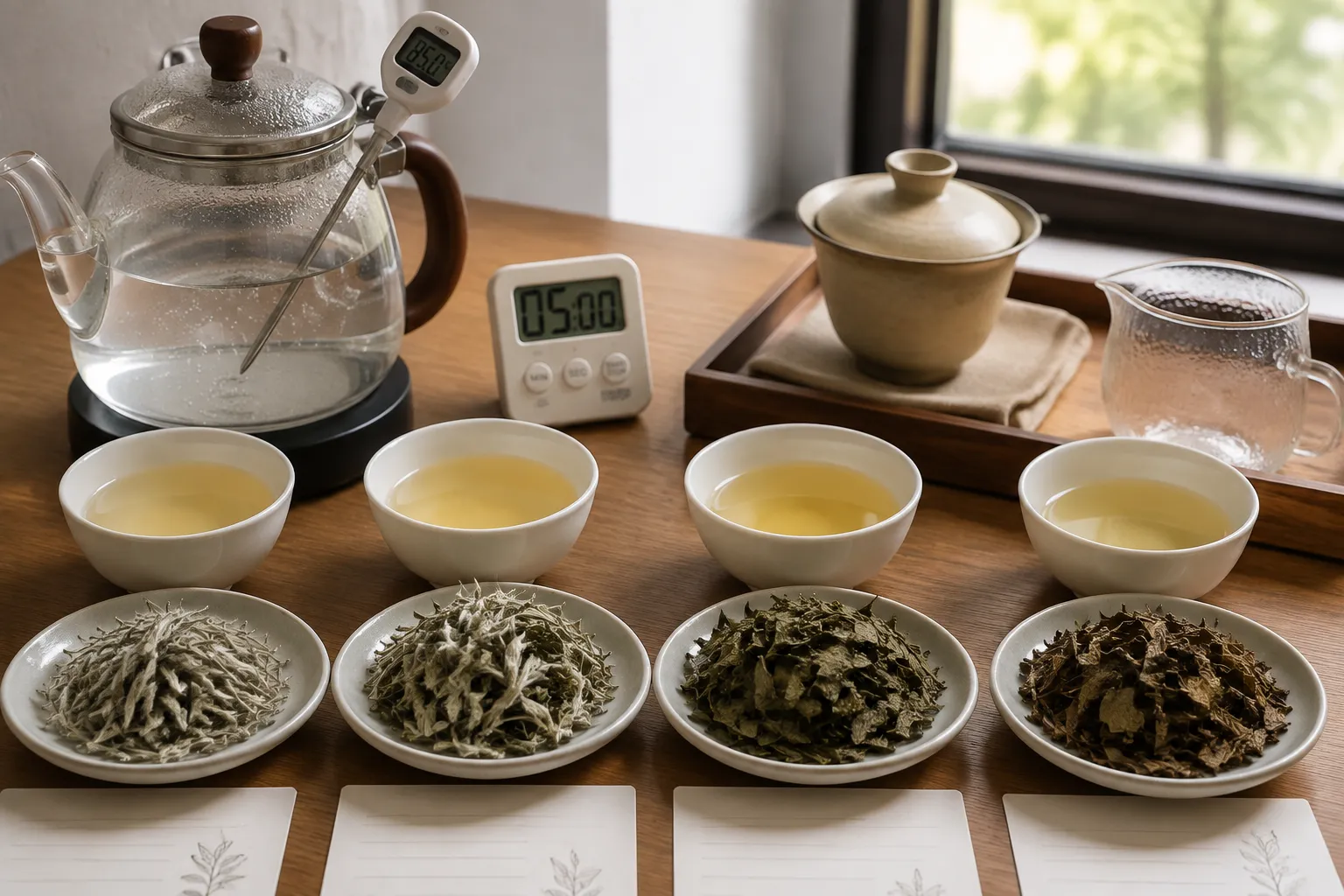
For a first cup, start here: Silver Needle around 80-90°C for 30-60 seconds gongfu or 3-5 minutes Western style; White Peony around 85-95°C for 25-60 seconds gongfu or 3-4 minutes Western style; Gongmei around 90-95°C for 20-45 seconds gongfu or 3-5 minutes Western style; Shoumei around 90-98°C for 15-45 seconds gongfu or 3-5 minutes Western style. If the cup tastes thin, raise the heat or lengthen the infusion. If it turns harsh, drying, or flat in fragrance, pull one of them back.
upward
Start with the broader guide
Use the broader guide first if you need the full scope before this page.
White tea brewing chart by leaf type
Use this chart for the first steep. Gongfu brewing usually puts more leaf into a small gaiwan or pot, so the timing starts short. Western-style brewing uses less leaf for more water, so the infusion runs longer.
Silver Needle
Leaf structure: Mostly buds, often downy and slow to wet.
Gongfu starting point: 80-90°C, 30-60 seconds.
Western-style starting point: 80-90°C, 3-5 minutes.
What to watch: Pale liquor is normal, but the cup should not feel hollow.
White Peony
Leaf structure: Buds with young leaves, more open surface.
Gongfu starting point: 85-95°C, 25-60 seconds.
Western-style starting point: 85-95°C, 3-4 minutes.
What to watch: Fragrance, light body, and gentle sweetness should arrive together.
Gongmei
Leaf structure: Larger leaves, often more mature material.
Gongfu starting point: 90-95°C, 20-45 seconds.
Western-style starting point: 90-95°C, 3-5 minutes.
What to watch: Look for body without rough drying edges.
Shoumei
Leaf structure: Larger leaves, sometimes coarse, aged, or compressed.
Gongfu starting point: 90-98°C, 15-45 seconds.
Western-style starting point: 90-98°C, 3-5 minutes.
What to watch: Heat can help body, but broken leaves may turn sharp quickly.
These numbers are broad on purpose. Research on white-tea infusions supports the basic point that tea type, shoot tenderness, physical form, infusion time, and temperature affect what the water extracts. It does not give one universal best temperature for Silver Needle, White Peony, Gongmei, or Shoumei. Gongmei and Shoumei need the most caution because the actual leaf can vary widely: loose or pressed, young or aged, whole or broken.
If you remember only one adjustment, make it this: change one variable at a time. Keep the same leaf amount and vessel, then move either water temperature or infusion time after tasting.
Silver Needle steeping temperature is not always the coolest
Silver Needle is often described as fragile because it is bud-heavy and pale in the cup. Cooler water around 80-85°C can suit a fragrant, gentle style, especially when the buds are fresh-looking, lightly handled, and easy to wet. That approach often protects high notes, but it can also leave the infusion watery if the buds float, repel water, or open slowly.
A hotter Silver Needle approach can also make sense. Some downy buds are slow to sink; water around 90°C, even pouring, and gentle submersion can help when the cup smells sweet but tastes empty. That does not mean every Silver Needle should be pushed hot. It is a troubleshooting path, not a command.
For gongfu Silver Needle, start with 30-60 seconds. If the first infusion has aroma but little body, keep the same time and raise the temperature by a few degrees, or pour more directly across the buds so they wet evenly. If the cup becomes grassy, bitter, or drying, lower the heat before making the infusion extremely short; dense buds can stay under-extracted inside.
For Western style, 3-5 minutes is a reasonable starting band. A pale gold cup can still have good texture. Judge by aroma, mouthfeel, and aftertaste rather than color alone.
White Peony brewing time has a wider middle range
White Peony, or Bai Mu Dan, usually combines buds with young leaves. That mixed structure often extracts more readily than a bud-only tea, while still keeping a floral, hay-like, or lightly sweet side when handled gently. A useful first range is 85-95°C, with 25-60 seconds for gongfu and 3-4 minutes for a larger mug or pot.
This is also where advice often conflicts. Some brewing notes stay cooler and longer, aiming for softness and fragrance. A controlled Pai Mu Tan study found that 98°C for seven minutes did not automatically flatten one studied sample under its chemical and sensory evaluation goals. That is useful as a boundary: near-boiling water is not automatically destructive. It does not make 98°C for seven minutes the best everyday White Peony brewing time.
When White Peony tastes thin, check leaf amount first. Open leaves take up space quickly, so a casual spoonful may contain less tea than expected. If the ratio is reasonable, move the temperature toward 90-95°C or extend the infusion slightly. If the cup is fragrant but rough on the tongue, keep the temperature and shorten the next infusion by 10-15 seconds in gongfu, or by 30-60 seconds in Western style.
White Peony near boiling water can work for some leaves, especially when the goal is body and fuller extraction. For a first comparison session, start below boiling and move upward only if the cup asks for it.
Gongmei and Shoumei water temperature should follow the leaf
Gongmei and Shoumei are often discussed as larger-leaf white teas, but the names alone do not tell you how the tea will brew. A loose, intact Gongmei may behave differently from a compressed Shoumei cake with broken edges. Age, storage condition, compression, stems, and fragments can change how quickly the liquor becomes thick, sweet, woody, fruity, or drying.
For Gongmei water temperature, begin around 90-95°C. In gongfu brewing, try 20-45 seconds for the first infusion. In a Western-style pot, try 3-5 minutes. If the liquor is weak and the leaf remains stiff, extend time before jumping straight to boiling water. If the cup has body but leaves a dry edge, reduce time first.
For Shoumei water temperature, 90-98°C is a useful starting range because larger or older material often needs enough heat to show body. Start short in a gaiwan: 15-45 seconds, depending on leaf amount and compression. A tightly pressed piece may need a brief rinse or a slightly longer first infusion to loosen, while loose broken leaf can release quickly and turn rough if pushed too hard.
The evidence for exact Gongmei and Shoumei numbers is weaker than the evidence for the general extraction pattern. Treat the range as cautious starting advice. The cup should decide the second steep.
Why leaf structure changes infusion time
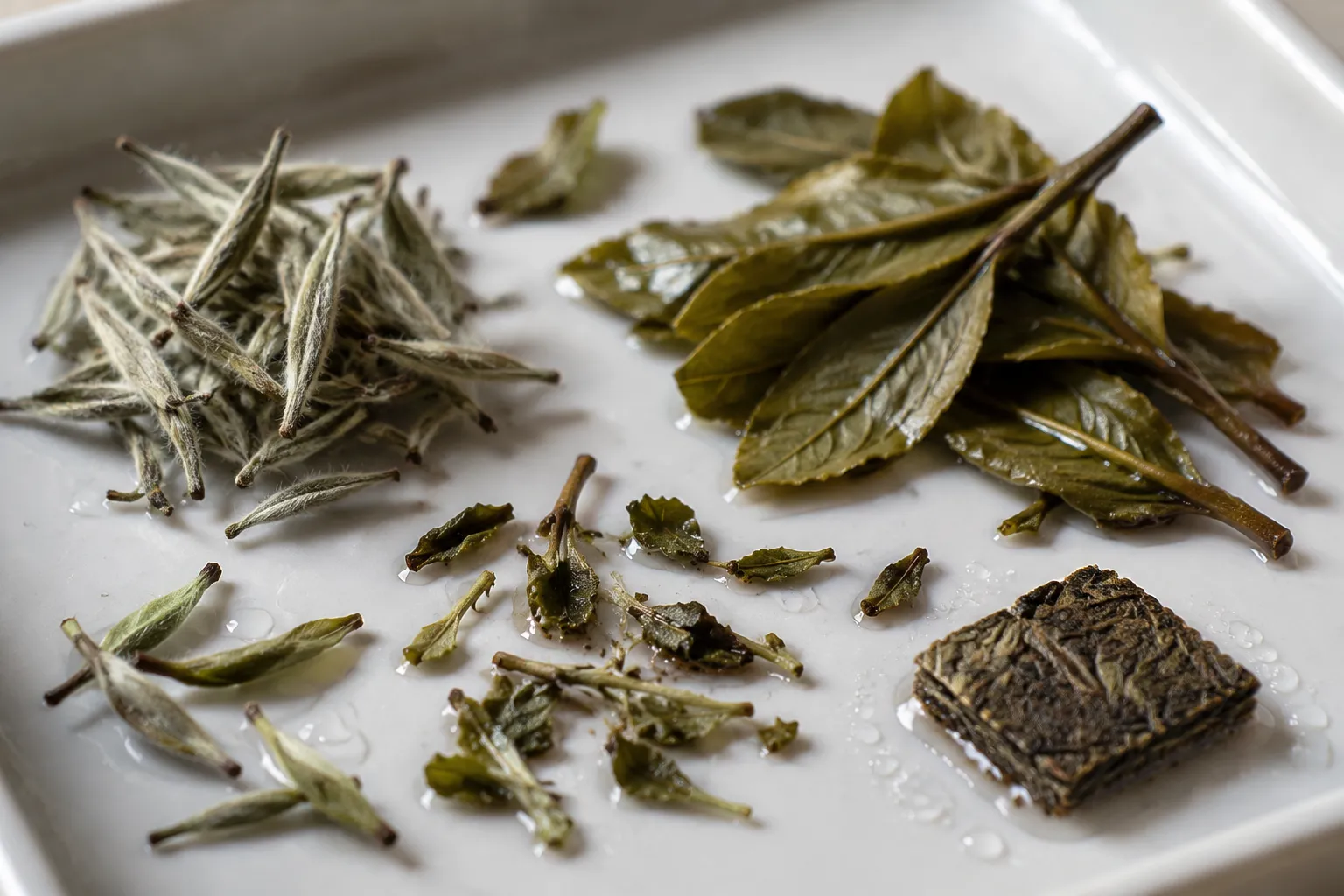
Leaf structure matters because water does not contact every surface equally. Buds may be dense and covered with fine hairs. Young open leaves expose more area. Broken pieces release quickly from damaged edges. Pressed tea may need time for water to reach the inner layers. These physical differences explain why white tea temperature by type is useful, but incomplete.
Time and temperature also work together. Hotter water usually extracts faster, so it often pairs with shorter gongfu timing. Cooler water usually needs more time, especially in a larger pot. A 30-second gaiwan infusion and a four-minute mug infusion are not contradictions; they belong to different leaf-to-water ratios.
Water composition, vessel material, and heat retention also matter. A thin porcelain gaiwan cools quickly. A larger glazed pot may hold heat longer. Very mineral-heavy or very soft water can shift aroma and body. These variables are not reasons to abandon the chart; they are reasons to adjust after tasting.
Thin or watery
This suggests more heat, more time, more leaf, or better wetting.
Heavy bitterness
This points toward too much extraction.
Drying astringency
This often means the time or temperature has gone too far for that leaf.
Loss of fragrance
This can mean the infusion is being pushed harder than the aromatics can carry.
Common confusion about hot water and white tea
The first confusion is that all white tea should be brewed cool. That is too simple. Cooler water can help fragrant buds and gentle cups, but it can under-extract dense Silver Needle or larger-leaf teas. Hotter water is a tool, not a mistake by itself.
The second confusion is that hotter water is always better because it extracts more. More extraction can bring body and sweetness, but it can also bring bitterness, roughness, or a flatter aroma. The best cup is not the one with the most extracted material; it is the one where fragrance, body, sweetness, and structure feel balanced to the drinker.
The third confusion is treating grade language as a recipe. Silver Needle, White Peony, Gongmei, and Shoumei are useful category names, and Fuding white-tea terminology often places them in a familiar comparison set. But a label cannot replace looking at the leaf. Whole buds, leafy pieces, broken fragments, pressed cakes, and storage aroma all change the next steep.
The fourth confusion is reading chemistry studies as home-brewing commands. Research on infusion variables helps explain why temperature and time matter. It does not make a single universally best recipe, and health-adjacent extraction measurements should stay out of the brewing decision. This page is about sensory extraction in the cup.
A simple adjustment path for the next steep
Start with the table, then taste before changing anything. If the cup is pale but aromatic and pleasantly sweet, stay close to the same range. Pale color alone is not failure, especially with Silver Needle.
- If the cup is thin, raise the temperature by 3-5°C or add 10-20 seconds in gongfu. For Western style, add 30-60 seconds. With floating buds, pour slowly across the surface and make sure the leaf is fully wetted before blaming the tea.
- If the cup is bitter, drying, or blunt, shorten the next infusion. If that does not help, lower the temperature slightly. For broken Gongmei or Shoumei, time often matters more than another small temperature change because exposed edges release quickly.
- If the aroma is good but the body is weak, add a little more leaf in the next session rather than stretching every infusion. Leaf amount, vessel size, water temperature, and timing work together; changing only time can make a fragrant tea taste stewed.
The useful range is the one you can repeat and adjust. Keep the leaf type in mind, read the surface of the brewed leaves, and let the next cup tell you whether to move heat, time, or ratio.
Sources
Sources and further reading
Reference links are limited to sources considered suitable for public citation in this page.