
How White Tea Is Processed
Look at finished Silver Needle or White Peony before the kettle boils: pale buds, soft leaf edges, fine down, uneven greens and silvers, sometimes a faint hay or dried-flower scent. Those surfaces come from white tea processing, not from a lack of craft. Fresh buds and leaves are selected, spread for withering, dried, and then sorted for sale.
The process is often called “minimal,” but that word can flatten the real work. White tea is usually handled less aggressively than many other teas, yet withering and drying still change moisture, aroma, oxidation, texture, and how the leaf opens in the cup. The useful question is not whether processing happened. It is what kind of processing the leaf seems to have gone through, and whether the seller’s language matches what you can see, smell, and brew.
upward
Read the full overview first
Use the broader guide first if you need the full scope before this page.
White Tea Production Steps from Fresh Leaf to Finished Tea
The basic path is short: plucking, withering, drying, and sorting. The difficulty sits inside those words.
Plucking
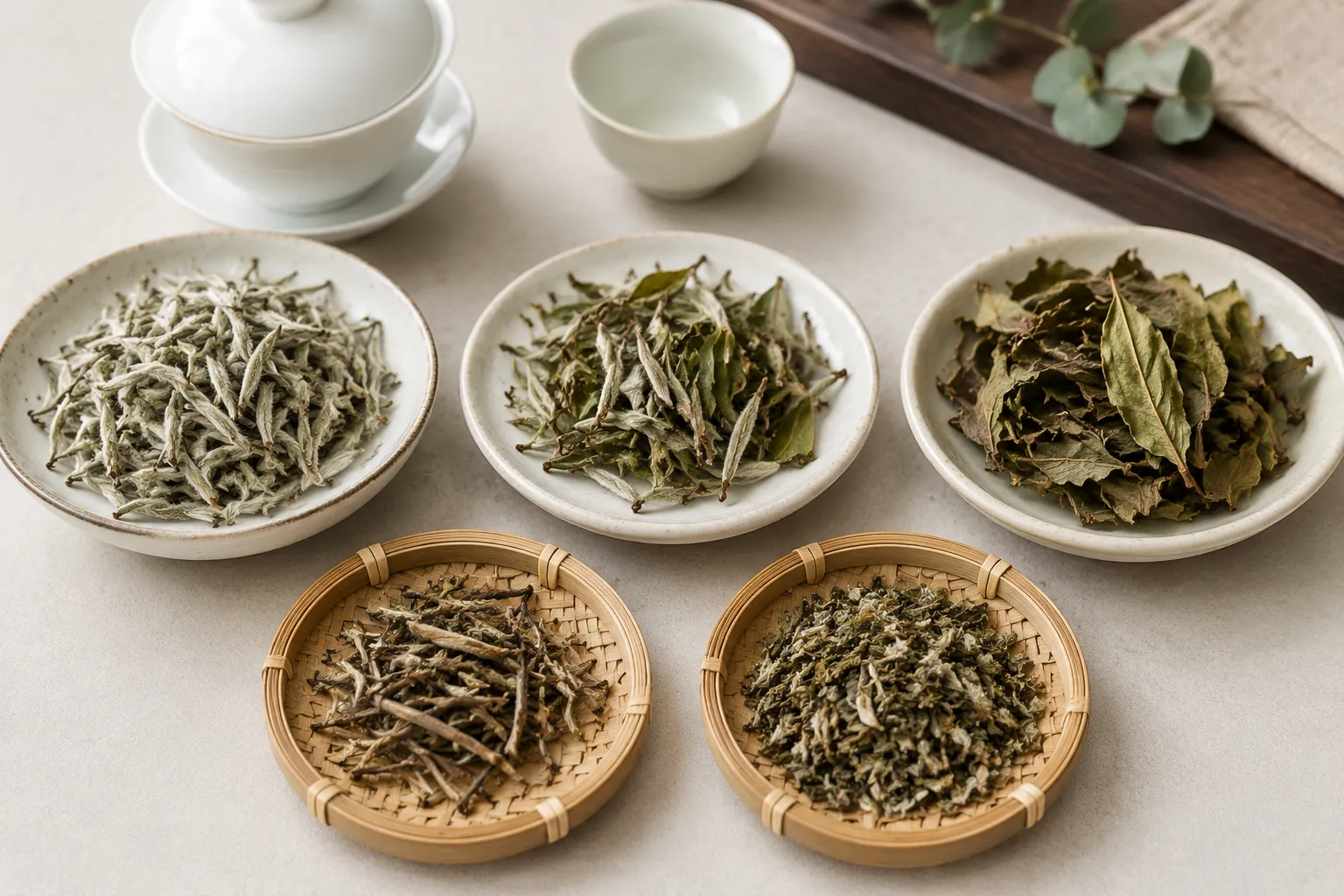
White tea plucking starts with the material. A bud-only tea such as Silver Needle depends on tender buds with fine down and relatively even maturity. White Peony uses a bud with one or two young leaves. Gongmei and Shoumei usually include more open leaf material and may look broader, looser, and darker. These names are not only label language; they point to the kind of fresh material the maker had to manage before withering began.
Withering
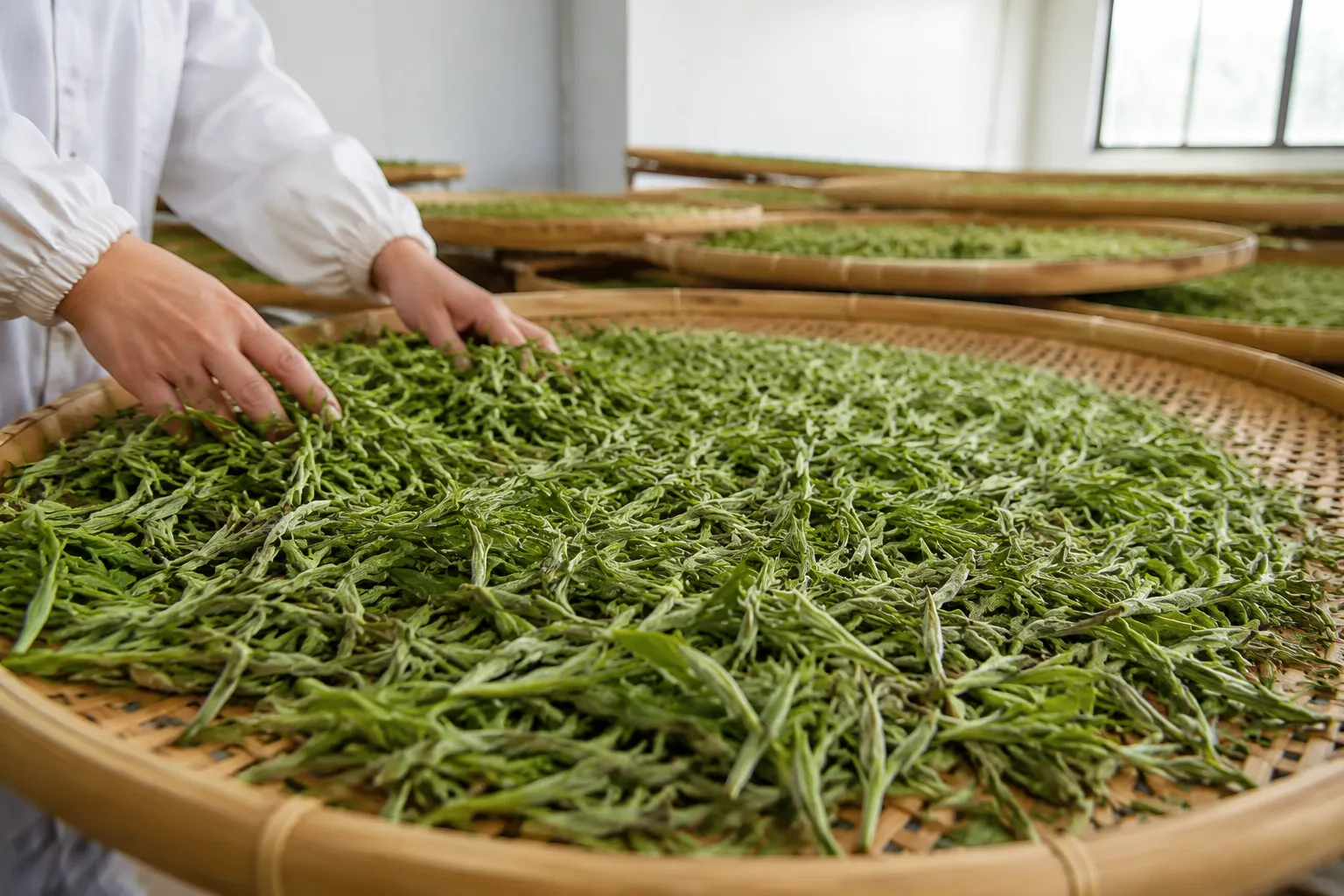
After selection, the fresh leaf is spread out. Withering reduces moisture and allows internal changes to continue while the leaf rests. Processing literature treats withering as a quality-forming stage in white tea, not just a passive wait. The leaf softens, grassy sharpness can ease, and aroma may develop differently depending on time, temperature, airflow, leaf thickness, and whether the wither uses sun, indoor air, or a combination of conditions.
Drying
Drying finishes the tea by lowering remaining moisture. General food-moisture guidance supports the broad point that available water affects stability, but that does not turn a tea page into a storage manual. For the drinker, the takeaway is narrower: drying matters because a tea left too damp may smell, store, and age differently from one that was finished more thoroughly. In the cup, the difference can show as clarity, aroma, and whether the leaf feels lively or dull.
Sorting
Sorting comes after the main processing. It can separate bud-heavy material from broken pieces, remove stems or fragments, or create a more even grade. Sorting cannot make weak fresh leaf excellent, but it can affect appearance, brewing evenness, and how confidently a buyer can read the batch.
Why White Tea Is Not Rolled Like Many Other Teas
Traditional white tea is commonly described as withered and dried, without the fixing and rolling steps used in many other tea styles. That is one reason the dry leaf often looks open, loose, and less shaped than green, oolong, or black tea.
Rolling matters because it ruptures leaf cells, changes contact between enzymes and plant compounds, and helps shape tea into strips, pellets, twists, or broken grades. In black tea production, rolling is part of a stronger path toward oxidation. In many oolongs, bruising and shaping are central to the style. White tea takes another route. It depends more on the condition of the plucked material and the slower management of withering.
For a buyer, the phrase “not rolled” is useful only when it stays tied to the leaf. Intact buds and open leaves fit the traditional processing idea. A heavily twisted, crushed, or pellet-like tea is not automatically poor, but the label deserves closer reading. Some modern or local variations may use handling that does not fit the simple textbook line. The better conclusion is restrained: rolling is not the usual defining step for traditional white tea.
The brewing implication is visible. Unrolled buds often hydrate slowly, especially in a gaiwan or small pot. Silver Needle may need enough time and heat to open its bud structure. A leafier Shoumei can give color and body faster because more surface meets the water. Processing affects extraction before you name a single flavor note.
Does White Tea Go Through Kill-Green Processing?
White tea is often confused with green tea because both can look pale, fresh, and plant-like. The processing distinction is important: green tea is commonly associated with an early heat-fixing step, sometimes called kill-green, while traditional white tea is usually described as withered and dried rather than fixed at the start.
Kill-green is used in green tea production to slow enzymatic activity quickly. White tea usually follows a different pattern. Its oxidation is guided more indirectly through plucking standard, spreading, withering time, airflow, and drying. That is why “no kill-green” appears so often in shop language. The phrase says what is not done; it does not tell you how carefully the withering was managed, how the drying was finished, or whether the fresh leaf was strong.
This also explains why “least processed white tea” can be helpful and shallow at the same time. Minimal processing means fewer visible interventions and less mechanical shaping, not that the leaf remains unchanged. Withering is a transformation. Drying is a transformation. Pale appearance should not be read as proof that nothing happened.
A practical reading test is to compare the wording with the tea in front of you. “Naturally dried” may sound attractive, but it is not enough by itself. Look for intact structure, clean aroma, no heavy damp smell, no oddly flat scent, and an infusion that opens gradually rather than collapsing into roughness. These cues do not authenticate origin or grade, but they keep processing claims tied to something observable.
How Withering and Drying Control Oxidation Without Heavy Handling
White tea oxidation control is not the same as turning oxidation off immediately. It is more like managing a narrow corridor: the leaf loses moisture, internal activity continues for a time, and the maker tries to guide that change without heavy bruising or rolling.
Withering conditions can influence aroma. Research on withering and aroma formation supports that general direction, though cup results are never controlled by processing alone. Cultivar, harvest season, bud maturity, weather, storage, and brewing method all sit beside the factory step. Still, processing differences often show up as recognizable tendencies.
Common processing tendencies to read carefully
- A short, careful wither on tender bud material may lean lighter: pale liquor, soft sweetness, fresh hay, cucumber skin, or faint floral notes.
- A longer or warmer wither can move some teas toward deeper dried-fruit, honeyed, herbal, or grain-like tones.
- Leafier material may bring more body and a darker liquor, especially when brewed with more leaf, hotter water, or longer contact time.
Drying is the closing move. Some trade explanations describe drying as sometimes completing during a long withering period, while other productions use a more distinct finishing step after leaves have rested in deeper layers. Treat that as practical context rather than a universal rule. “White tea withering and drying” is not always a tidy two-button sequence; timing and finish can vary.
In the cup, under-managed processing may appear as thin aroma, rough greenness, dull leaf smell, or a liquor that feels flat despite careful brewing. Those signs can also come from age, storage, water, or a weak batch, so do not over-read one session. Brew again with a slightly higher water temperature, a little more leaf, or a longer first infusion before making processing the only explanation.
How Bud-Only and Bud-and-Leaf White Teas Are Processed Differently
Bud-only white tea processing starts with narrow raw material. Silver Needle buds are thicker than they look, protected by fine hairs, and slower to give up flavor. The maker has to dry the interior enough without damaging the bud’s pale appearance and soft texture. For the drinker, this often means patience: pre-warm the vessel, use enough leaf, and give the first infusion time to wake the buds.
White Peony has a different balance. The bud contributes sweetness and downy texture, while the young leaves add more aroma and faster extraction. Because there is more leaf surface, differences in withering can show more clearly. One White Peony may lean toward fresh flowers and light grass; another may move toward dried herbs, apricot skin, or warmer hay. Processing is part of that difference, not the whole story.
Gongmei and Shoumei are usually leafier and less visually uniform. Their broader leaves may darken more, brew with more body, and show processing or storage changes more openly. A well-made leafier tea can be generous and layered in a gaiwan. A weak one may taste coarse or empty. The category name should not stand in for quality; leaf selection, withering, drying, storage, and seller transparency all need to be read together.
This is where white tea leaf selection becomes a practical buyer cue. Bud-heavy teas often require more selective plucking and may look more refined, but appearance alone does not settle the cup. A clean, aromatic White Peony may be more satisfying than a dull bud-only tea. A stored Shoumei cake may be interesting because of leaf material and storage history, not because “aged” automatically means better.
What Sorting Means After White Tea Is Processed
Sorting is easy to overlook because it happens after the headline steps. Yet it shapes what the buyer sees.
A sorted batch may separate whole buds, bud-and-leaf sets, larger leaves, broken pieces, stems, and fannings. This affects both price language and brewing. More broken material extracts faster and may become bitter or rough sooner. Larger intact leaves can need more time and may give a slower, rounder progression. Stems are not automatically a flaw, especially in leafier grades, but too much random debris can suggest careless handling or a lower sorting standard.
Sorting can also make a tea look more consistent than the original processed batch. That is not dishonest by itself; grading is part of preparing tea for sale. The problem comes when visual neatness is treated as proof of origin, age, or superior processing. Finished appearance is one clue, not a complete record.
For loose tea, look at the bottom of the bag or tin. Excess powder and shards change brewing behavior. For compressed aged white tea, inspect the surface and a loosened piece if possible: are there recognizable leaves, stems, and buds, or mostly dark fragments? Compression adds another layer, so a cake will not look like loose Silver Needle. Still, the visible material should make sense with the grade being claimed.
Can Processing Hide Poor Fresh Leaf Quality?
Processing can soften, deepen, or organize fresh leaf character, but it cannot fully erase weak material. A careful wither may reduce rough green edges. Drying can stabilize the tea and help preserve aroma. Sorting can remove some unattractive fragments. None of these steps should be read as a way to make any leaf equally good.
Poor leaf selection may show up as mixed maturity, excessive coarse leaf, bruised patches, stale aroma, or a brew that turns harsh before it becomes flavorful. Those signs are not always simple. A rustic Shoumei will not look like Silver Needle, and an aged cake will not smell like a fresh spring bud tea. Judge within the category.
Buyer-claim skepticism helps here. Phrases such as “minimal processing,” “naturally dried,” “no kill-green,” and “ageable” describe ideas readers often see in shops. They are not proof of careful work. Ask what the claim connects to: plucking grade, harvest timing, region, processing style, storage condition, or tasting notes. If a seller uses processing language but gives no observable details, treat the wording as a starting point rather than a conclusion.
Why White Tea Processing Can Be Slow Compared with Many Teas
White tea may have fewer visible production steps, but the timing can be slow because withering is gradual. Leaves need space, airflow, and monitoring. Weather can matter when sun or ambient air is part of the process. Indoor withering still depends on conditions rather than force alone.
That slowness is part of the confusion. A process with fewer named steps sounds simple on a label: pluck, wither, dry. In practice, each step contains decisions. How thick is the leaf layer? How tender is the pluck? Is the day humid? Does the maker want a fresher profile or a deeper one? When should drying begin or finish? These questions influence the finished tea more than a short product description can show.
For readers, the useful move is to connect process pace with cup behavior. If a tea tastes unusually green and sharp, it may be fresh, lightly processed, under-brewed, or simply made from certain material. If it tastes warm, honeyed, and darker, that may reflect withering, drying, age, storage, leaf grade, or brewing. Processing gives you a map of possible causes; it does not give one answer by itself.
How Processing Differences Affect Fresh and Aged White Tea
Fresh white tea often makes processing easier to notice. The dry leaf may smell like hay, flowers, fresh herbs, or melon rind. The liquor may be pale gold to deeper yellow depending on grade and brew. A clean fresh tea should not need a dramatic story to be enjoyable; it should show enough aroma, texture, and aftertaste to make the next infusion worth adjusting.
Aged white tea adds more variables. Processing still matters because moisture reduction and drying influence how a tea enters storage. But storage condition, compression, packaging, humidity exposure, and time become part of the reading. Aged white tea processing should not be discussed as though the processing step alone creates a predictable future cup.
Some white teas can develop deeper sweetness, dried fruit, herbal, woody, or old-apothecary aromas over time, especially in storage conditions that suit the tea. That does not mean every aged cake is better than fresh loose tea, or that an age claim proves careful storage. Check wrapper information, seller context, dry smell, leaf appearance, rinse aroma, liquor clarity, and how the tea behaves across several infusions.
If a stored tea smells damp, musty, sour, or strangely muted, do not explain it away with romantic aging language. Processing and storage should make the tea more legible, not require blind trust.
Common Misconceptions About How White Tea Is Made
- The first misconception is that white tea is “just dried leaf.” It is dried, but not only dried. Withering is a managed stage where moisture loss and internal changes shape aroma, texture, and oxidation level.
- The second is that “least processed” means best. It only means fewer visible interventions compared with many other tea styles. A poorly managed minimal process can still produce a flat or rough tea, while a careful one can preserve clarity and depth.
- The third is that white tea is basically green tea without strong color. Traditional white tea is usually not heat-fixed at the start in the way green tea is. That difference helps explain why it can continue along a gentler oxidation path during withering.
- The fourth is that aged white tea becomes valuable because of processing alone. Processing is one part of the foundation, but age claims need storage context and sensory checking. The better habit is to taste across infusions, compare the dry and wet leaf, and keep price or age language separate from what the cup actually shows.
White tea processing is easiest to understand when you return to the leaf in front of you: what was plucked, how intact it remains, how it smells dry, how slowly it opens, how the liquor changes, and whether the seller’s words match those observations. For the next cup, adjust the brewing before you finalize the judgment: a little more leaf, a warmer pour, or a longer first steep can reveal whether the processing left the tea quiet, layered, or simply under-extracted.
Sources
Sources and further reading
Reference links are limited to sources considered suitable for public citation in this page.