
Cold brew ratio
Cold Brew White Tea Ratio: How Much Leaf to Use
Start with 10 to 12 grams of loose leaf white tea per liter of cold water. For a U.S. quart, that is roughly 9 to 11 grams. If the tea will be poured over ice, or if the dry leaf is very fluffy, move toward 12 to 14 grams per liter.
That is a practical starting ratio, not a fixed standard. In cold brew testing, a range around 8 to 12 grams per quart is a useful calibration point, but white tea still needs adjustment for leaf shape, density, and how the finished cup will be served.
upward
Start with the broader guide
Use the broader guide first if you need the full scope before this page.
The working ratio
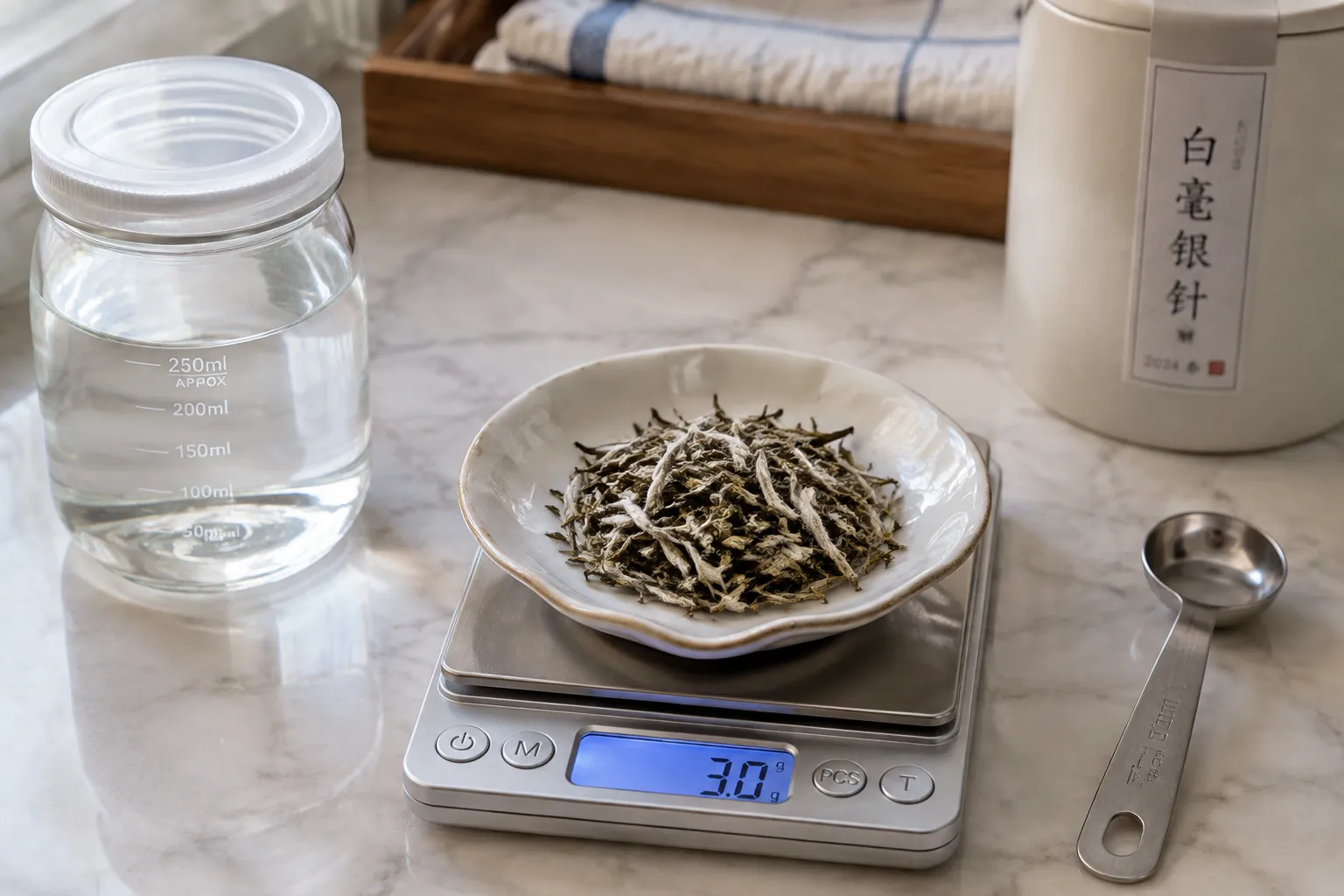
For most refrigerator cold brew batches, weigh the leaf first:
| Water volume | Light cold brew | Fuller cold brew | Over ice |
|---|---|---|---|
| 500 ml | 5 g | 6 g | 7 g |
| 750 ml | 7.5 g | 9 g | 10 g |
| 1 liter | 10 g | 12 g | 12 to 14 g |
| 1 quart | 9 g | 11 g | 12 to 13 g |
The lighter end works well for Silver Needle, fresher White Peony, or a pale brew with floral and honeyed edges. The fuller end suits Shoumei, Gongmei, older loose leaf, or tea that will be cut by ice. Cold brew white tea can taste thin when the leaf amount is too low, especially after dilution.
If you want one simple first batch, use 10 grams per liter, cold water, a covered jar, and the refrigerator. Taste it before adding ice. If the liquor already feels full, you are close. If it tastes gentle but clear, the next batch can go up by 1 to 2 grams per liter.
Why grams work better than spoons
White tea is awkward to measure by volume because the leaf form changes so much. Silver Needle is mostly buds; it can look full in a spoon while weighing very little. White Peony includes buds and leaves, so the same spoon may hold a lot of air. Gongmei and Shoumei can be leafier and denser, while broken or compressed material can weigh more than it looks.
That is why “one tablespoon” is not a stable cold steep tea ratio. It may work for one tea and miss badly for another. If you only have spoons, treat them as a backup, not the main method.
| Dry leaf shape | What happens in a spoon | How to adjust |
|---|---|---|
| Long Silver Needle buds | Looks bulky but weighs light | Use grams if possible; do not pack the spoon |
| Open White Peony leaf | Traps air between pieces | Start at the normal gram range |
| Leafy Gongmei or Shoumei | Often brings more body | Start moderate, then taste |
| Broken or compressed pieces | Weighs more per spoon | Use less by volume, or weigh it |
If you move from fluffy White Peony to a denser Shoumei, keep the water volume the same and reweigh the leaf. That gives you a clean comparison.
Steep time changes the result
Cold water pulls flavor slowly. For most loose leaf batches, 8 to 12 hours in the refrigerator is a sensible window. South Dakota State University Extension and Iowa State University Extension both describe refrigerated cold brewing in that general range. Those sources help with handling and timing; they do not replace tasting.
Use the first batch as a read on the leaf:
| Result after chilling | Likely cause | Next batch adjustment |
|---|---|---|
| Thin, watery, barely aromatic | Too little leaf, too much ice, or too short a steep | Add 1 to 2 g per liter |
| Clear but too light | Ratio is close, but not full enough | Move from 10 g/L to 12 g/L |
| Pleasant before ice, weak after ice | Dilution is the issue | Brew at 12 to 14 g/L, or use less ice |
| Bitter, heavy, or flat | Too much leaf, too long a steep, or too many fine particles | Reduce leaf by 1 to 2 g/L, or strain earlier |
| Strong aroma but rough finish | Fine particles or long extraction may be showing | Strain more carefully and shorten the next steep |
Do not assume a much longer steep is the answer. If a 10 g/L batch tastes thin at 10 hours, try 12 g/L next time before pushing the jar into an all-day steep. If a 12 g/L batch feels heavy at 12 hours, strain earlier instead of cutting the leaf too far.
Leaf amount controls body. Time controls extraction. Ice controls dilution.
How to adjust by white tea style
The same grams per liter will not taste identical across styles.
Silver Needle
Silver Needle often looks large and light in the hand. For a pale, quiet cold brew, 10 g/L may be enough. If it drinks like chilled water, add leaf in small steps rather than stretching the steep too far.
White Peony
White Peony is often the easiest place to start. Use 10 to 12 g/L. If the leaf is very open and fluffy, weigh it rather than trusting a spoon.
Gongmei and Shoumei
Gongmei and Shoumei can bring more body, dried fruit, hay, wood, or a mellow sweetness depending on age and storage. Start near 10 g/L if the material is broken or dense; move closer to 12 g/L if it is broad and airy. If the dry leaf smells stale, damp, or muddled, more grams will not fix that.
Compressed white tea
Compressed white tea needs one extra step before ratio matters: break it into loose, even pieces so water can reach the leaf. Then weigh the broken tea and brew it as loose material.
When you will pour it over ice
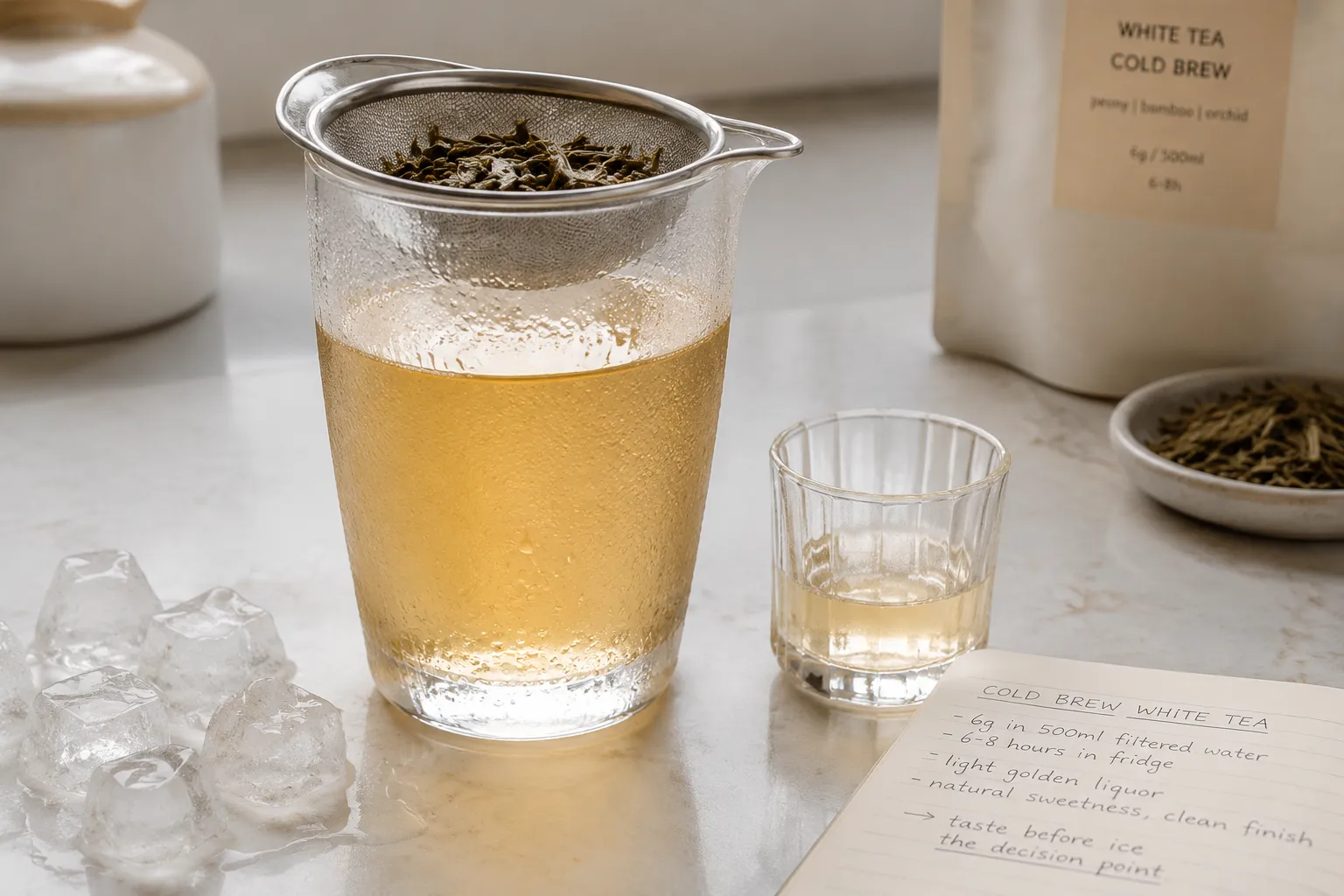
Cold brew white tea over ice usually needs more leaf than tea served straight from the refrigerator. Ice changes the cup twice; it chills the tea further, and it melts into it.
For iced serving, start at 12 g/L for most loose leaf white tea. Use 14 g/L when the leaf is very fluffy, the steep is short, or the glass will be packed with ice. If you prefer a lighter cup, keep the ratio near 10 g/L and chill the glass instead of piling on ice.
A simple check helps: taste the strained tea before serving. If it tastes slightly stronger than you want, it will often land well over ice. If it tastes exactly right before ice, the glass may soften it. If it already tastes flat or bitter, more ice will not solve the extraction problem.
A short safety note
Cold brew tea is usually handled as a refrigerated drink: clean container, cold water, covered steep in the fridge, then strain and keep chilled. Extension guidance commonly advises not leaving brewed tea at room temperature for long periods and using refrigerated tea within a short window such as about three days.
That is a handling boundary, not a flavor claim. For this ratio question, the useful point is simple: keep the brew cold, taste it after chilling, and adjust the leaf weight before you chase time or ice.
The smallest reliable first batch
- 1. Weigh 10 grams of loose leaf white tea.
- 2. Add it to 1 liter of cold water in a clean covered jar.
- 3. Refrigerate for 8 to 12 hours.
- 4. Strain fully.
- 5. Taste before adding ice.
If it is thin, move to 12 g/L next time. If it will be served over ice, try 12 to 14 g/L. If it is bitter, heavy, or flat, shorten the steep or reduce the leaf slightly. Keep the water volume steady while you change one variable at a time; that is the cleanest way to find the ratio your tea actually wants.
Sources
Sources and further reading
Reference links are limited to sources considered suitable for public citation in this page.