
Aging comparison
White Tea Cakes vs Loose Leaf for Aging
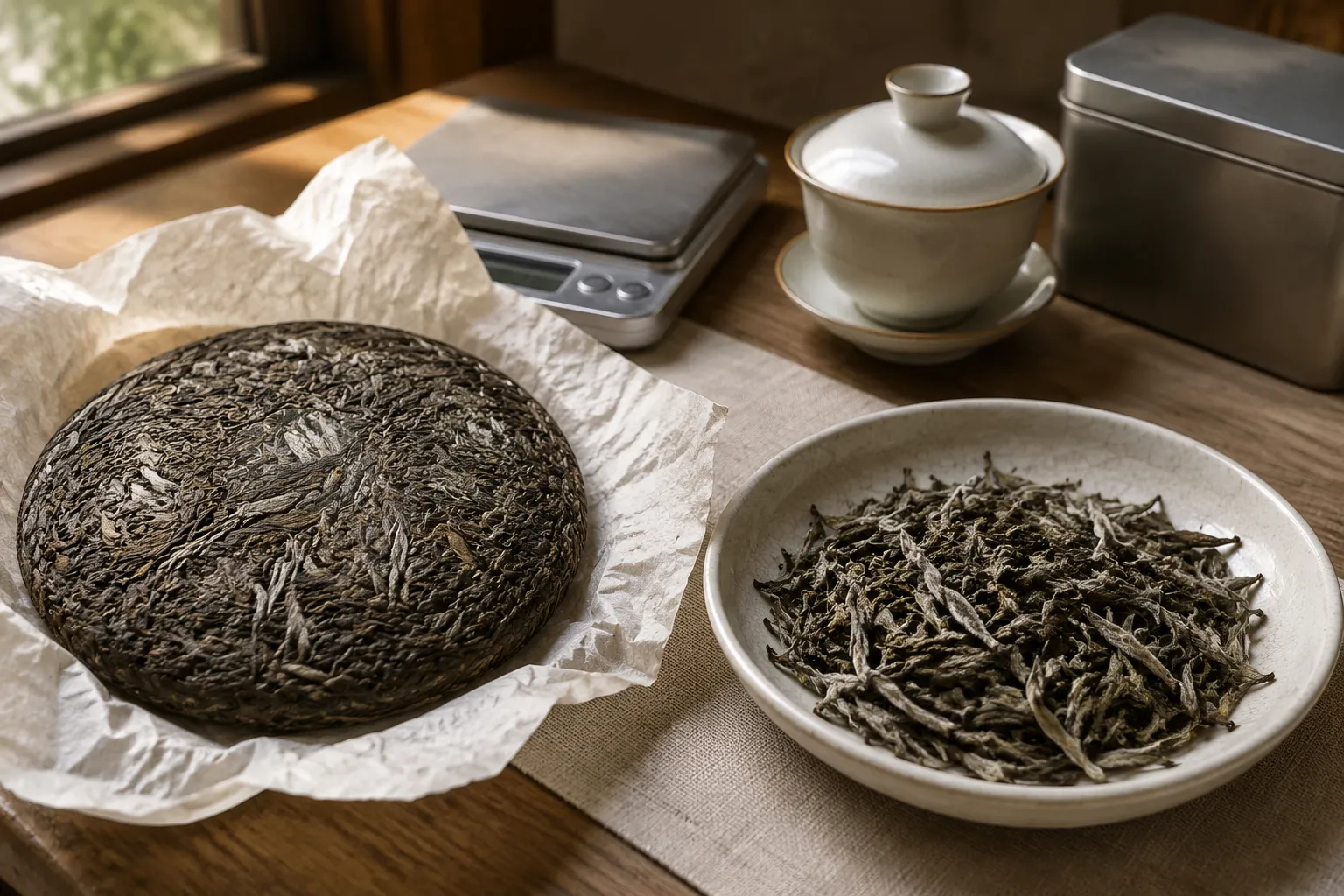
A dry white tea cake gives you a clean object to store: a pressed disk, a wrapper, a batch that stays together on the shelf. Loose leaf gives you access. You can lift a few buds and leaves, smell the material directly, weigh a small portion, and brew without a tea pick.
That handling difference is why white tea cakes vs loose leaf becomes a real aging question. The useful answer is not that one form is always better. Cakes can be compact and may expose less inner leaf surface when kept intact. Loose tea is easier to inspect and taste, but it depends more visibly on container discipline, clean air, and protection from humidity and odors.
For aging, form matters. Leaf material and storage history matter more.
upward
Read the full overview first
Use the broader guide first if you need the full scope before this page.
Do White Tea Cakes Age Differently Than Loose Leaf White Tea?
White tea can change during storage. Research on aged white tea describes shifts in aroma-related compounds and quality markers over time, while volatile-aroma work suggests that fresh floral, tender, and grassy notes may fade or transform as storage continues. That supports a cautious aging conversation, but it does not show that aged white tea cakes always outperform loose leaf.
The form changes the conditions around the leaf.
A pressed cake holds material together. The outer face and edge meet the storage air first; the center stays more sheltered. In some storage situations, that can make change feel slower, denser, or less immediately readable. It also explains why a cake may taste slightly different from edge to center.
Loose leaf has more exposed surfaces. It is easier to smell, weigh, and brew, but it may interact more readily with container air, nearby odors, and handling breakage. That does not make loose tea weak. It means the container and storage place become part of the result.
Variable
Storage space
Cake form is more compact for the same weight. Loose leaf is bulkier, especially with large leaves.
Variable
Inspection
A cake surface is visible, but the inside is harder to judge. Loose leaf is easier to see and smell.
Variable
Sampling
Cakes require prying or breaking. Loose leaf makes it easy to remove a measured amount.
Variable
Exposure
Cake outer layers are more exposed while the center is more protected. More loose leaf area meets container air.
Variable
Brewing access
Dense cake pieces may open unevenly. Loose leaf is easier to weigh and infuse evenly.
Variable
Buyer judgment
Wrapper and pressed surface are not enough. Loose material is clearer, but still not certain.
Cakes and loose leaf can age differently because compression, exposure, handling, and storage shape the tea. Pressed form is not a quality certificate.
Why Pressed White Tea Cakes Can Age More Slowly
Pressed white tea cakes are not simply loose tea in a round shape. Compression changes how air movement, moisture exposure, and handling reach the material. Studies on compressed white tea and compression methods support treating the pressed form as a meaningful processing and flavor variable. They do not make compression a stand-in for better leaves.
A tightly pressed cake may slow access to the inner material. The face and edge respond first to the storage environment; the center may remain quieter and slower to open. In a clean, stable place, that can make the cake feel like a longer aging experiment. In a poor place, compression does not protect the tea from dampness, musty smells, odor contamination, or weak starting material.
Loose leaf changes at a different rhythm. Because the material is separate, it may respond more quickly to container conditions. That can help if you want to taste development over months or a few early years. It can also work against you if the tea sits in a thin bag near spices, incense, cleaning products, kitchen steam, or a damp cupboard.
“Cake ages slower” is a plausible handling idea. “Cake ages better” is too neat. Slower can mean steadier, muted, protected, uneven, or simply harder to read. The cup still depends on leaf grade, dryness, aroma cleanliness, and storage.
Short-Term White Tea Aging: Loose Leaf Is Easier to Learn From
If your plan is short-term white tea aging—one season, one year, or a few early years—loose leaf is often easier to study. You can open the container, smell the dry material, check for broken pieces, weigh a consistent amount, and brew a small comparison without disturbing a whole cake.
This is especially useful with White Peony, Gongmei, and Shoumei, where the mix of buds, leaves, and stems gives visible information. You can see whether the material is mostly intact or dusty, whether the color looks coherent, whether stems are clean, and whether the aroma leans sweet, dry, woody, floral, hay-like, or suspiciously damp. None of these cues verifies age or origin alone. Together, they help you decide whether the tea is worth continuing to store.
Loose leaf white tea aging also makes tasting notes easier to repeat. If you use 5 grams in a gaiwan now and the same amount later, your comparison is more controlled. With a cake, a thin edge flake may not behave like a dense piece from the center. Small fragments can brew quickly; compressed chunks may open slowly.
Choose loose leaf when you want learning access
- You plan to taste the tea often.
- You want easy inspection before committing to storage.
- You are still learning what clean aged aroma smells like.
- You brew with a scale and gaiwan and want repeatable sessions.
- You are not storing large quantities.
The trade-off is protection. Loose tea needs a clean, dry, odor-free container and a stable place away from heat, light, steam, and strong smells. If the container is careless, loose material can turn flat or pick up foreign scent faster than expected.
Long-Term White Tea Aging: Cakes Are Convenient, Not Automatically Better
Aged white tea cakes are attractive because they solve a real storage problem. A 300-gram cake takes less shelf space than the same weight of fluffy Shoumei or White Peony loose leaf. Cakes stack neatly, keep a batch together through the wrapper, and are easier to move without crushing every leaf.
That is why many buyers look at white tea cakes for aging when they imagine a longer timeline. The cake feels intentional. It looks like a stored object rather than a half-open bag of tea.
Long-term white tea aging still depends on more than compactness. A cake made from stale, heavily broken, poorly dried, or badly stored material does not become good because it was pressed. A strong loose tea, stored cleanly, may develop more gracefully than a weak cake. Cake form and tea quality need to be judged separately.
Silver Needle
Mostly buds and often valued for fresh fragrance and soft texture; aging expectations should be cautious because the original appeal may shift as fresh notes change.
White Peony
Combines buds and leaves; it can show more visible structure and a wider aroma range.
Gongmei and Shoumei
Often include larger leaves and stems; many aged white tea cakes use this kind of material because it can bring body and durability in brewing.
Broken leaf and dust
May infuse strongly, but they age and brew differently from intact material.
Then look at the press. A very tight cake may be harder to pry and slower to open in the gaiwan. A looser cake may be easier to sample but more exposed around its layers. Neither is automatically right. The better question is whether the compression suits the leaf and whether the tea smells clean.
For longer storage, cakes make sense when you want compactness, batch continuity, and less frequent sampling. They do not remove the need to inspect, smell, and question seller claims.
How Compression Changes the Aroma of Aged White Tea Cakes
Compressed white tea flavor is often described with rich language: deeper sweetness, warmer body, dried fruit, wood, herbal notes, or aged character. Those notes may appear in some teas, but they are possibilities rather than promises. White tea aroma during storage can shift; what replaces fresh fragrance depends on material, storage, time, and handling.
Compression affects aroma in three practical ways.
First
The cake may not smell or taste the same everywhere. The edge has more contact with storage air. The center can remain quieter, tighter, or slower to open.
Second
Compressed pieces brew unevenly if handled carelessly. A thin flake can release quickly, while a dense nugget may need a rinse or a longer first steep to open.
Third
Compression can hide detail. You cannot easily see all the leaves inside a cake, and a neat surface may cover mixed material below.
If the first infusion tastes thin, the tea may not be poor; the piece may still be unfolding. If later steeps suddenly become strong, the chunk has finally opened.
That is not a reason to reject cakes, but it is a reason not to treat the pressed face as proof of quality.
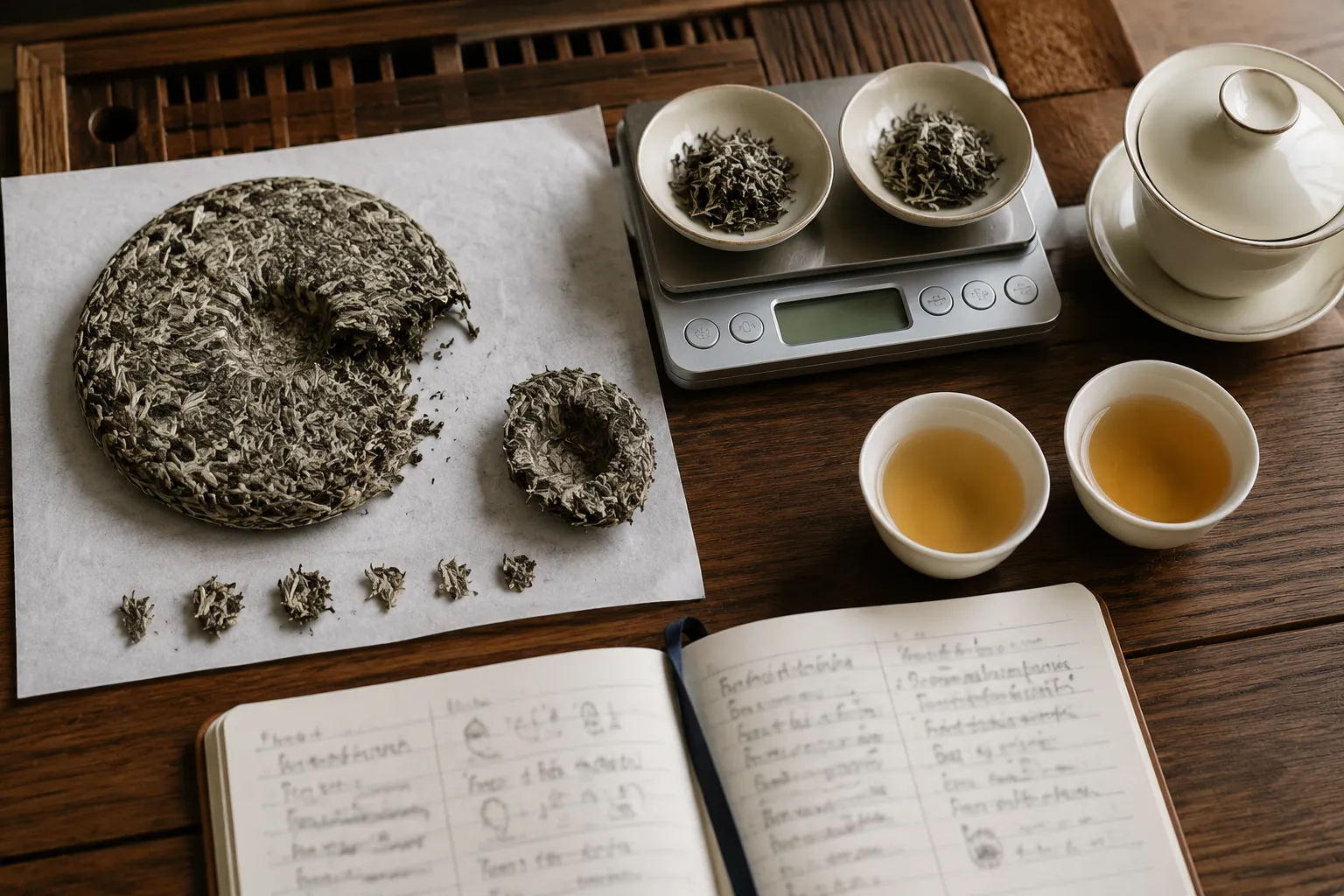
When sampling a cake, pry from different areas over time if you plan to follow its development. Keep notes on edge pieces and inner pieces. Use similar water temperature, leaf weight, vessel, and steeping rhythm so storage change is not confused with brewing variation.
Does Loose Leaf White Tea Lose Aroma Faster During Aging?
Loose leaf can lose aroma faster if it is poorly stored, but the form alone does not decide the outcome. A well-sealed, clean-smelling container in a stable cupboard may protect loose tea better than a cake left in a damp, scented, or overheated space.
The main white tea storage risks are ordinary but important:
- moisture exposure;
- musty or damp smells;
- visible suspicious growth or fuzz;
- odor contamination from food, incense, wood, cardboard, or cleaning products;
- heat and direct light;
- repeated opening and handling;
- crushed leaf from poor packaging.
Tea storage writing and experience-based storage discussions often return to the same practical caution: home aging is not just waiting. The tea must remain dry and clean. Damp leaves trapped in a container are not aging well; they are showing a storage problem. A cake stored near strong odors may keep its shape while losing its clean fragrance.
Loose leaf needs more container discipline. Use packaging that protects the tea from air movement and scent while avoiding damp conditions. Do not treat the refrigerator as an easy answer; temperature changes and condensation concerns can create new problems. A steady, dry, odor-free place is the more useful starting point.
If a loose tea’s dry aroma turns flat, sour, musty, or perfumed by its surroundings, the issue may be storage rather than age.
Should You Break Up a White Tea Cake Before Aging It?
Usually, do not break up the whole cake unless you have a clear reason. Keeping it intact preserves compact shape and reduces handling. Breaking it apart increases exposed surface area, creates flakes and dust, and makes it easier for the tea to interact with the container environment.
There are exceptions. You might loosen a small section if you plan to drink from the cake regularly. You might separate a sample to compare how it tastes now and later. You might inspect more deeply if the surface aroma or wrapper condition raises concern. But turning the full cake into loose tea removes one of the main reasons to buy a cake.
A balanced approach works better
- Keep the main cake intact.
- Pry a small drinking portion with care.
- Store broken pieces separately if you will drink them soon.
- Avoid crushing the cake into fragments.
- Note where the sample came from: edge, face, or deeper center.
White tea cake sampling should be slow and tidy. Use a tea pick or careful hand, work with the natural layers, and avoid forcing the cake into powder. Leaf breakage matters because small fragments infuse quickly and can make a session seem harsher or heavier than a larger intact piece from the same cake.
Buyer Uncertainty: Separate Cake Form from Leaf Material
A wrapped cake can look more trustworthy than a loose bag, but packaging is not proof. A product name may mention Shoumei, Bai Mudan style, downy buds, tender leaves, old trees, early harvest, cultivar, mountain area, or organic growing. Those words can be useful clues, but they do not verify quality by themselves.
For both cakes and loose leaf, ask what you can actually observe.
Appearance
Are there visible buds, larger leaves, stems, or many broken bits? Is the color reasonably consistent for the style and claimed age, or does it look oddly mixed?
Aroma
Does the dry tea smell clean, dry, and coherent? Or does it smell damp, musty, accidentally smoky, perfumed, or like the storage room?
Packaging
Is the wrapper clean and dry? Does the loose tea bag or tin protect from odor and crushing? Is there any sign of water exposure?
Seller context
Is there a harvest year, production area, leaf grade, storage explanation, or batch detail? Claims are still claims, but transparent details give you more to compare.
Infusion behavior
Does the tea open gradually? Do liquor color, mouthfeel, and aroma match the leaf material? Does the taste remain clean after several steeps?
This is the buyer boundary that matters most: cake form can support storage convenience, but it does not confirm better leaves. Loose form can support inspection, but it does not guarantee careful storage. Judge the tea in front of you.
A Simple Decision Frame for White Tea Cakes vs Loose Leaf
Choose a cake if your main goal is compact storage, long-term comparison, and keeping a batch together. This is especially practical for Gongmei or Shoumei material that takes up a lot of room when loose. Accept that sampling takes more effort and that the edge and center may not taste identical.
Choose loose leaf if your main goal is learning, frequent tasting, easy inspection, and flexible brewing. This is often the better first step if you are new to aged white tea and want to understand aroma change without prying into a cake. Accept that packaging and odor protection matter a great deal.
Choose a smaller amount of both if you are unsure. Store them in the same clean, dry area, taste them with the same gaiwan, use the same water temperature and leaf ratio, and write down what changes. That comparison will teach more than a broad rule about format.
A calm rule of thumb
- For access and inspection, loose leaf wins.
- For compact storage, cakes win.
- For quality, neither form wins by itself.
- For aging potential, leaf material, storage cleanliness, compression, and seller transparency all matter together.
Common Misconceptions About Aging White Tea Cakes and Loose Leaf
“Pressed white tea cakes are always better for aging.”
The available material does not support that as a fixed rule. Compression can affect storage density, surface exposure, and brewing behavior, but it is only one variable.
“More age always means better tea.”
Storage can change aroma and quality markers, but age does not automatically improve flavor. Fresh, floral, tender notes may fade, and poor storage can make tea less pleasant.
“White tea cakes should be stored exactly like pu-erh cakes.”
The language overlaps—cakes, wrappers, storage, aging—but white tea should not be pushed into a pu-erh storage model without caution. Aggressive humidity ideas are especially easy to overborrow.
“If a cake looks neat, the inside must be good.”
The surface is only the surface. Check aroma, compression, leaf material, wrapper condition, seller details, and how the tea brews.
“Loose leaf is too exposed to age well.”
Loose tea can be more exposed, but good packaging and clean storage can reduce that weakness. It remains the easier form to inspect and sample.
The better habit is to buy less on format romance and more on observable tea. Smell the dry leaf, check the wrapper or container, note the grade and harvest information, brew a measured sample, and decide what kind of storage experiment you actually want to manage next.
Sources
Sources and further reading
Reference links are limited to sources considered suitable for public citation in this page.