
Buying check
What Storage History Should You Ask About When Buying Aged White Tea
Before buying aged white tea, ask how the tea was stored, not just how old it is claimed to be. The most useful storage history covers where it was kept, whether conditions were relatively dry or humid, whether the tea stayed sealed or was opened often, whether it moved between regions or owners, and what records support the harvest year.
Aged white tea storage history does not prove quality, age, or value by itself. It gives you a story to compare with the tea in front of you: leaf color, aroma, wrapper condition, compression, brewed behavior, seller documentation, and price.
upward
Start with the broader guide
Use the broader guide first if you need the full scope before this page.
The storage questions to ask first
Start with questions about real conditions. “Well stored” is too vague. “Kept in a dry cabinet, still in its original carton, then moved to a shop warehouse in 2021” gives you something to check against appearance and aroma.
Ask:
- What harvest year is being claimed, and what supports it?
- Was the tea stored loose, pressed into a cake, or kept in another form?
- Where was it stored for most of its aging period?
- Was the environment relatively dry, moderately humid, or damp at any point?
- Was it sealed, semi-sealed, or opened often for sampling?
- Did it move between regions, warehouses, shops, or owners?
- Has the wrapper, inner paper, box, or original packaging been replaced?
- Are there dated photos, batch notes, invoices, warehouse notes, or other records?
- Can the seller explain any mismatch between the wrapper, claimed year, leaf appearance, and aroma?
These questions matter because aged tea changes with both time and surroundings. A clean, steady storage path may produce a different result from tea that passed through several unknown environments. That does not automatically make one better, but it does change how much confidence you can place in the white tea storage claim.
A seller who answers plainly is easier to evaluate than one who only repeats market phrases such as “rare,” “traditional storage,” “old material,” or “many years aged.” Those words may describe how the tea is being sold, but they are not storage evidence on their own.
Compare the answer with the tea
Once you have the storage story, look for alignment rather than one perfect clue. Aged white tea condition is usually judged through several small signs together.
Leaf appearance
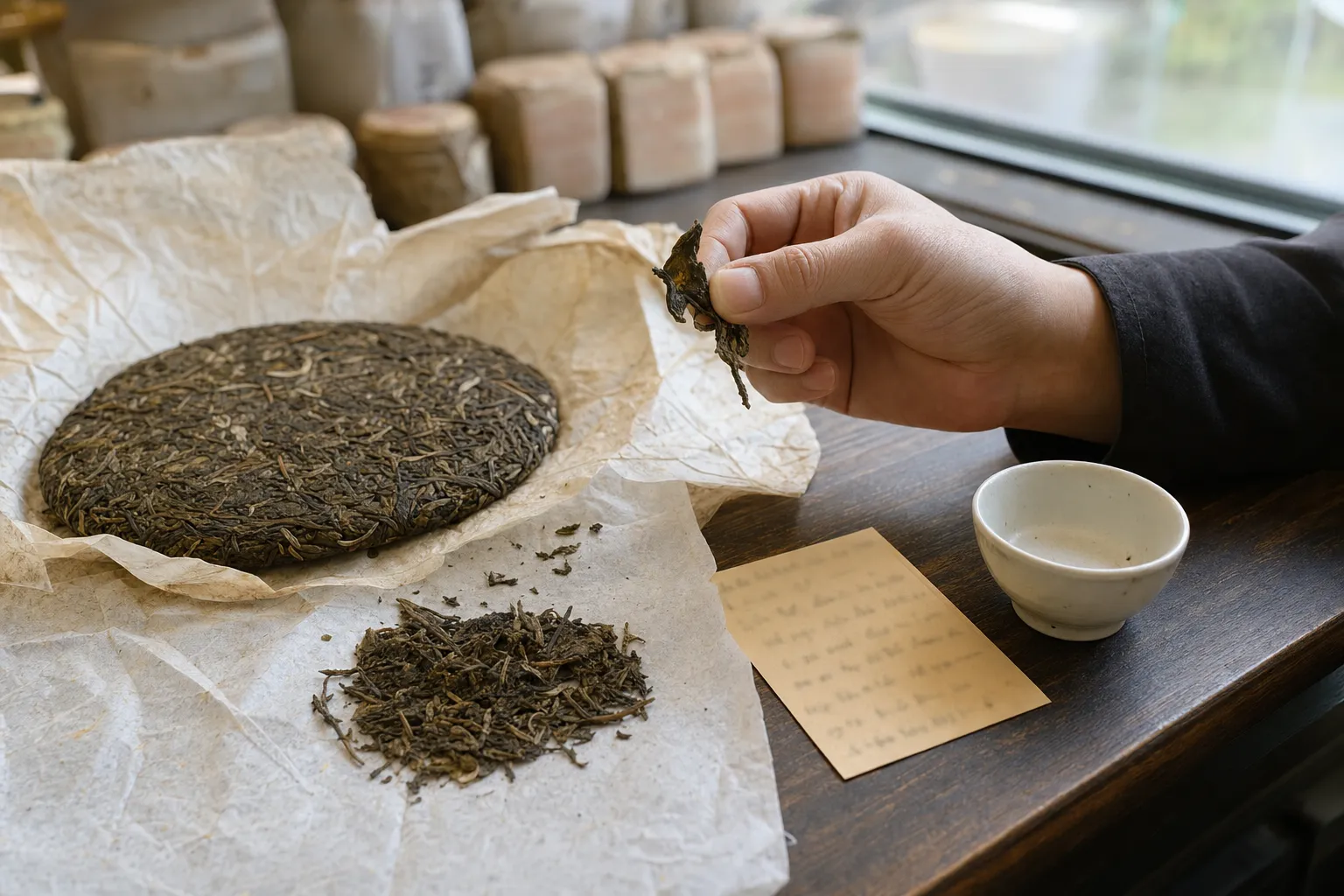
Older white tea often looks darker than fresh white tea, but color alone is not harvest year verification. Grade, processing style, original material, compression, storage exposure, and lighting can all affect what you see. A dark cake is not automatically old, and a lighter cake is not automatically young.
Aroma
Clean aged white tea is often described with mellow sweetness, dried leaf depth, woody notes, or a softer aged character. Still, aroma development is not a calendar. A tea can smell mature without proving a specific year, and a tea with an impressive year on the wrapper can still smell flat, stale, or unclear.
Wrapper condition
Fading, stains, soft corners, and storage marks can fit an older tea, yet they can also come from handling, moisture, poor storage, or replacement packaging. A clean wrapper does not disprove age. A worn wrapper does not prove it. The better question is whether the wrapper fits the seller’s explanation.
Compression and form
Loose tea, a tightly pressed cake, and a looser cake will not age or brew in exactly the same way. Loose leaf may show condition more openly, while a compressed cake may protect inner material differently from its outer surface. If the seller describes long storage in a certain form, the physical tea should not strongly contradict that account without a good explanation.
If you can brew a sample, notice whether the leaves open evenly, whether the liquor feels thin or rounded, whether the aroma fades quickly, and whether any unpleasant storage note dominates. These observations do not settle the harvest year, but they help you decide whether the tea is coherent and worth the price.
Dry versus humid storage is not a shortcut
Dry versus humid storage is worth asking about, but it should not become a simple good-or-bad label.
Relatively dry storage is often described in buying conversations as slower, cleaner, or more controlled. More humid storage may be associated with faster change or a stronger storage character. Without clear records and condition checks, those labels remain broad. They do not prove quality.
Ask more specific questions:
- How was humidity managed?
- Was the tea kept away from kitchen smells, smoke, perfume, damp walls, or mixed storage?
- Was it stored in original cartons, sealed bags, ceramic jars, cardboard boxes, or open shelving?
- Were there any periods of high moisture exposure?
- Did the seller hold the tea through the whole storage period, or did it come from another owner?
Regional storage styles can be part of the story, especially if the tea moved through different climates. But a regional label only becomes useful when it is tied to actual handling, packaging, and current condition.
For a buyer, the practical question is not which storage label sounds more prestigious. It is whether the storage story gives you enough confidence to try the tea at that price.
What seller documentation can and cannot do
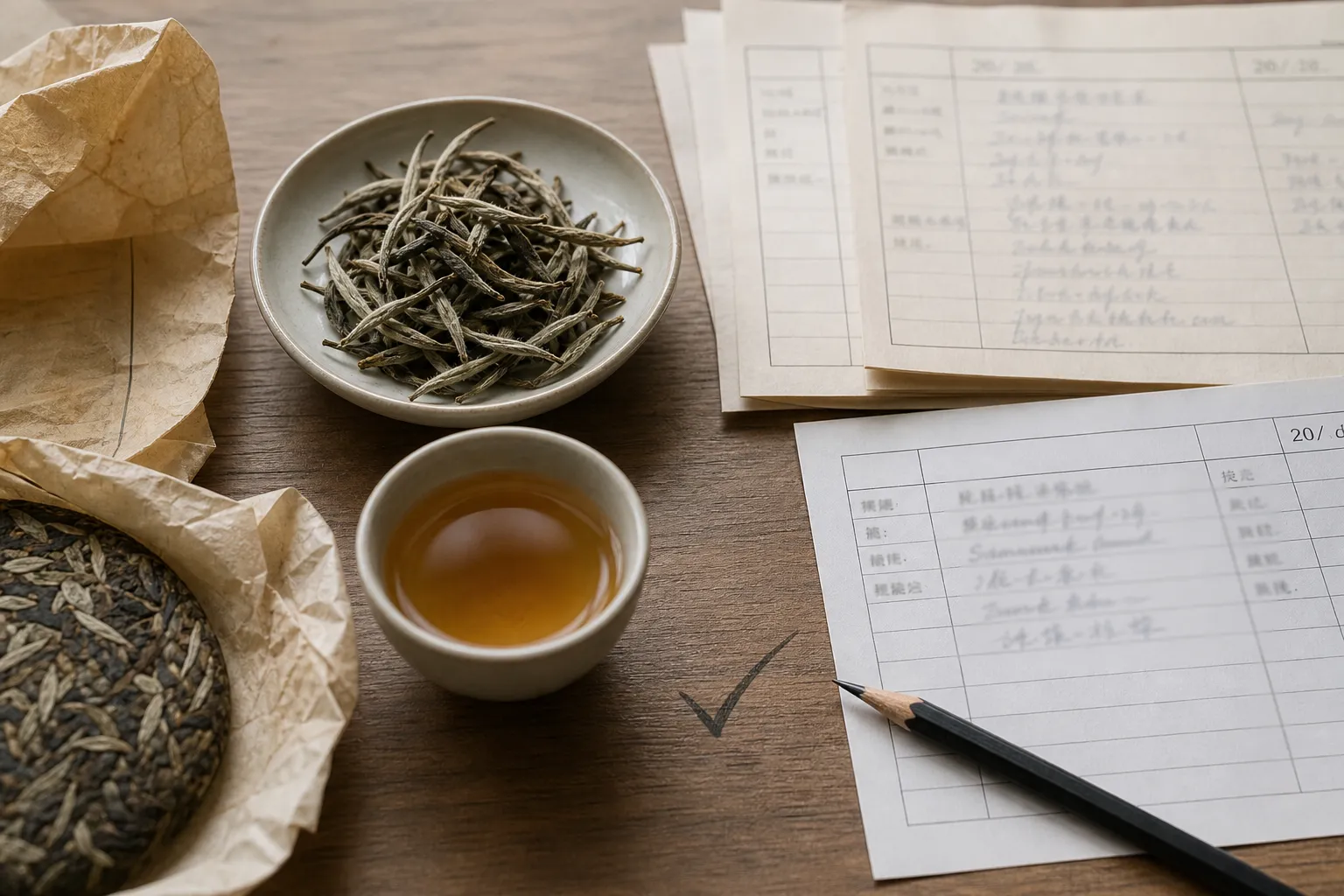
Seller documentation can reduce uncertainty, especially when the tea is expensive or priced mainly around age. A dated invoice, batch note, original carton, production label, storage photo, or purchase record may support the claimed timeline.
It still has limits. A wrapper can be mismatched. A storage photo can be too general to identify the exact cake. A year on a listing may refer to raw material, pressing, packing, or cataloging, depending on how the seller uses the term. If the seller cannot clarify which year is being claimed, treat the age claim carefully.
Good harvest year verification is usually cumulative. Compare:
- the stated year,
- the storage timeline,
- the wrapper and packaging context,
- the seller’s records,
- the leaf and aroma condition,
- the brewed behavior,
- the price being asked.
If those pieces broadly agree, the claim may be more plausible. If several pieces pull in different directions, slow down, request a sample, or choose a tea with clearer records.
Aged white tea is often sold through story. A calm, detailed record is more useful than a dramatic claim. The seller does not need to know every moment of the tea’s life, but they should be able to describe the major storage stages without sounding evasive.
Warning signs in a thin storage story
A thin storage story does not always mean the tea is poor. Some older teas really do pass through several hands. But uncertainty should affect how much you trust the age claim and how much you are willing to pay.
Be careful when:
- the seller gives only a year and no storage explanation,
- the wrapper seems unrelated to the claimed story,
- the price depends heavily on age but records are vague,
- the aroma is musty, sour, smoky, or hard to explain,
- the tea shows possible signs of unwanted moisture exposure,
- the seller refuses a sample for an expensive tea,
- the same tea is described with shifting years or origins,
- the story relies on prestige terms instead of storage details.
Mold concerns should be handled plainly. If you see fuzzy growth, unusual spotting, damp clumping, or an aroma that suggests problematic moisture rather than normal aged character, do not talk yourself into the purchase because the tea is “old.” A buyer cannot fully judge condition from a product photo or seller description. When the tea looks or smells doubtful, walking away is reasonable.
Overly neat stories deserve the same caution. A very old claimed year, dramatic wrapper aging, unusually low price, and no supporting context should make you ask more questions, not fewer. Age can make white tea interesting, but age language can also be used as a selling device.
Compact buying check
A compact buying check
Use a three-part check before buying aged white tea:
- Timeline: Can the seller explain the harvest year, storage years, movement between places, and packaging changes?
- Condition: Do the leaf, wrapper, aroma, compression, and brewed tea broadly fit that explanation?
- Confidence: Do the records and seller clarity justify the price, or are you paying mainly for an uncertain age claim?
You do not need to become a storage historian for every cake. For a modestly priced sample, a basic explanation and pleasant condition may be enough. For a higher-priced aged tea, especially one sold mainly on age, the storage history should be clearer.
The point is not to reject every uncertain tea. It is to price uncertainty honestly in your own decision. A tea with a beautiful cup and incomplete records may still be enjoyable, but it should not be treated the same as a tea with a coherent storage trail and condition cues that support the story.
Common confusion about aged white tea storage history
Does an old wrapper prove aged white tea is old?
No. Wrapper condition can be a clue, but it does not prove the tea’s age by itself. Paper can be replaced, stored separately, damaged early, or kept unusually clean. Compare the wrapper with the seller’s records, leaf condition, aroma, and brewed tea.
Is dry storage always better than humid storage?
Not automatically. Dry versus humid storage is useful to ask about because moisture exposure can change the tea’s development and condition. But the label alone is too broad. Ask how the tea was protected, whether it moved, and whether the current aroma and appearance seem clean and coherent.
Should I buy if the seller cannot verify the harvest year?
It depends on price, taste, and your tolerance for uncertainty. If the tea is inexpensive and you like the sample, incomplete records may matter less. If the tea is priced mainly because of a specific age claim, weak harvest year verification should make you more cautious.
The buyer’s bottom line
When buying aged white tea, ask for the storage history before you accept the age story. The most useful answers describe place, packaging, moisture exposure, movement, seller records, and uncertainty. Then check whether the tea’s appearance, aroma, wrapper condition, infusion behavior, and price support that story.
Aged white tea can be rewarding to explore, but the storage claim is only one signal. Treat it as a starting point for better questions, not as proof on its own.